
Neither material is better for everyone. Monolithic zirconia full-arch teeth are generally harder and more resistant to chipping and staining, but they’re heavier, harder to repair, and often cost more. Acrylic teeth over a supporting framework are lighter and easier to adjust and repair, but they tend to wear and stain more over the years.
If you’re planning All-On-4 dental implants or another fixed full arch, the material your new teeth are made from is one of the bigger decisions you’ll make with your dentist. Here’s a plain-English comparison of the two broad families.
What are full-arch implant teeth made of?
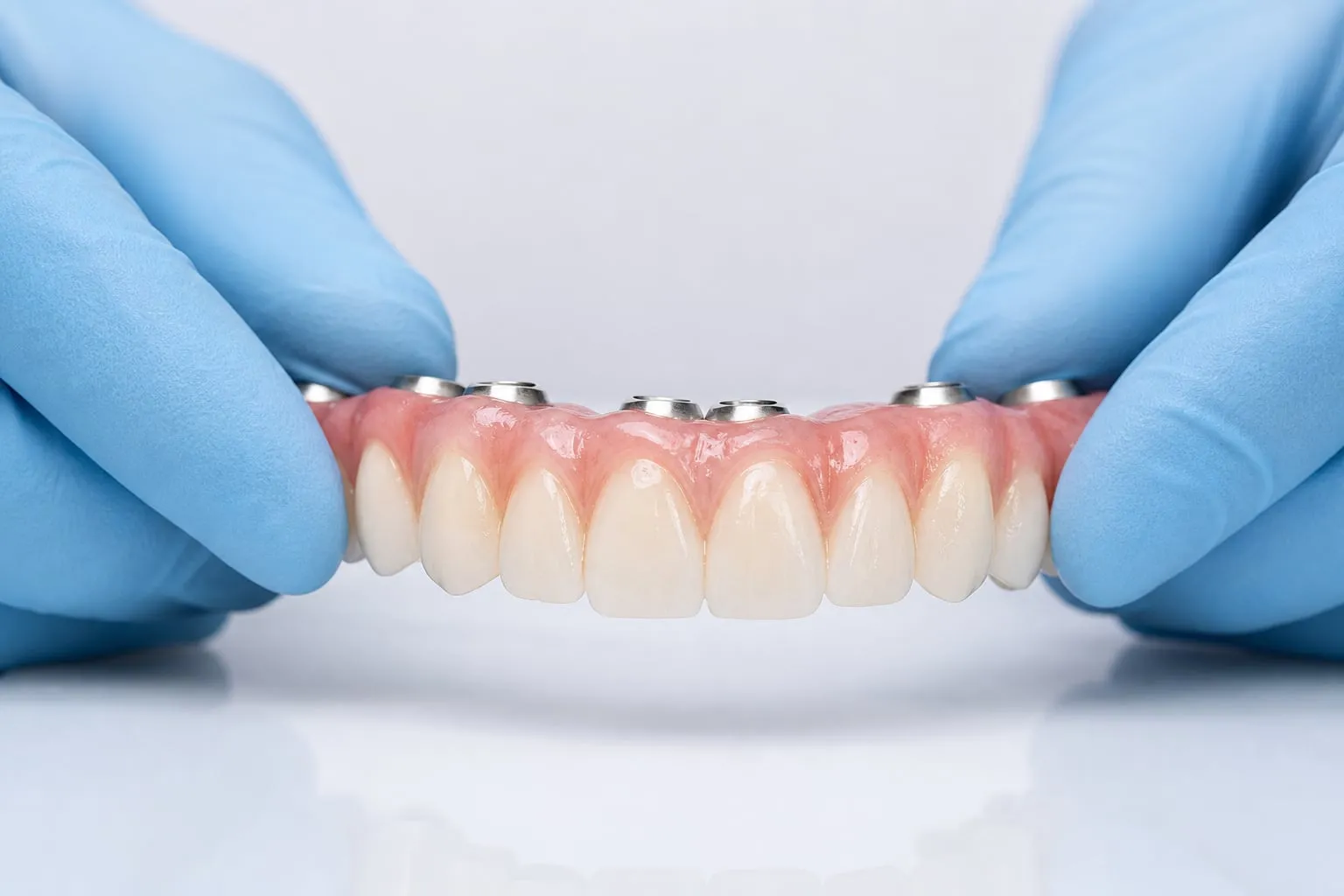
A full-arch prosthesis is a complete set of replacement teeth for one jaw, attached to several implants. You may also hear it called a hybrid denture or a fixed full-arch bridge. Most fall into one of two families:
- Monolithic zirconia. Monolithic means made from one solid piece. The teeth and the gum-colored section are milled from a single block of zirconia, a strong, tooth-colored ceramic, then shaded and glazed to look natural.
- Acrylic or composite over a framework. Denture-style teeth made of acrylic (a hard plastic) or composite resin are set in a pink acrylic base, built around a rigid internal framework, often metal, that adds strength.
There are many variations within each family, including designs that combine materials, so treat these as broad categories rather than exact products.
How do zirconia and acrylic compare?
| Monolithic zirconia | Acrylic over a framework | |
|---|---|---|
| Strength and chipping | Very hard; generally resists chipping | Softer; teeth can chip, wear, or come loose |
| Wear over time | Generally wears slowly | Tends to wear faster, especially with grinding |
| Weight and feel | Generally heavier and more rigid | Lighter; some people find it feels softer when biting |
| Appearance | Tooth-colored; generally holds its color | Can look very natural; may stain or dull over the years |
| Repairs | Usually can’t be patched; damage may mean remaking | Individual teeth can often be repaired or replaced |
| Cleaning | Dense, smooth surface tends to resist stains and plaque | Can pick up stains and odors more readily as it ages |
| Up-front cost | Often higher | Often lower |
These are general characteristics. Designs and materials vary, and your dentist can explain the trade-offs for your situation.
Is zirconia stronger than acrylic?
Generally, yes. Zirconia is very hard, so it resists chipping, cracking, and wear better than acrylic. That’s a big part of its appeal for people with a strong bite.
The flip side is that hardness makes it less forgiving. Zirconia doesn’t flex, and its surface needs to stay smooth and polished to be gentle on whatever it bites against. It can still fracture under heavy force, and when it does, it usually can’t be fixed in the chair the way acrylic often can.
Acrylic is softer. Over time the teeth can wear down, chip, or loosen from the base, and bruxism (habitual grinding or clenching) speeds that up. But individual teeth can often be repaired or replaced, and the prosthesis can be adjusted, sometimes without starting over.
Which looks and feels more natural?
Both can look natural when they’re well designed and made. The differences tend to show over time.
Zirconia generally keeps its color and surface polish, while acrylic can gradually absorb stains from coffee, tea, red wine, and tobacco and lose some of its shine. Acrylic’s pink base can look very lifelike; zirconia’s gum section is shaded ceramic.
On feel, zirconia arches are generally heavier and more rigid. Acrylic is lighter, and some people describe it as softer when they bite. Most people adjust to either one as they get used to their new teeth.
Which is easier to clean?
Neither comes out at home, because both are fixed. Daily cleaning focuses on the gumline and the underside of the bridge, usually with a water flosser, interdental brushes, or floss threaders. Our guide on how to clean implant-supported teeth covers the routine.
Zirconia’s dense, glazed surface tends to resist plaque buildup and staining. Acrylic can become more porous as it wears, so it may pick up stains and odors more readily. With either material, professional maintenance visits matter, since your dental team can clean areas you can’t reach.
Are temporary teeth different from the final teeth?
Usually, yes. Full-arch treatment typically involves two stages of teeth:
- Provisional (temporary) teeth, worn during osseointegration, the bone bonding to the implants, and while the gums settle into their new shape.
- The final prosthesis, made once the implants have integrated.
Provisional teeth are commonly acrylic, because it’s light, quick to adjust, and easy to modify as the gums change. The zirconia-or-acrylic decision usually applies to the final teeth. What you wear while you heal is planned in advance and discussed with you, and our article on how long All-On-4 healing takes explains the timeline.
How do you and your dentist choose?
The decision usually weighs several factors:
- Your bite. Strong chewing forces or grinding matter a lot, since acrylic tends to wear faster under heavy loads. A night guard may also be recommended.
- What the arch bites against. Natural teeth, another implant arch, or a denture each interact differently with zirconia and acrylic. Upper and lower arches are planned individually; see upper vs. lower All-On-4.
- Available space. Each design needs a certain amount of room between the jaws to be strong, which depends on your bone and bite.
- Repairs vs. durability. Some people value easier, lower-cost repairs; others prefer a harder material that’s less likely to need them.
- Appearance and stain resistance, especially if you drink coffee, tea, or red wine regularly.
- Budget. Full-arch treatment is quoted after a consultation, and your written treatment plan should show the cost of the option recommended for you before work begins.
The same kinds of trade-offs come up with single crowns; see implant crown materials explained.
Questions worth asking:
- Which material do you recommend for my case, and why?
- What happens if a tooth chips or the arch is damaged?
- What maintenance or repairs should I expect over the years?
- How will my provisional teeth differ from my final teeth?
The bottom line
Zirconia and acrylic are both established choices for full-arch implant teeth, and each balances strength, weight, repairability, and cost differently. Zirconia leans toward hardness and stain resistance, while acrylic leans toward lighter weight and easier repairs. The right material depends on your bite, your anatomy, and your priorities, so it’s a decision to make with your dentist rather than from a chart. To talk through your full-arch options, request a free consultation or call (949) 773-4170.
This article is general education, not a diagnosis or a substitute for professional dental advice. Individual results vary, and only a personalized evaluation can determine which restoration may be appropriate for you.

