Implant crowns are usually made from one of four material families: zirconia, glass-ceramics such as lithium disilicate, porcelain fused to metal, or gold and other metal alloys. Each trades off strength and appearance differently, which is why the choice often depends on whether the tooth is at the front or the back of your mouth.
This article is about the crown, the part you see and chew with. The implant post in the bone is a separate component with its own material decision. For that, see titanium vs. zirconia dental implants.
What’s the difference between the implant, the abutment, and the crown?
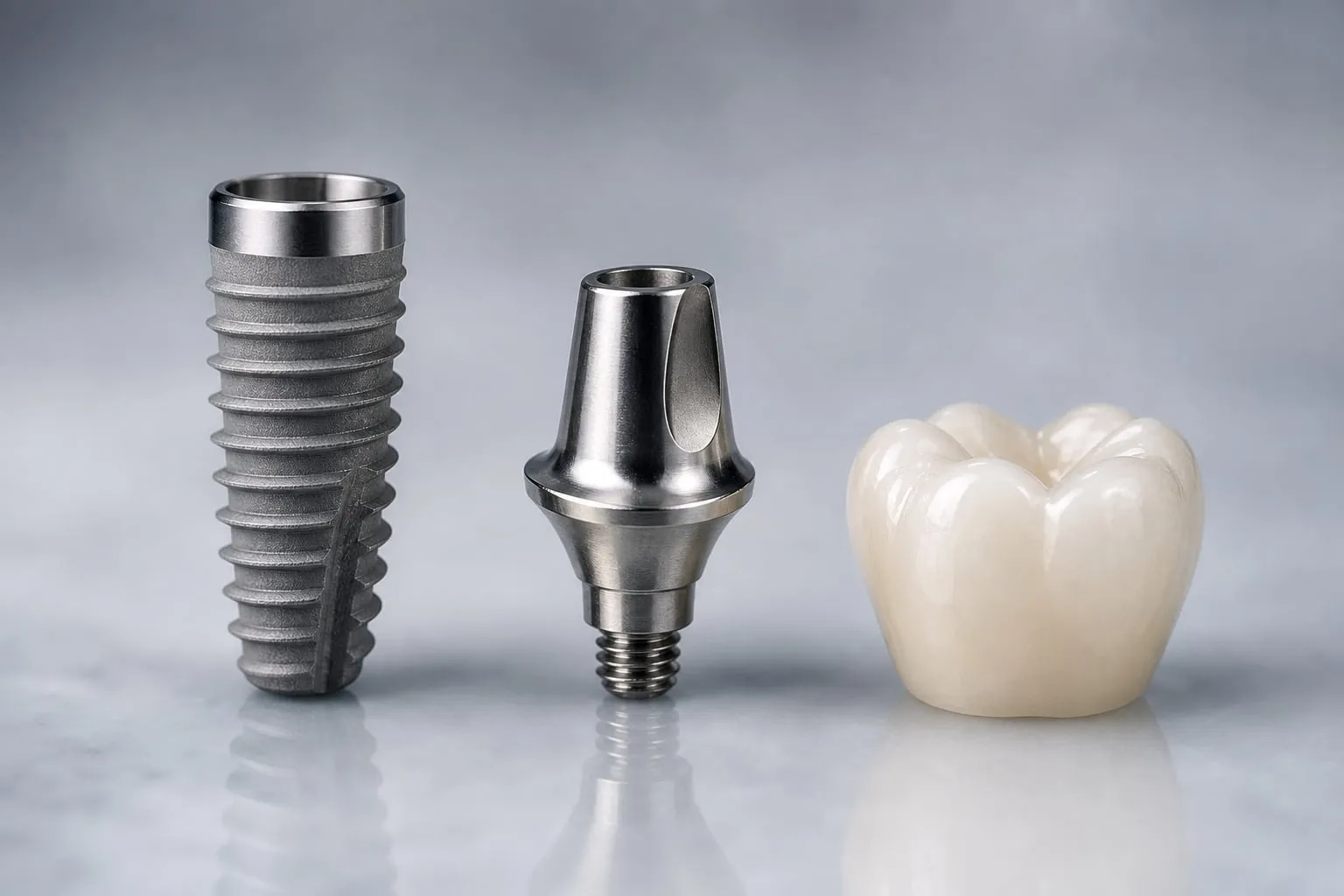
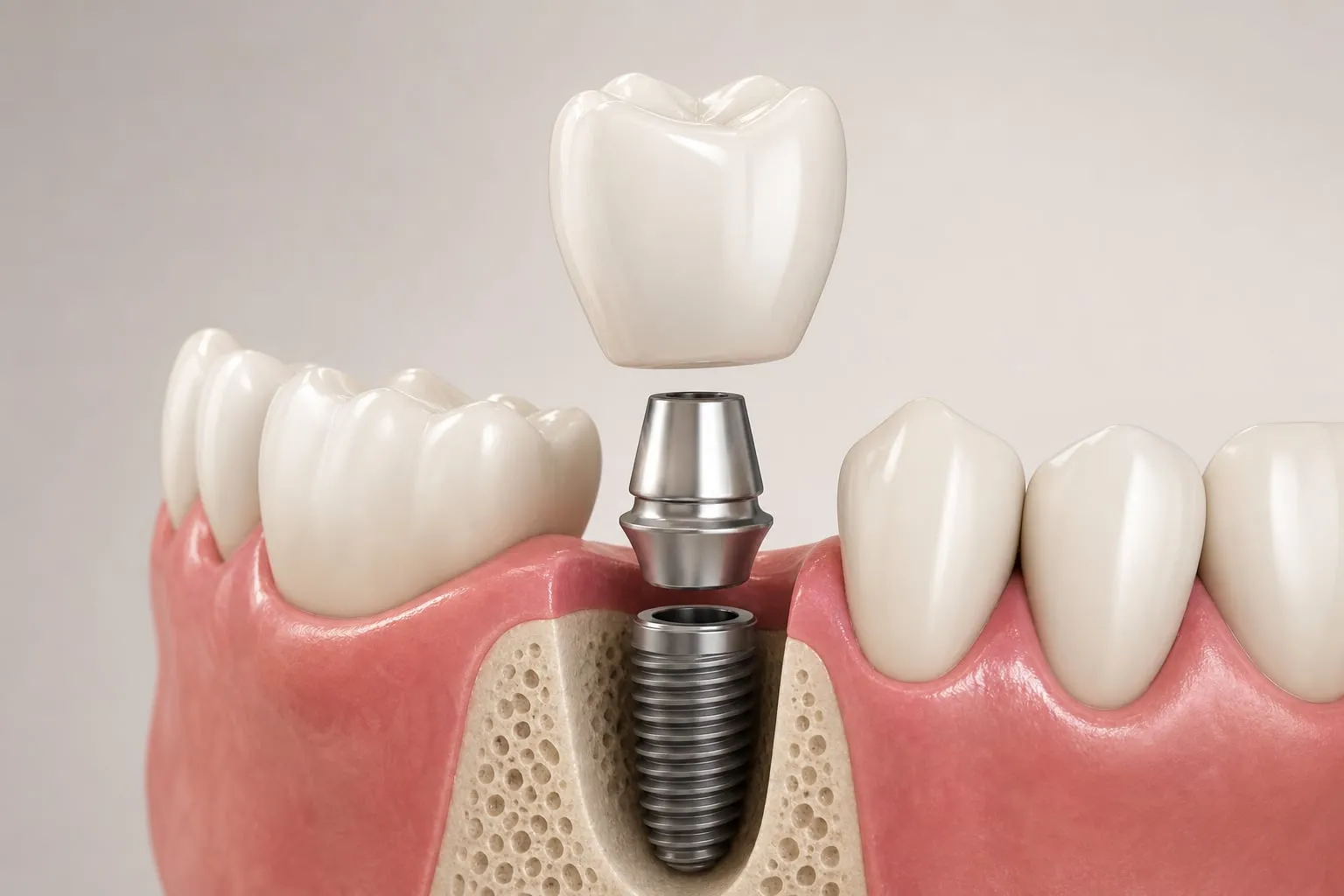
An implant tooth is built in three parts:
- The implant: a small post, usually titanium or zirconia, placed in the jawbone to act as an artificial root. Over a healing period the bone bonds to it, a process called osseointegration.
- The abutment: a connector that attaches to the top of the implant and rises through the gum. Abutments are commonly titanium or zirconia, and they may be prefabricated or custom-shaped.
- The crown: the tooth-shaped cap on top, and the only part visible when you smile.
The crown takes the chewing forces and carries the appearance, so its material matters. It’s also the part most likely to need attention over the years. Like other restorations, a crown may eventually show wear and need replacing, even when the implant beneath it stays healthy.
What materials are implant crowns made of?
Zirconia
Zirconia is a strong, tooth-colored ceramic. A crown milled from a single solid block, often called monolithic or full-contour zirconia, is highly resistant to chipping and cracking. That makes it a common choice for molars and for people who grind their teeth. Earlier forms looked fairly opaque; newer, more translucent versions look more natural, though they are generally not quite as strong as the most opaque types.
A smooth, well-polished zirconia surface is generally considered gentle on the opposing teeth. Rough or poorly finished surfaces are a different matter, which is one reason finishing and polishing get careful attention.
Zirconia can also be layered: a zirconia core with porcelain applied over it for a more lifelike surface. That improves appearance but reintroduces a porcelain layer, which can chip.
Glass-ceramics (lithium disilicate)
Lithium disilicate is a glass-ceramic that can be pressed or milled into a crown. Its main strength is appearance. Its translucency is close to natural enamel, so it is frequently chosen for front teeth and premolars. It’s strong for a glass-ceramic, but generally not as strong as zirconia, so it may be less suited to heavy molar loads or a grinding habit.
Porcelain fused to metal (PFM)
A porcelain-fused-to-metal crown has a metal framework with porcelain bonded over it. It has the longest track record of the tooth-colored options and is used at both the front and the back of the mouth. The trade-offs: the porcelain layer can chip, the metal underneath makes the crown less translucent, and a thin dark line can sometimes show at the gumline if the gum recedes.
Gold and other metal alloys
All-metal crowns, including gold alloys, are very durable, rarely fracture, and tend to be kind to opposing teeth. They are also the most noticeable, so they’re usually reserved for back molars where appearance matters less.
Temporary crowns
Acrylic or composite resin crowns are generally used as provisional (temporary) crowns while the final crown is made or while the gums settle, rather than as long-term restorations.
How do implant crown materials compare?
| Material | Strength | Appearance | Typically used |
|---|---|---|---|
| Monolithic zirconia | Very high; resists chipping | Tooth-colored; can look less lifelike than glass-ceramics | Molars and premolars; people who grind |
| Layered zirconia | High core; porcelain layer can chip | Very natural | Front and back teeth |
| Lithium disilicate | Moderate to high | Very natural translucency | Front teeth and premolars |
| Porcelain fused to metal | High; porcelain can chip | Natural but more opaque; possible dark line at the gumline | Front and back teeth |
| Gold or metal alloy | Very high | Metal-colored | Back molars |
These are general characteristics. Products within each family vary, and your dentist can explain the trade-offs for your situation.
Screw-retained or cement-retained: what’s the difference?
Besides the material, there’s the question of how the crown is attached.
- A screw-retained crown is fastened to the implant with a small screw. The screw access opening is then covered with a tooth-colored filling. Because it can be unscrewed, the dentist can remove it for cleaning, repair, or replacement.
- A cement-retained crown is bonded onto the abutment, much like a crown on a natural tooth. There’s no access opening on the chewing surface, which can help appearance in some positions. The trade-offs are that the crown is harder to remove later, and any excess cement under the gum has to be cleaned away carefully because it can irritate the surrounding tissue.
Which approach fits depends largely on the angle of the implant and where a screw opening would come out. If it would emerge through the visible front surface of a tooth, a cemented crown or a different design may be preferred.
How is an implant crown shade-matched?
A shade-matched crown is one whose color is chosen to blend with your surrounding natural teeth. That typically involves comparing your teeth against a shade guide, often in natural light, and sending photos and notes to the dental lab. A good match accounts for more than color: translucency at the biting edge, surface texture, and the way shade shifts from the gumline to the tip all matter.
A few practical points:
- Whiten first, if you plan to. Crowns don’t respond to whitening products, so whitening is usually done before the shade is selected.
- Front teeth are the hardest. Matching one front crown to its natural neighbor is one of the more demanding tasks in dentistry. Our article on front tooth implants covers why.
- Ask how it will be checked. It’s reasonable to ask how the shade will be confirmed before the crown is finalized.
How does your dentist choose the crown material?
There’s rarely one right answer. The decision usually weighs:
- Location. Front teeth prioritize appearance; molars prioritize strength.
- Your bite. Heavy chewing forces or bruxism (habitual grinding or clenching) point toward stronger materials, and often a night guard.
- Available space. Some materials need more thickness than others to be strong, and an over-erupted opposing tooth can limit room.
- Gum thickness. With thin gums, a metal framework can sometimes show through as a grey shadow.
- The opposing teeth. What the crown bites against affects wear on both.
- Retrievability. Whether the crown should be removable for future maintenance.
- Your preferences, including a wish to avoid metal.
Useful questions to bring: Which material do you recommend for this tooth, and why? Will the crown be screw-retained or cement-retained? How will the shade be matched?
The bottom line
Implant crowns come in several materials that balance strength and appearance differently: zirconia leans toward strength, glass-ceramics toward lifelike translucency, porcelain fused to metal sits in between, and gold puts durability ahead of looks. The right choice depends on the tooth, your bite, and the space available, so it’s a conversation to have with your dentist rather than a decision to make from a chart. If you’re planning an implant and want to talk through your options, request a free consultation or call (949) 773-4170.
This article is general education, not a diagnosis or a substitute for professional dental advice. Individual results vary, and only a personalized evaluation can determine which restoration may be appropriate for you.