
Short answer: if the tooth can be reliably restored, saving it with a root canal is usually the better choice. An implant is the right answer when there isn’t enough healthy tooth left to rebuild — not simply because a tooth needs a root canal.
We place implants for a living, and we’ll still say it plainly: a natural tooth you get to keep is worth more than a very good replacement. If your tooth is savable, go save it.
They aren’t really the same procedure
A root canal treats the inside of a tooth you’re keeping. The infected or inflamed pulp is removed, the canals are cleaned and sealed, and the root stays in your jaw. The tooth then usually needs a core buildup and a crown — and that crown matters as much to the outcome as the root canal itself.
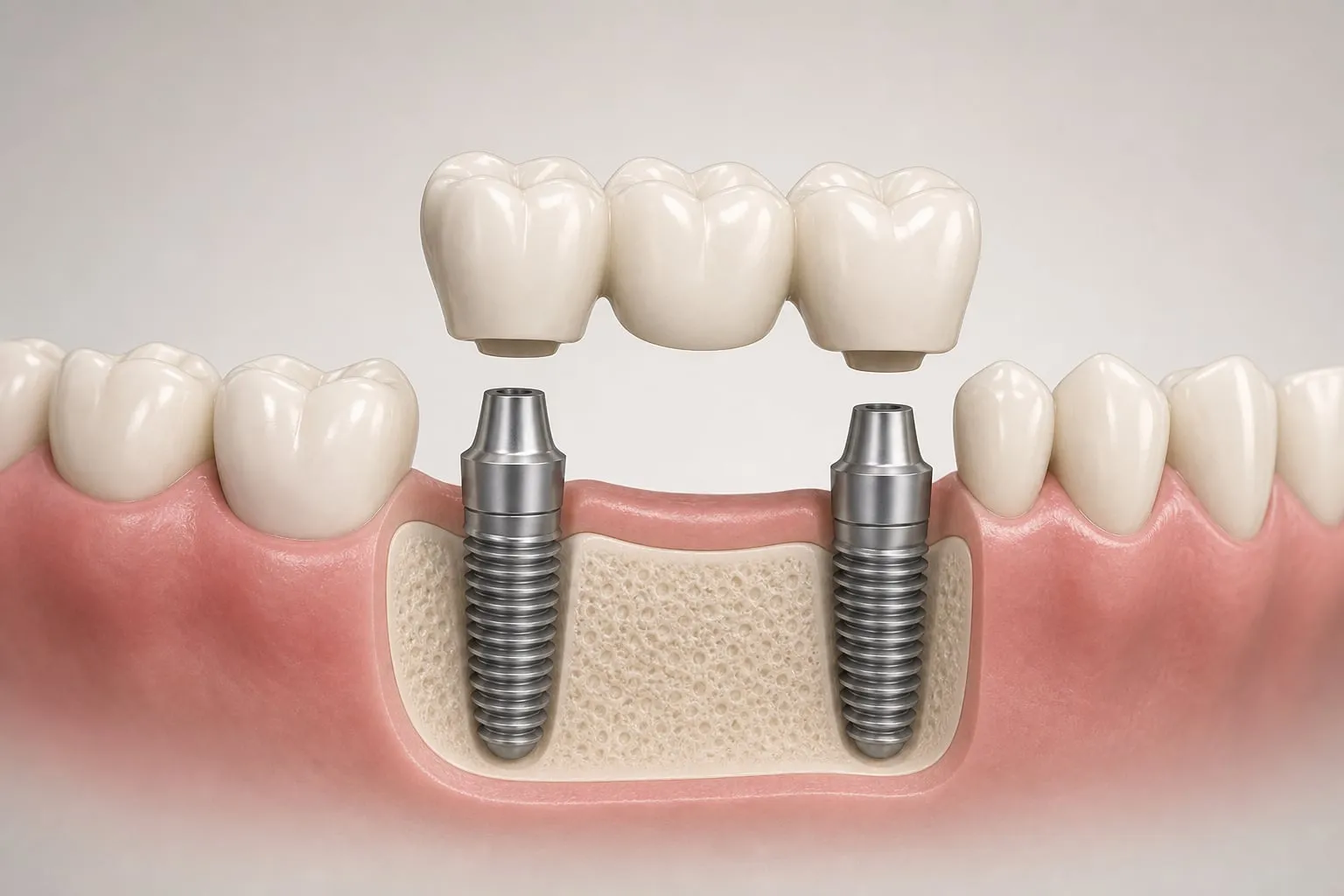
A dental implant replaces the tooth entirely. The tooth and root come out, a titanium post is placed in the bone, and after it integrates, a custom crown goes on top.
So the real question isn’t “which procedure is better.” It’s: is there enough sound tooth left to hold a restoration for years?
When a root canal is the right call
Saving the tooth generally makes sense when:
- The decay or infection reached the pulp, but the tooth’s structure is largely intact
- Enough sound tooth remains around the circumference for a crown to grip — clinicians call this a ferrule, and it’s one of the strongest predictors of how long a restored tooth lasts
- The roots aren’t fractured
- The bone and gum supporting that tooth are healthy
If those apply, keeping it preserves your natural root, the periodontal ligament that gives you pressure sensation, and the bone that root maintains. No replacement reproduces all three.
When a tooth usually can’t be saved
There are situations where a root canal is not a realistic option, no matter how much you’d prefer it:
- Vertical root fracture — a crack running down the length of the root. There’s no dependable repair.
- Decay extending well below the gum line, particularly onto the root surface
- Too little sound tooth structure left for a crown to hold onto securely
- A previous root canal that has failed where retreatment or root-end surgery isn’t likely to work
- Advanced bone loss around that specific tooth from gum disease — a root canal fixes the inside of the tooth, not its foundation
- Significant root resorption
If you’re dealing with a tooth in trouble right now, our guide on what to do about a failing or broken tooth covers the immediate steps.
The middle options people rarely hear about
Before agreeing to extraction, it’s fair to ask about retreatment (redoing a failing root canal), an apicoectomy (treating the root tip surgically when the problem is confined there), and crown lengthening or orthodontic extrusion (exposing more tooth structure so a crown has something to grip).
These don’t fit every case, but a tooth written off in one office is sometimes restorable with one of them.
Side by side
| Root canal + crown | Single dental implant | |
|---|---|---|
| What it does | Keeps your natural root in place | Replaces the root and the crown |
| Depends on | Enough sound tooth structure remaining | Enough bone volume and healthy gums |
| Typical timeline | Weeks | Months — bone integration comes first |
| Up-front cost | Usually lower, though the crown adds to it | Starts at $1,995 here for a single tooth |
| Sensation | Normal pressure feedback through the ligament | Very natural, but without that ligament feedback |
| How it tends to fail | Recurrent decay, fracture, reinfection | Peri-implantitis, integration failure, wear |
Pricing may vary based on individual needs — contact the office for a personalized estimate.
What the research actually says about longevity
Published reviews commonly report survival of root-canal-treated teeth in roughly the 85 to 90 percent range at eight to ten years, varying by study, by tooth type, and — importantly — by how well the tooth was restored afterward. Reported long-term survival for implants in published reviews is also high.
Neither is a certainty, and no one can honestly promise you a number for your specific tooth. What moves the odds most in both cases is the quality of the final restoration and how consistently it’s maintained.
The cost question, honestly
Up front, the root canal route usually costs less. But the arithmetic changes if the tooth is marginal. If a borderline tooth is saved and fails in three years, you’ve paid for the root canal, the buildup, the crown, the extraction, possibly a bone graft, and then the implant. The cheaper option is only cheaper if it lasts.
That’s an argument for an accurate assessment — not for pulling questionable teeth. Plenty of teeth that look bad at first glance restore well. See what implants cost and financing and insurance options if you’re weighing numbers.
How to get an honest assessment
- Look at the images yourself. Ask to see the bone level, the root, and how much tooth sits above the gum. Our 3D imaging and digital scanning exist for exactly this kind of question.
- Ask direct questions. How much sound structure is left? Is there a visible crack? Can this be retreated?
- Get a second opinion from someone who does the other procedure. If an office that only places implants recommends extraction, an endodontist’s read is worth having.
- Know who you’re asking. Our focus is implants, All-On-4, and full-mouth restoration. That cuts both ways: when we tell you a tooth looks restorable, we have nothing to gain by saying so — and we’ll say it.
If the tooth does have to come out
Extractions are handled as part of implant treatment, and if the socket needs support, bone grafting may be part of the plan. We plan around confirmed bone integration rather than same-day teeth, so the timeline runs in stages — final teeth don’t go on the day of surgery.
From there, compare a single tooth implant against a traditional bridge, or review the options for a missing tooth. Whether an implant is workable for you depends on the bone and health factors covered under candidacy.
Get a straight answer
Bring your question, your images if you have them, and we’ll tell you what we see — including when the answer is “keep the tooth.” Request your free consultation or call (949) 773-4170.
This article is general education, not a diagnosis or a substitute for professional dental advice. Individual results vary, and only a personalized evaluation can determine what’s appropriate for your situation.
References: Tooth survival of non-surgical root-filled posterior teeth: systematic review and meta-analysis (International Endodontic Journal) · Long-term tooth survival and success following primary root canal treatment (PMC)