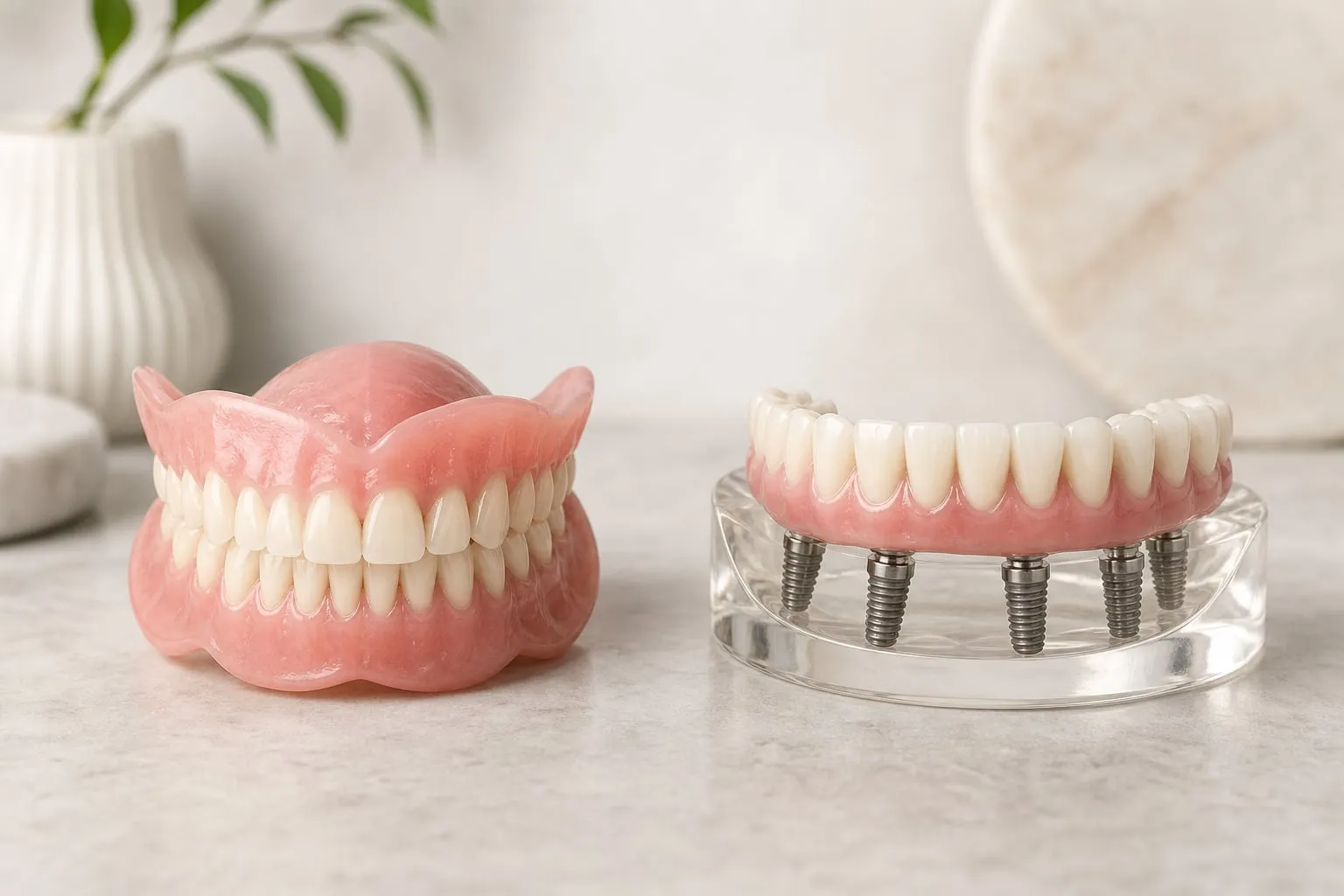
When a dental bridge fails, contact your dentist promptly, avoid chewing on it, and don’t try to reattach it yourself. Warning signs include a bridge that feels loose, a bad taste or smell, pain, or swelling around the anchor teeth. An exam with imaging shows whether the bridge can be recemented or replaced, or whether implant-supported options make more sense.
A failing bridge is a familiar problem, and it usually has a clear cause. Here’s how to recognize it, what’s typically going on underneath, and what your options are.
How does a dental bridge work?
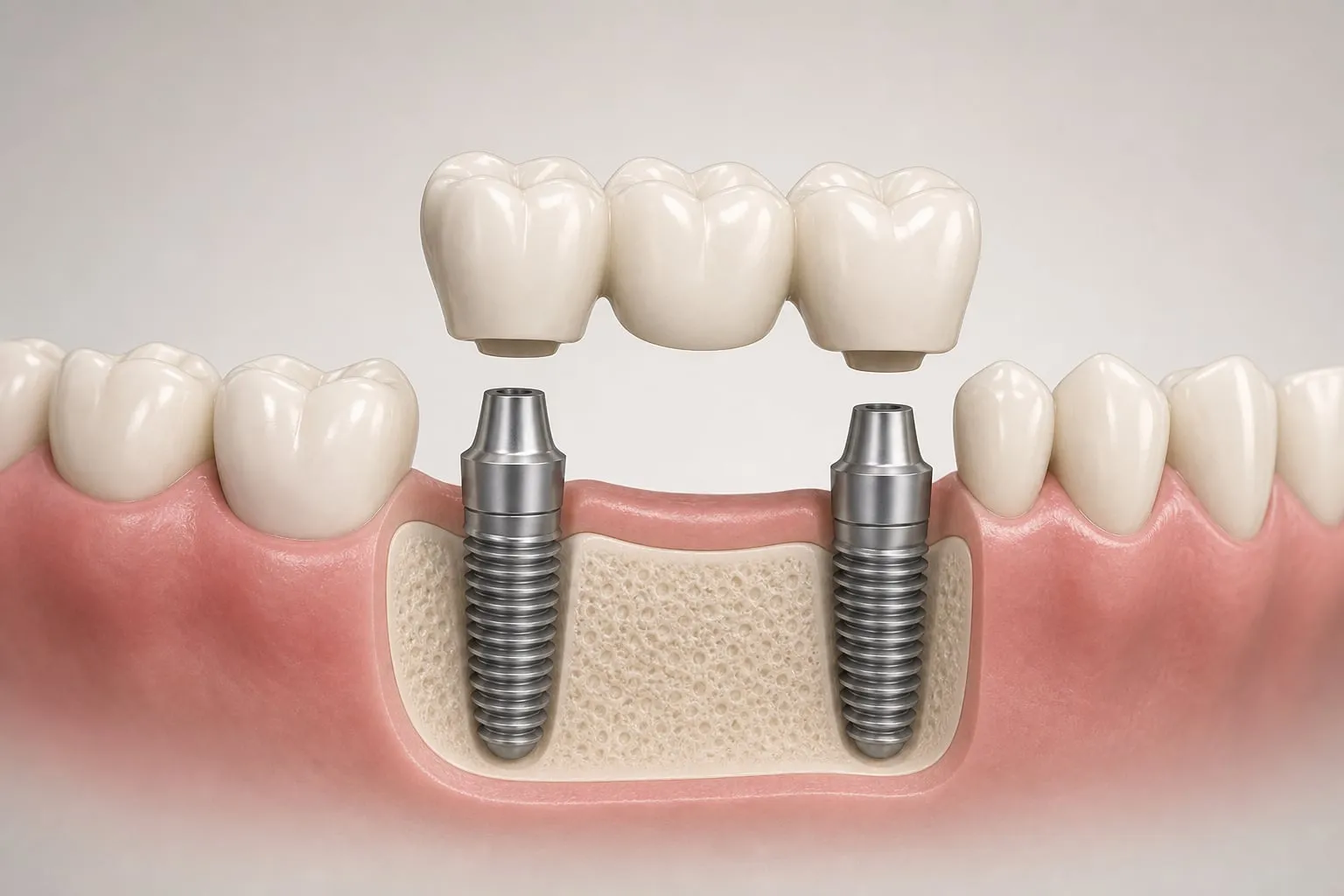
A traditional bridge replaces one or more missing teeth by anchoring to the teeth on either side of the gap. Those anchor teeth are called abutment teeth: they’re reshaped and covered with crowns. The false tooth suspended between them is called a pontic.
Because a bridge is one connected piece, it depends on the health of every abutment tooth. If one of them develops a problem, the whole bridge is affected.
What are the signs a bridge is failing?
Watch for:
- Looseness or movement. The bridge shifts when you bite, or you feel a slight click.
- A bad taste or odor that keeps returning near the bridge, even after brushing.
- Pain or sensitivity around an abutment tooth when chewing, or to hot and cold.
- Gum changes such as redness, bleeding, swelling, or gums pulling back to expose the edge of a crown.
- A visible gap or dark line where a crown meets the tooth.
- Food packing under the bridge more than it used to.
- Chipped or cracked porcelain on the bridge.
- A pimple-like bump on the gum, which can signal infection.
Some of these problems, especially decay under a crown, can progress without much discomfort. Regular checkups and X-rays catch what you can’t see or feel.
Why do dental bridges fail?
Bridges usually fail because of what happens to the teeth and gums supporting them, rather than the bridge itself. Common causes include:
- Decay under an abutment crown. Bacteria can get in at the crown’s edge, and because the tooth is covered, decay may go unnoticed until it’s advanced.
- Cement washout. Over time, the seal can break down at one end. A bridge that’s loose on one side but still held on the other can trap bacteria underneath.
- Gum disease and bone loss around the abutment teeth, which loosens them.
- A fractured abutment tooth. Teeth that have had a root canal can be more brittle.
- Bite forces and grinding, which stress both the bridge and its anchors.
- Hard-to-clean areas under the pontic, where plaque builds up if cleaning is difficult.
Bridges also simply age. Even a well-made bridge has a working life, and how long it lasts varies with hygiene, bite, and the health of the teeth holding it.
What happens at the evaluation?
At an evaluation, your dentist will typically:
- Check whether the bridge moves, and at which end
- Examine the gums and check for pockets around the abutment teeth
- Take X-rays and, in many cases, a 3D CBCT scan — a 3D X-ray that shows the roots, bone height and width, and nearby structures
- Assess whether each abutment tooth can still be restored
- Look at your bite and for signs of grinding
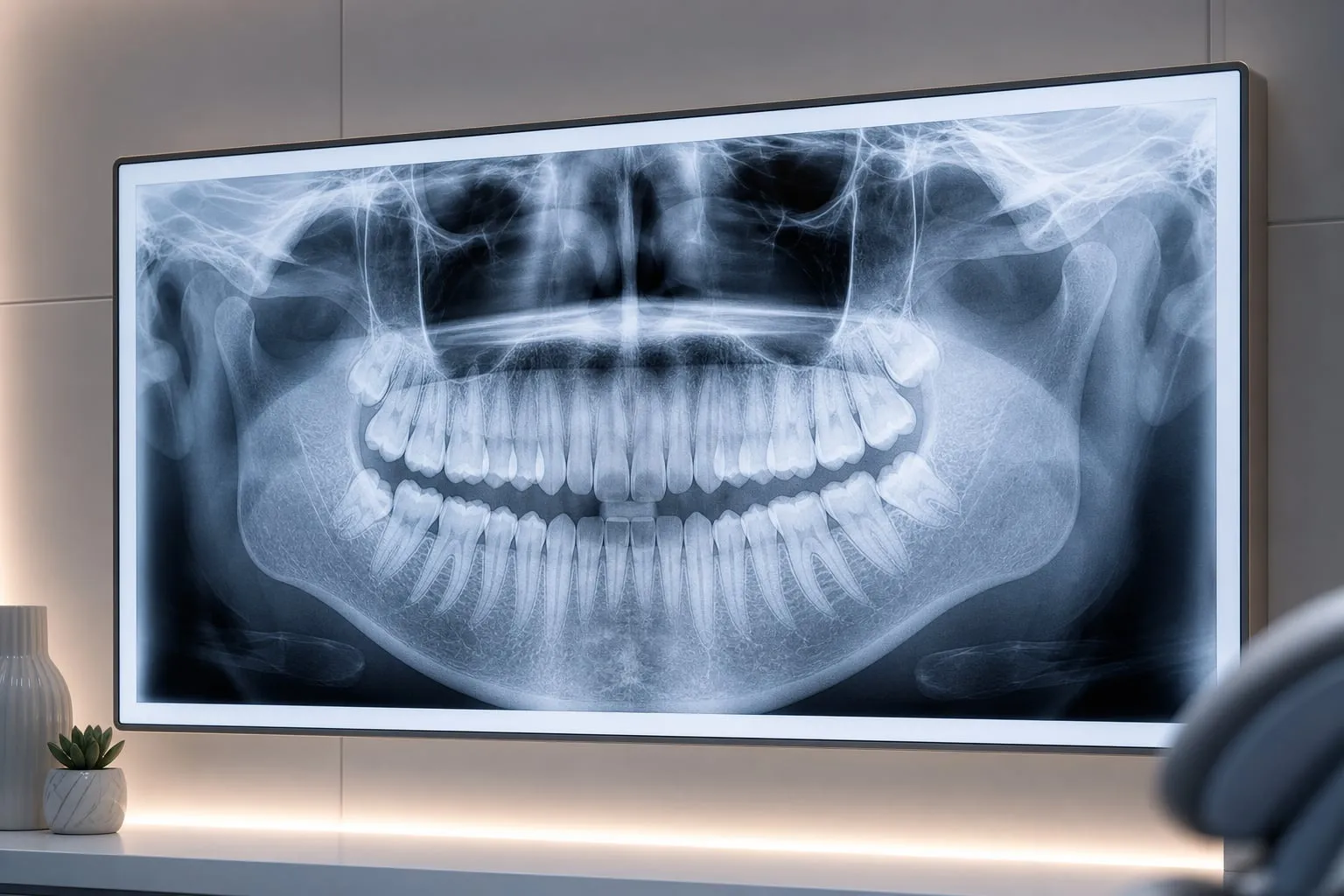
At our Mission Viejo office, the consultation is free and comes with no obligation, we use 3D CBCT imaging, and you’ll receive a written treatment plan before any work begins. Here’s what to expect at your first visit.
What are your options when a bridge fails?
The right option depends mostly on the condition of the abutment teeth and the bone.
| Option | When it may fit | What to consider |
|---|---|---|
| Recement the bridge | The bridge is intact and the abutments are healthy | Only works if there’s no decay or damage underneath |
| Replace with a new bridge | Abutment teeth are sound or can be restored | Relies on the same anchor teeth again |
| Single implants | An abutment tooth is lost, or the gap suits tooth-by-tooth replacement | Neighboring teeth aren’t used for support; requires healing time |
| Implant-supported bridge | Several teeth are missing in a row | Two implants can often carry three or more teeth |
| Removable partial denture | Surgery isn’t an option, or cost is the priority | Lower up front; clasps rely on remaining teeth |
Replacing the bridge
If the abutment teeth are healthy, or can be restored with treatment such as a filling or root canal, a new bridge may be a reasonable choice. Ask how much sound tooth remains on each abutment, since that determines how well a new bridge can hold.
Moving to implant-supported options
If an abutment tooth can’t be saved, or you’d rather not rely on those teeth again, implants are worth discussing. A single tooth implant replaces one tooth with its own root and crown, without involving its neighbors. For several teeth in a row, an implant-supported bridge spans the gap on implants rather than natural teeth. Our comparison of a single tooth implant vs. a dental bridge lays out the trade-offs.
Implant treatment happens in stages. The implant first integrates with the bone — a process called osseointegration — before the final crown or bridge is attached, so plan for a healing period and ask how the gap will be handled in the meantime.
Extraction and socket preservation
If an abutment tooth has to come out, how it’s removed matters. Socket preservation means placing graft material in the empty socket at the time of extraction to help the ridge keep its shape for a future implant. It isn’t always needed, and your dentist will explain whether it’s worthwhile in your case. Our page on tooth extraction and socket preservation explains when it helps.
If your bridge is anchored to implants
If the bridge that’s failing sits on implants rather than natural teeth, the causes and fixes differ. Sometimes only the bridge or a connecting part has loosened; other times the gum and bone around an implant are involved. See failing dental implants and second opinions.
When should you act?
Sooner is generally better. A bridge that’s loose at one end can allow decay to progress underneath, and an abutment tooth that might be savable now may not be later.
Until you’re seen:
- Avoid chewing on the bridge
- Keep the area clean with gentle brushing
- If the bridge comes off, rinse it, store it in a clean container, and bring it to your appointment
- Don’t reattach it with household glue or adhesive
Contact a dental office promptly if you have swelling, fever, or severe pain.
The bottom line
A failing bridge usually signals a problem with the teeth or gums holding it up, and those problems tend to grow if left alone. Depending on what the exam shows, the fix might be a recemented or new bridge, implant-supported teeth, or an extraction with socket preservation. Getting it checked early keeps more of those options open — request your free consultation or call (949) 773-4170.
This article is general education, not a diagnosis or a substitute for professional dental advice. Individual results vary; discuss your own situation with your dentist.