A removable partial denture is usually the lower-cost, non-surgical way to replace several missing teeth, while dental implants give you fixed teeth that don’t depend on your remaining teeth for support and help preserve the jawbone. Which is right for you depends on your health, your bone, your budget, and how much day-to-day stability matters to you. An exam with imaging is what turns that general answer into a specific one.
Both are legitimate options, and neither is right for everyone. Here’s how they actually differ.
What is a removable partial denture?
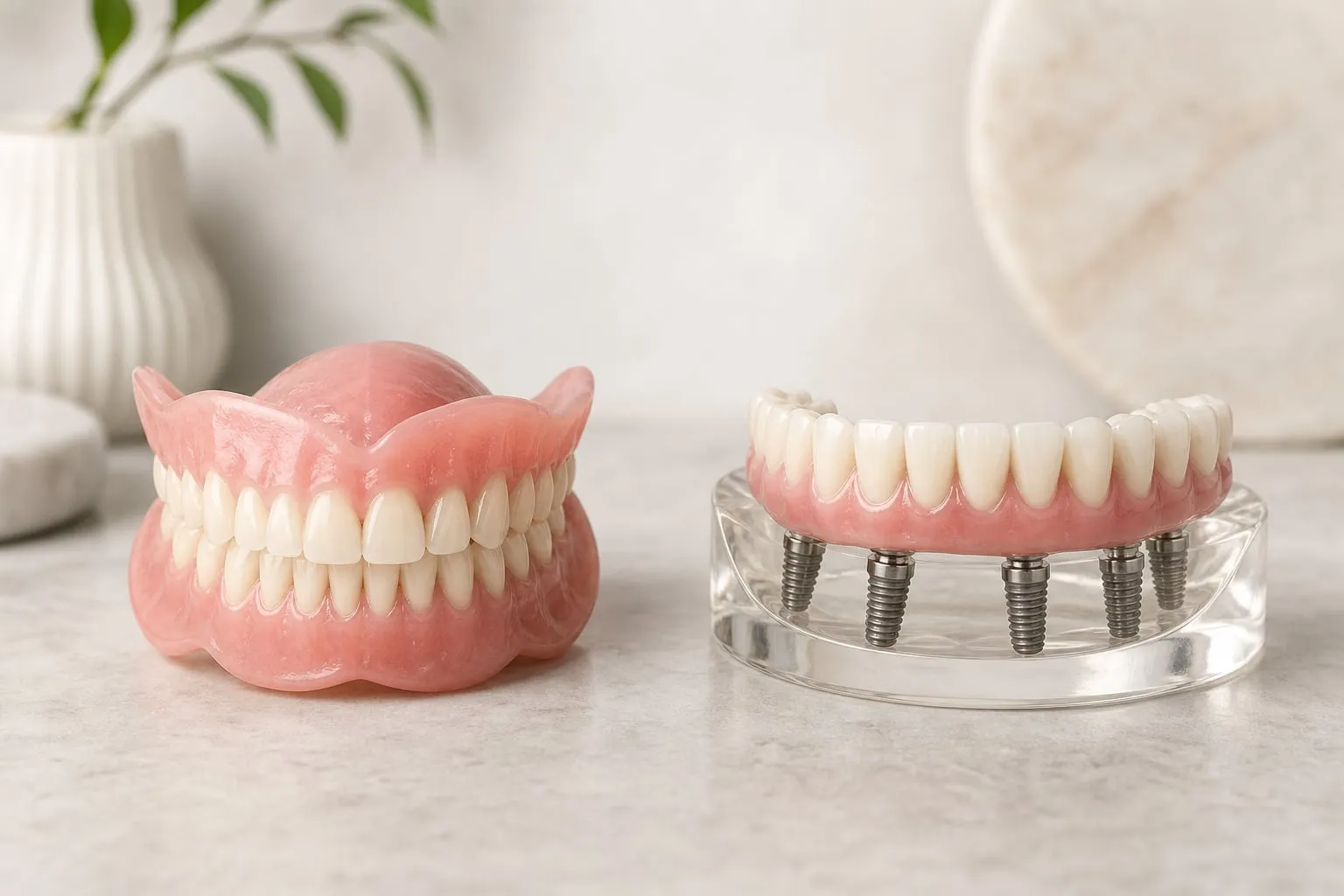
A removable partial denture, usually just called a “partial,” replaces several missing teeth when some natural teeth remain. It has three basic parts:
- Replacement teeth, set into a gum-colored base
- A framework, either cast metal (thin and rigid) or acrylic (a hard plastic often used for simpler or temporary partials)
- Clasps, small arms that hook around nearby natural teeth to hold the partial in place
You take a partial out to clean it, and many people remove it at night. Because it rests on the gums and grips your remaining teeth, it replaces the visible teeth but not their roots.
What implant options exist for several missing teeth?
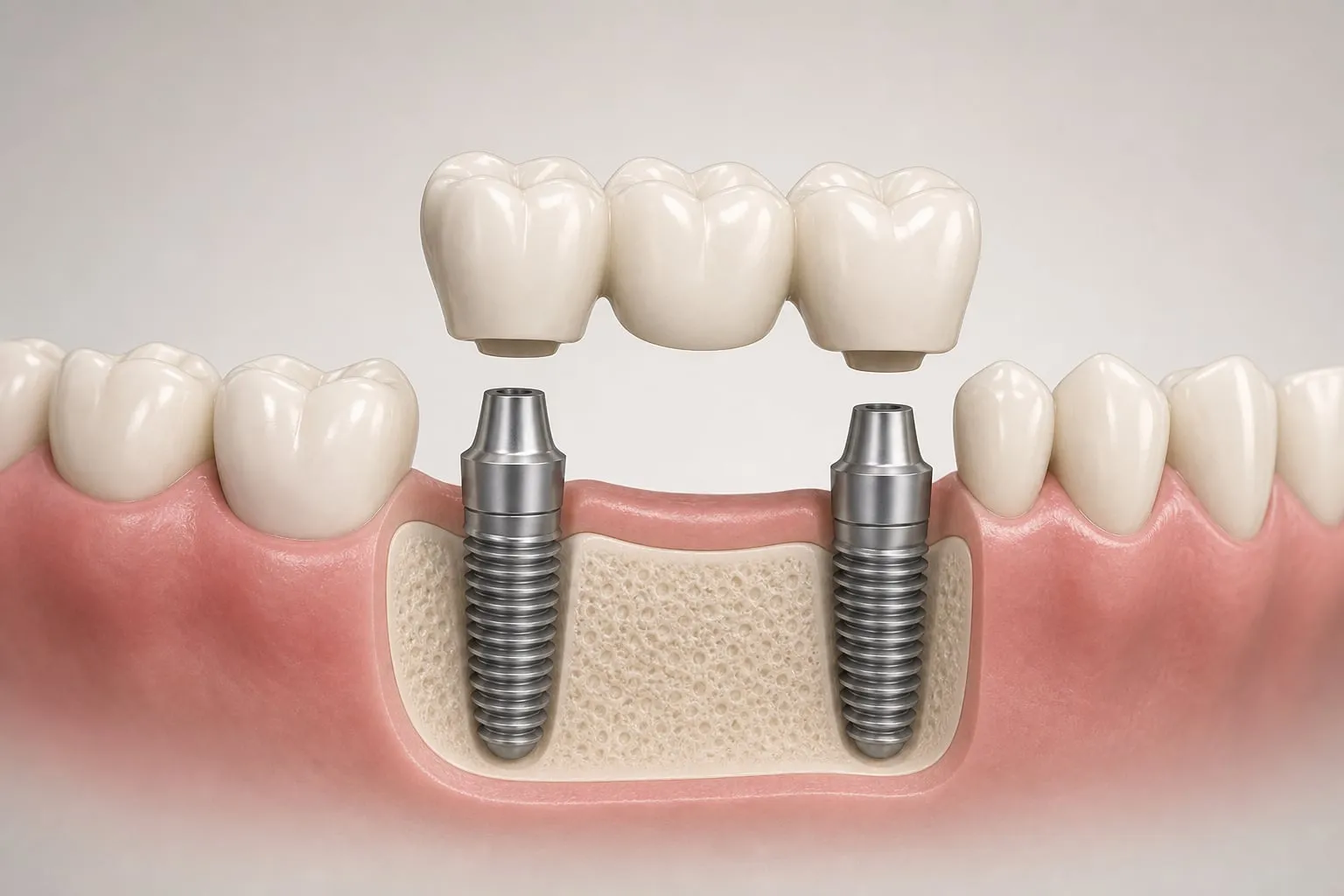
A dental implant is a titanium post placed in the jawbone to act as a replacement root. Over a healing period of several weeks to a few months, it bonds with the bone — a process called osseointegration — and then supports a crown or bridge on top.
For several missing teeth, the common approaches are:
- Single implants. Each missing tooth gets its own implant and crown. This tends to suit gaps that are spread out around the mouth.
- An implant-supported bridge. When teeth are missing in a row, two implants can often support a bridge of three or more teeth, so you may not need one implant per tooth.
- Full-arch options. If most of the teeth in an arch are missing or failing, a full arch on four implants (All-On-4) may fit better.
Our multiple tooth implants page walks through how those options are planned, and our post on how many implants you need explains how the number is decided.

How do partial dentures and implants compare?
| Removable partial denture | Implant-based options | |
|---|---|---|
| Stability | Held by clasps and the gums; can shift when chewing | Anchored in bone; fixed in place |
| Neighboring teeth | Clasps grip and carry load on remaining teeth | Stand on their own; neighbors aren’t used for support |
| Jawbone | Doesn’t replace roots; the ridge can shrink over time | Replace roots and help preserve bone |
| Daily upkeep | Remove to clean the partial and the teeth beneath it | Brushed and flossed in place, with extra care under bridges |
| Eating and speaking | Some foods and sounds take adjustment | Closer to natural teeth |
| Treatment | No surgery; fewer visits | Surgery to place implants, then healing before final teeth |
| Up front | Lower cost | Higher cost |
| Over time | May need adjustments, relines, or replacement as your mouth changes | Designed as a long-term solution; crowns may eventually show wear |
General comparison for education only. Individual results and suitability vary.
A reline resurfaces the underside of a denture so it fits the gums again after they change shape.
How does each option affect the teeth you still have?
This is the difference people most often overlook. A partial depends on your remaining teeth. The clasps hold onto them, and every time you chew, some of that force passes to those teeth. Clasps can also make it easier for plaque to collect around the teeth they touch.
None of that means a partial will harm your teeth, but it does mean the anchor teeth need careful cleaning and regular checkups.
Implants carry the load themselves. Your remaining teeth don’t have to hold anything up, and nothing needs to clasp onto them. If those teeth are already fragile, that can matter a great deal.
What happens to the jawbone under each option?
When a tooth is lost, the bone that held its root no longer gets the stimulation of chewing, and it gradually shrinks. A partial sits on the gums, so it doesn’t change that process. Over time the ridge under a partial can change shape, which is one reason partials may need relining or remaking.
Implants replace the root, and the chewing forces they carry help preserve the surrounding bone. If you’ve already lost bone, implants may still be possible — sometimes after bone grafting to rebuild the site.
Who tends to suit a partial denture?
A removable partial may be the better fit if:
- Keeping the up-front cost as low as possible is the priority
- You’d prefer to avoid surgery, or a health condition makes surgery inadvisable
- You want a shorter treatment timeline
- Your remaining teeth have an uncertain outlook and a longer-term plan isn’t settled yet
- Significant bone loss would require more grafting than you want to undertake
Who tends to suit dental implants?
Implants may be the better fit if:
- You want teeth that stay in place rather than coming out
- You’d rather not rely on your remaining teeth for support
- Preserving jawbone matters to you
- You’re healthy enough for implant surgery and have enough bone, or are open to grafting
- You see tooth replacement as a long-term decision
Gum health, bone, and medical history all affect candidacy, which is why the evaluation comes first.
Can you switch from a partial to implants later?
Often, yes. Plenty of people wear a partial for a while and move to implants when the timing, health, or budget works. The main thing to know is that bone can keep changing while you wait, so a site that would have been straightforward earlier may need grafting later. Imaging shows where you stand.
If you do start implant treatment, ask how the gap will be handled while the implants heal. Final teeth are attached after the implants have integrated with the bone, so treatment happens in stages rather than in a single day.
For a broader view, compare every approach on our missing teeth options page. If you’re weighing a full denture rather than a partial, see dental implants vs. dentures.
How do the costs compare?
A partial generally costs less up front. Implants cost more up front and are designed for the long term, while a partial may need adjustments or replacement over the years. Weigh both the number today and what each option is likely to need later.
At our office, a single implant starts at $1,995, covering the consultation, implant surgery, and crown, with extractions, bone grafting, and sinus lifts quoted separately. Pricing may vary based on individual needs. Multi-tooth plans are quoted individually, and you’ll receive a written treatment plan before any work begins. Our dental implant cost page explains how pricing and financing work.
The bottom line
A removable partial denture is a sensible, lower-cost way to replace several teeth without surgery, but it relies on your remaining teeth and doesn’t preserve bone. Implant options cost more up front and take longer, and in return they give you fixed teeth that stand on their own. The right choice depends on your mouth, your health, and your priorities, which is exactly what an exam and 3D imaging reveal. See what happens at your first visit, or request your free consultation to compare your options in person.
This article is general education, not a diagnosis. Individual results vary; discuss your own situation with your dentist.