Short answer: no, you almost certainly don’t need one implant for every missing tooth. An implant replaces a tooth root, and a single root can carry more than one tooth when the teeth sit next to each other. That one fact changes the math — and usually the price — of replacing several teeth.
This is one of the most common misunderstandings we hear at consultations. Someone missing six teeth arrives braced for six surgeries and a number to match. Most of the time, that isn’t the plan.
Why the count isn’t one-to-one
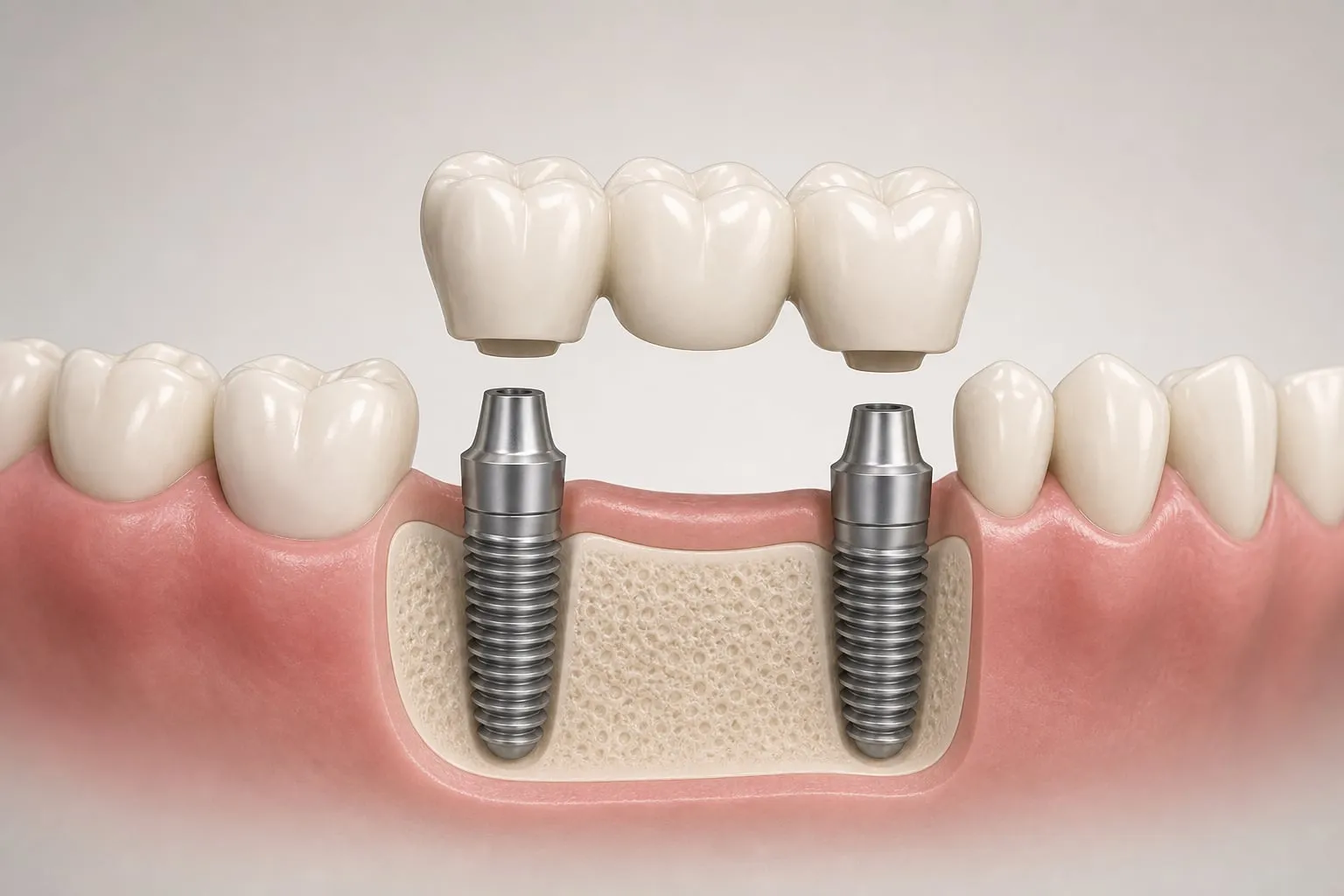
Think about how a bridge works. A traditional bridge spans a gap by anchoring to the teeth on either side, with a false tooth suspended in between. Implant dentistry uses the same principle, except the anchors are implants in bone rather than your natural teeth — which means the neighboring teeth don’t have to be reshaped to hold anything.
Stretch that idea far enough and you get full-arch treatment: a small number of well-positioned implants carrying a complete row of teeth.
What decides the number isn’t how many teeth are missing. It’s:
- Where the gaps are, and whether they’re adjacent or scattered
- How much bone you have, and its density in each area
- Bite forces — molars take far more load than front teeth
- The type of restoration you and your provider choose
Situation by situation
One missing tooth
One implant, one crown. This is the straightforward case, and it’s what our single tooth implant page covers. The main alternative is a conventional bridge, which is faster and often cheaper up front but requires filing down two healthy neighbors. We compare them honestly in single tooth implant vs. dental bridge.
Two to four teeth in a row
This is where the one-to-one assumption costs people the most money. A run of adjacent missing teeth can frequently be restored with fewer implants than teeth — two implants carrying a three-tooth bridge, for example, or two to three implants carrying a four-tooth span.
Fewer surgical sites, less healing, lower total cost. Our multiple tooth implants page walks through how these bridges are designed.
Several scattered gaps
When missing teeth are spread out with healthy teeth between them, bridging isn’t an option — there’s nothing to span. Here you’re generally looking at individual implants, one per gap, because each one has to stand on its own. It’s the situation where the count does approach one-to-one, and it’s worth knowing that going in.
Most or all of an arch
If the teeth in an arch are missing or failing, replacing them individually would mean a lot of implants and a lot of bone. Full-arch designs avoid that. All-On-4 uses four implants per arch, angling the back two to make use of bone that’s still available and often reducing the need for grafting. Implant-supported dentures use a small number of implants to anchor a removable prosthesis that snaps securely into place.
More detail on the whole category is on our full mouth dental implants page.
A rough map — not a prescription
| Your situation | Common approach | Typical implant count |
|---|---|---|
| One missing tooth | Single implant and crown | 1 |
| Two to four teeth in a row | Implant-supported bridge | 2–3 |
| Scattered individual gaps | Separate implants | One per gap |
| Most or all of an arch, fixed | Full-arch prosthesis such as All-On-4 | Around 4 per arch, sometimes more |
| Most or all of an arch, removable | Implant-supported denture | A small number of anchors per arch |
Treat this as general orientation only. Real plans come from a clinical exam and 3D CBCT imaging, and it’s genuinely common for a case to land outside these patterns because of bone volume, bite, or gum health.
When more implants is the right call
Fewer isn’t automatically better. A provider may recommend additional implants when bite forces are heavy, when a span is long, when bone quality is compromised in one area, or when a particular prosthesis design calls for it. That’s a clinical judgment made from your imaging, not a sales decision — and you should feel free to ask why a specific number was chosen. A good answer will point at your scan, not at a brochure.
What about getting teeth the same day?
We don’t offer same-day teeth, immediate loading, or “teeth in a day.” Our planning is built around confirmed bone integration — meaning we verify the implants have bonded to bone before final teeth go on. It takes longer, and we think it’s the more dependable sequence. If a same-day timeline is your priority, it’s fair to say so early so nobody’s time is wasted.
Bone comes before count
Sometimes the honest first answer isn’t a number at all. If there isn’t enough bone to hold an implant where one is needed, bone grafting or a sinus lift may come first, and that changes both the timeline and the plan. If you’re weighing implants against other routes entirely, our missing teeth options overview lays out where bridges and dentures still make sense.
Find out your number
The only way to know how many implants your case needs is an exam and a 3D scan. The consultation is free, and you’ll get a written plan with the count, the reasoning, and the cost.
Request your free consultation or call (949) 773-4170.
This article is general education, not a diagnosis. Individual results vary, and only a personalized evaluation can determine what treatment may be appropriate for you.