Often, yes, but usually only when the denture is supported by dental implants. A conventional upper denture covers the palate, the roof of your mouth, because that coverage creates the suction that holds it in place. When implants take over the job of holding the denture, it can in many cases be designed to leave much or all of the palate open, depending on your bone, the number of implants, and the type of denture.
If you wear an upper denture and dislike the plate across the roof of your mouth, you’re far from alone. Here’s why it’s there, what changes with implants, and what to ask before you decide.
Why does a conventional upper denture cover the palate?
A conventional denture rests on the gums. Nothing anchors it to the jaw, so it has to stay in place another way.
For an upper denture, that way is mostly suction. The denture is shaped to fit closely against the gum ridge and the palate. A thin film of saliva fills the tiny space between them, and a seal along the back edge keeps air from getting in. Together, those create the suction that holds the denture up against gravity every time you talk or chew.
The palate is the largest surface available, so it does much of that work, and it also helps spread chewing pressure. Take it away from a gum-supported denture and the denture generally loses much of its hold. Horseshoe-shaped conventional designs exist for particular situations, but they typically trade away retention, meaning the denture’s ability to resist coming loose.

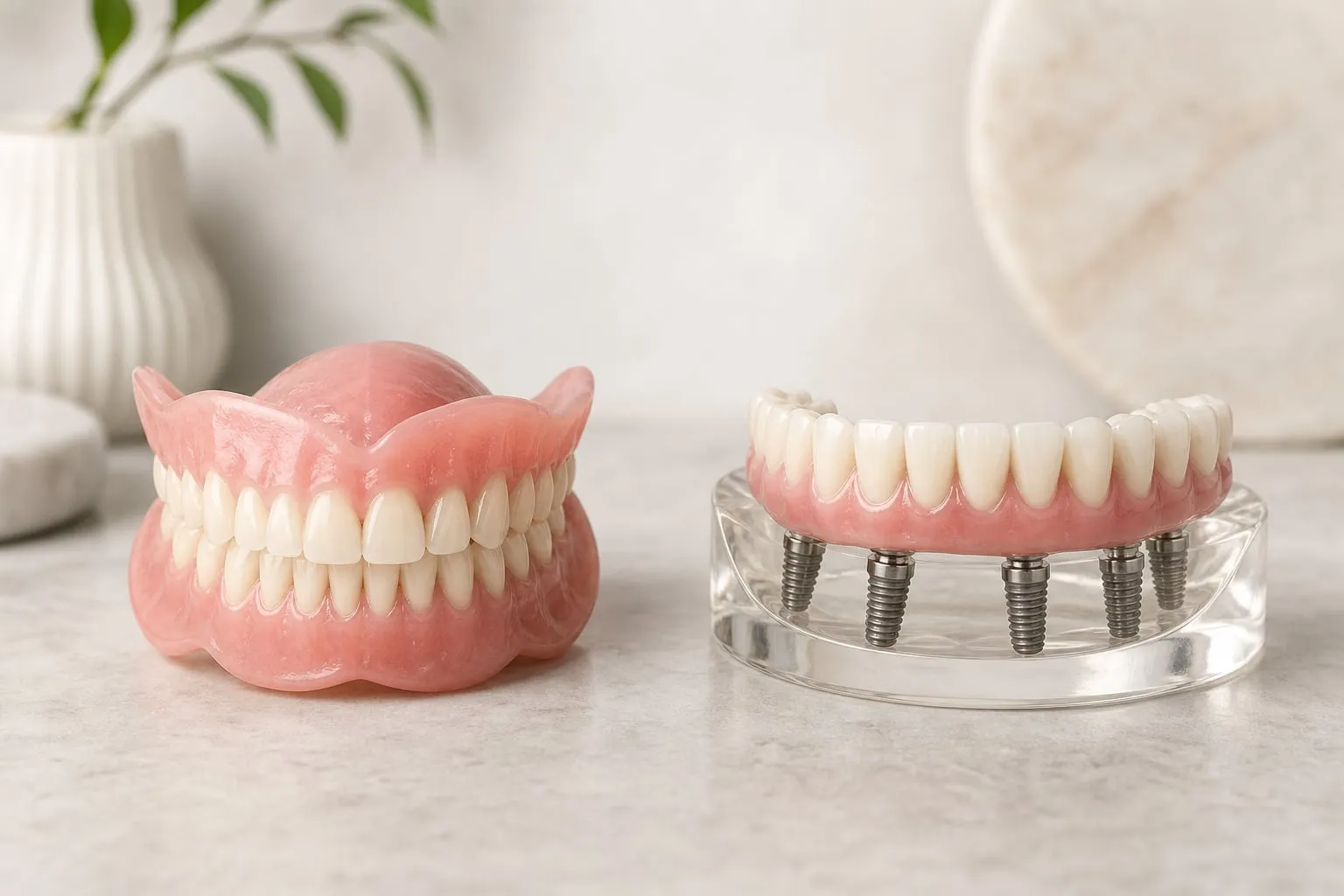
Compare the two in the image above. The upper denture covers the whole roof of the mouth. The lower one is already horseshoe-shaped, because the tongue sits in the middle, and lower dentures often don’t benefit from the same suction.
How do implants make a palate-free upper denture possible?
A dental implant is a small titanium post placed in the jawbone that acts as an artificial tooth root. Over the following weeks to months, the bone bonds to its surface, a process called osseointegration. Once that has happened, the implant can anchor a denture.
With implants, the denture is held by attachments or a bar connected to the implants rather than by suction alone. Because it no longer depends on the palate to stay up, the plate can in many cases be reduced to a horseshoe shape or left off entirely.
It helps to separate two jobs:
- Retention is what keeps the denture from coming loose.
- Support is what carries the force when you bite and chew.
A conventional palate helps with both. To remove it, the implants need to provide enough of both. That’s why the number, position, and spread of implants matter so much, and why the answer differs from one person to the next.
What are the palate-free options?
There are two broad approaches, and both are planned around how many implants your bone can support.
1. Implant-supported (snap-on) denture. An overdenture is a removable denture that clips onto implants using attachments or a bar. You take it out to clean it. Depending on how much support the implants provide, the palate can often be reduced or eliminated. With fewer implants, the denture may still rely partly on the palate for support. Learn more about implant-supported dentures.
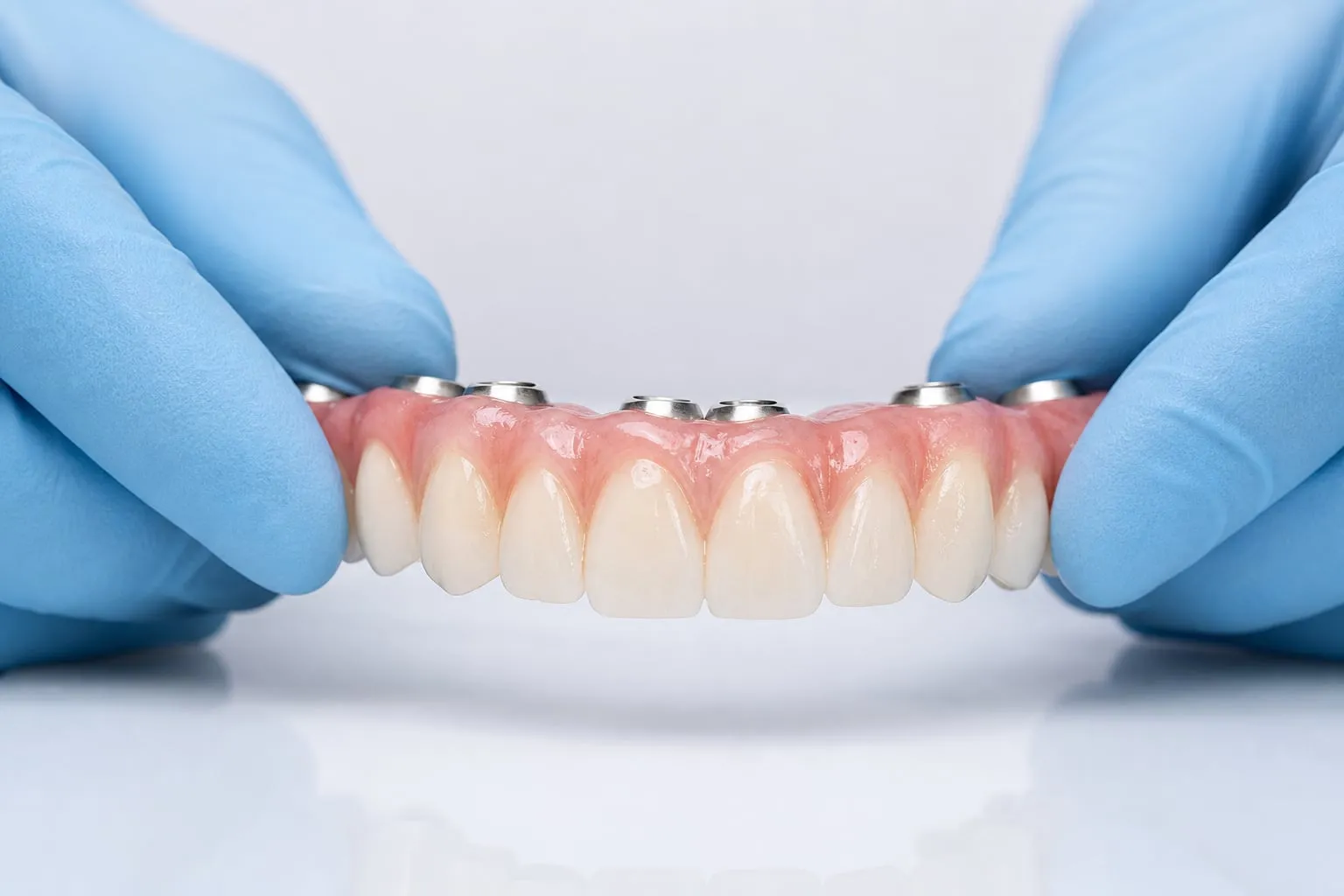
2. Fixed full-arch teeth. A fixed full-arch restoration, such as All-On-4, is a complete set of teeth attached to implants that only your dentist removes. It follows the curve of the arch and typically doesn’t cover the palate at all.
| Conventional upper denture | Implant overdenture (removable) | Fixed full-arch teeth | |
|---|---|---|---|
| What holds it | Suction against the gums and palate | Attachments or a bar on implants | Fixed to implants |
| Palate coverage | Usually full | Often reduced or none, depending on implant support | Typically none |
| Removed by you | Yes | Yes, for cleaning | No |
| Daily care | Remove and clean the denture | Remove and clean the denture and attachments | Clean around and under it, like natural teeth plus a few tools |
| Bone | Doesn’t stimulate the jaw, so the ridge tends to shrink | Implants help slow bone loss where they’re placed | Implants help slow bone loss where they’re placed |
| Up-front cost | Lowest | Often lower than fixed | Typically highest |
Our comparison of All-On-4 vs. implant-supported dentures goes deeper into the fixed-or-removable decision.
What do people notice when the palate is uncovered?
Results vary, but these are the changes many people find most noticeable:
- Taste and temperature. Many people find food tastes and feels more natural, partly because the roof of the mouth can sense the warmth and texture of food again.
- Gag reflex. For people with a sensitive gag reflex, the back edge of an upper denture can be hard to tolerate. Many find a design without that edge much easier.
- Speech. Your tongue touches the palate for many sounds. Many people find speaking feels more natural without a layer of plastic there, though any new set of teeth takes an adjustment period.
- Confidence. Without suction to break, there’s less worry about the denture dropping when you laugh, bite into something, or speak. No adhesive is needed.
None of these is guaranteed, and the teeth themselves will still feel different from natural teeth. But for many long-time denture wearers, getting the palate back is one of the changes they appreciate most.
How do bone and the sinuses affect an upper implant denture?
The upper jaw brings a few planning considerations of its own:
- Softer bone. Bone in the upper jaw tends to be less dense than in the lower jaw, which is one reason upper implant dentures often need more implant support than lower ones. Our article on upper vs. lower All-On-4 explains the difference.
- The sinuses. The sinuses sit just above the upper back teeth. After tooth loss, the bone there can thin and the sinus can expand downward, leaving less height for an implant. A sinus lift, which raises the sinus membrane and adds bone beneath it, or a bone graft may be recommended. Implant positions and angles can also be planned around the bone you already have.
- Years of denture wear. A ridge that has been carrying a denture for a long time has often lost some bone. That rarely ends the conversation, but it does shape the plan. See what to do when dentures no longer fit.
This is why planning starts with 3D CBCT imaging, which shows bone height, width, and the position of the sinuses. Bone grafting and sinus lifts, when needed, are quoted separately, and you receive a written treatment plan before any work begins.
Is a palate-free upper denture right for me?
Good questions to bring to a consultation:
- How much bone do I have in my upper jaw, and how close are my sinuses?
- How many implants would I need for a design that leaves the palate open?
- Would I need a bone graft or sinus lift first?
- Do I prefer removable teeth I can take out to clean, or fixed teeth that stay in?
- What will I wear while the implants heal?
On that last question: we don’t offer same-day teeth. The implants are given time to bond with the bone before the final denture or bridge is made, and what you wear during healing is planned in advance and discussed at your consultation. Our page on dental implants for denture wearers covers the options in more detail.
The bottom line
A conventional upper denture covers your palate because it needs the suction to stay in place. Implants can take over that job, which in many cases allows a removable overdenture or fixed full-arch teeth that leave the palate partly or completely open. Whether that’s realistic for you depends on your upper-jaw bone, your sinuses, and how many implants can be placed, which a 3D scan shows. To find out what’s possible, see what happens at your first visit or call (949) 773-4170.
This article is general education, not a diagnosis or a substitute for professional dental advice. Individual results vary, and only a personalized evaluation can determine whether a particular treatment may be an option for you.