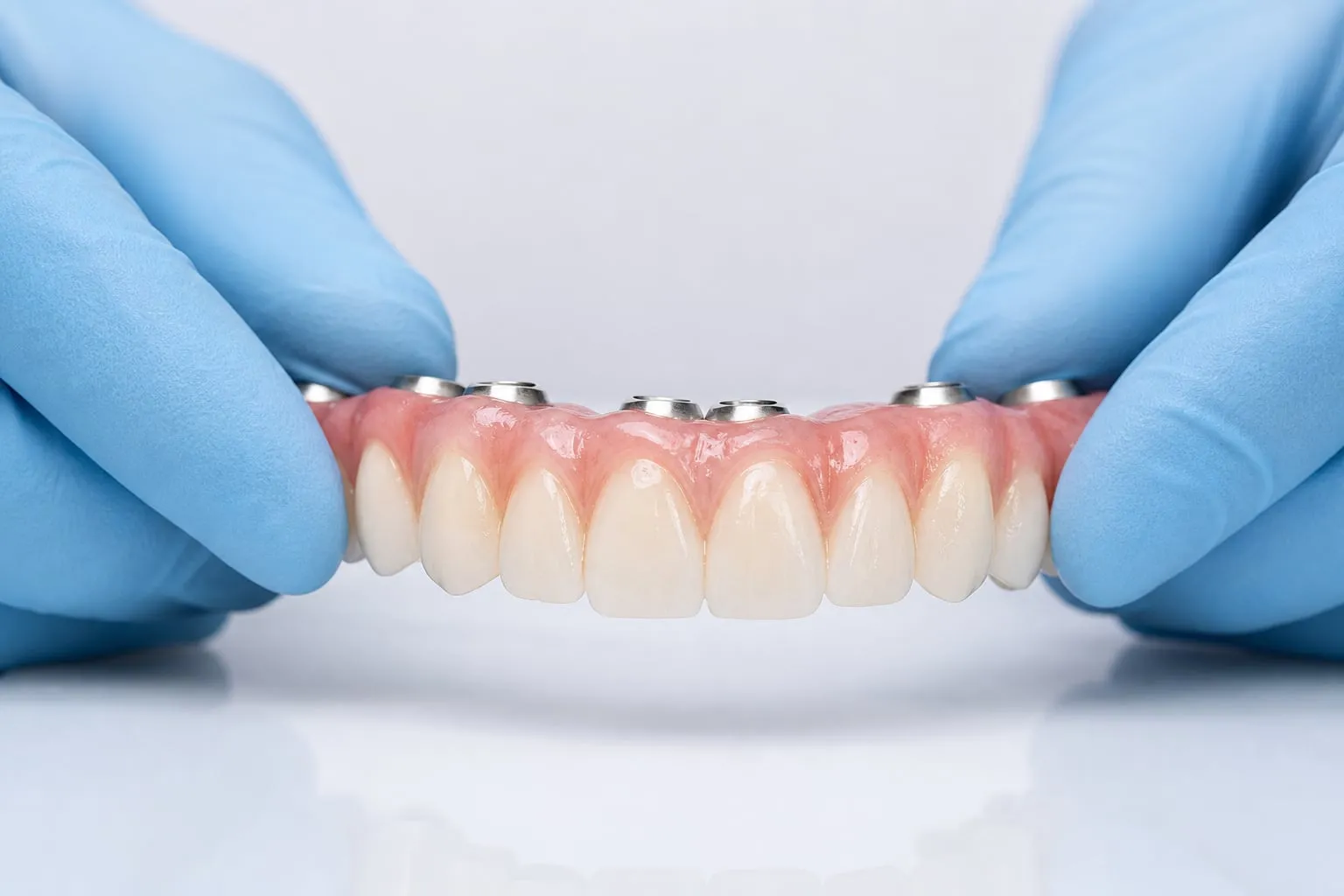
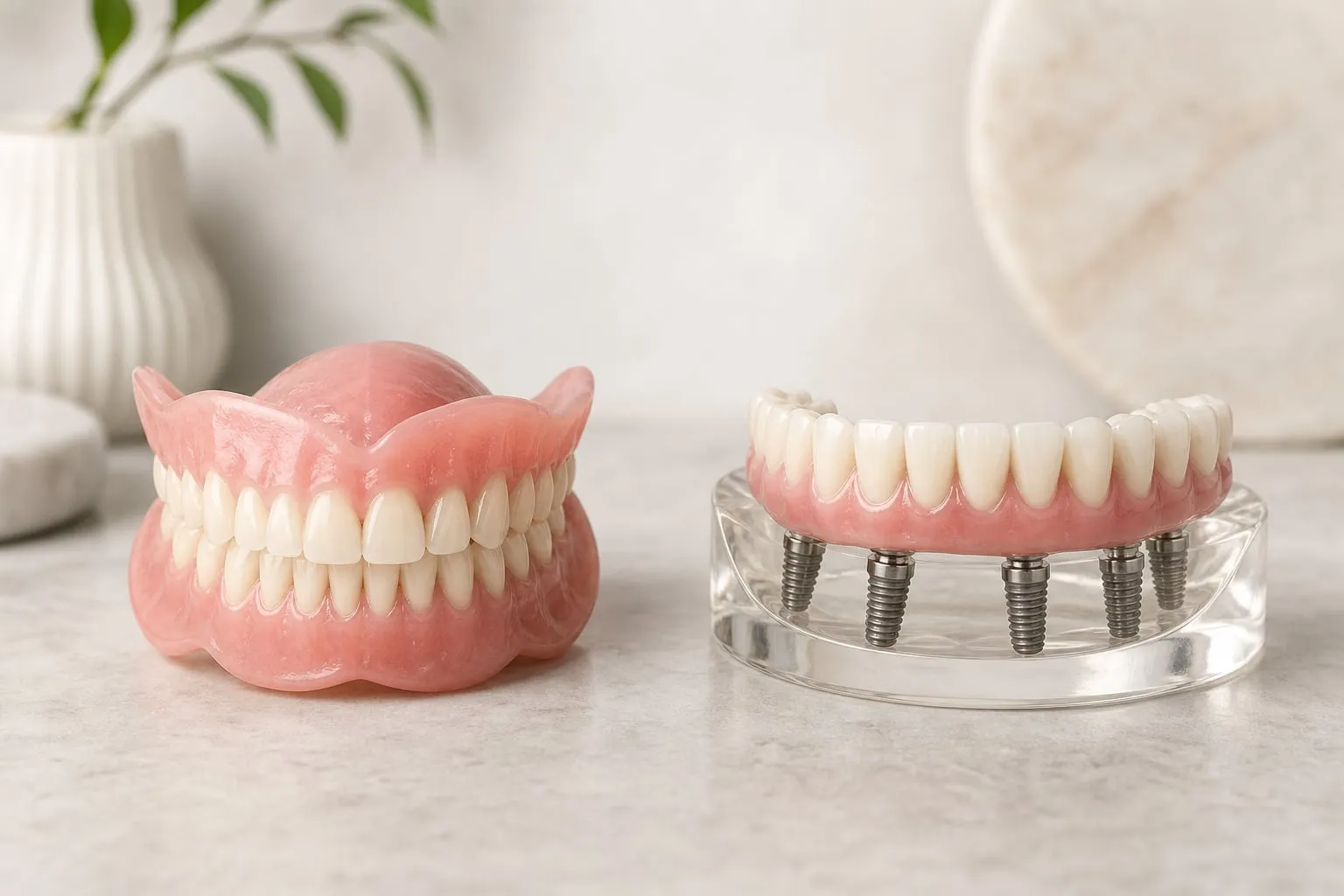
Snap-in dentures work by clipping onto a small number of dental implants placed in the jawbone. Each implant carries an attachment, and matching parts inside the denture click over those attachments, so the denture stays in place while you eat and speak but still comes out for daily cleaning. Dentists often call them implant-retained overdentures.
Instead of relying on fit, suction, or adhesive alone, the denture has something solid to hold onto. Here’s how the parts fit together, what daily care involves, and how snap-in dentures compare with fixed teeth.
What is a snap-in denture?
A snap-in denture is a type of overdenture: a removable denture that fits over and clips onto implants. You may also hear it called a snap-on denture or an implant-supported denture; the names overlap.
A conventional denture rests on the gums and is held by its fit, suction, and sometimes adhesive. A snap-in denture still looks like a denture, with teeth set in a gum-colored base, but it’s anchored to the jaw at a few points.
Those anchors are dental implants, small titanium posts placed in the jawbone that act as artificial tooth roots. After placement, the bone gradually bonds to the implant surface, a process called osseointegration.
How do the parts fit together?
A snap-in denture has three main pieces working together:
- The implants. They sit in the jawbone, below the gum, and are given time to integrate with the bone before the denture is attached to them.
- The attachments. A connector is fastened to the top of each implant and sits just above the gum line. It’s the part you’ll see when the denture is out.
- The matching parts in the denture. Small metal housings are set into the fitting side of the denture. Each one holds a replaceable plastic insert, sometimes called a retention insert, shaped to grip an attachment.
When you press the denture into place, each insert clicks over its attachment, which is where the name comes from. To take it out, you lift it off with your fingertips. Your dentist will show you the technique.
What types of attachments are there?
There are a few broad designs:
- Ball attachments. A small rounded knob on each implant fits into a socket-like insert in the denture.
- Stud-style attachments. A low-profile, button-shaped attachment on each implant snaps into a matching insert.
- Bar attachments. A slim metal bar connects two or more implants along the gum, and clips inside the denture fasten onto the bar.
Which design suits you depends on how many implants are planned, their positions and angles, the space available for the denture, and how much of your bite the implants are meant to carry.
That last point is worth understanding. Retention is what keeps a denture from coming loose. Support is what carries the force when you bite. With fewer implants, the denture usually still rests partly on the gums for support and relies on the implants mainly for retention. With more implants, more of the biting force can be carried by the implants themselves.
How many implants do snap-in dentures need?
A small number per arch, but there’s no single figure that applies to everyone. As our guide to how many implants you need explains, the count is decided from an exam and 3D imaging, not a formula.
Factors that shape the number include:
- How much bone you have, and how dense it is
- Whether the denture is for the upper or lower jaw (upper bone tends to be softer, so an upper denture often needs more implant support)
- Whether you’d like an upper denture to leave the roof of your mouth uncovered
- Your bite and how hard you chew
With enough implant support, an upper snap-in denture can often leave much of the palate uncovered; see palate-free upper dentures with implants.
What does daily care involve?
Snap-in dentures are removable, so they come out every day for cleaning. A typical routine looks like this:
- Clean the denture. Brush all surfaces with a soft denture brush and the cleaner your dentist recommends. Many regular toothpastes can be too abrasive for denture material.
- Clean the attachments. Gently brush around each attachment and the gum beside it, where plaque tends to collect. Healthy gums are part of keeping the implants healthy. See how to clean implant-supported teeth for more detail.
- Check the inserts. Food can lodge inside them and weaken their grip.
- Follow your dentist’s guidance on overnight wear. Many people take the denture out at night to give their gums a rest. Your dentist will tell you what suits your situation.
Regular checkups let your dentist examine the implants, attachments, and gums.
Why do the inserts need replacing?
The retention inserts are designed to be the part that wears. Each time the denture goes in and comes out, and as you chew, the inserts gradually lose some of their grip. You may notice the denture lifting more easily than it used to.
That’s expected, and it’s usually a straightforward fix. The worn inserts are swapped for new ones, often during a routine visit, and the snug fit returns. Inserts often come in different strengths, so your dentist can fine-tune how firmly the denture holds.
Over the longer term, the gums and bone away from the implants can still change slowly, so a reline, which resurfaces the fitting side of the denture, may be recommended at some point. Don’t try to adjust or repair any part yourself, because small changes can affect how the attachments line up.
How do snap-in dentures compare with fixed full-arch teeth?
The other main way to use implants for a full arch is a fixed set of teeth, such as All-On-4, that stays in place and that only your dentist removes.
| Snap-in denture | Fixed full-arch teeth | |
|---|---|---|
| Removed by you | Yes, daily for cleaning | No |
| How it’s held | Clips onto attachments on the implants | Attached directly to the implants |
| Implants per arch | A small number, varies by case | Around four, sometimes more |
| Palate coverage (upper) | Often reduced, depending on implant support | Typically none |
| Daily care | Take it out; clean the denture and attachments | Clean around and under it in your mouth |
| Ongoing upkeep | Inserts replaced periodically; relines possible | Professional cleanings and checks |
| Feel | Far more stable than a conventional denture | Generally the closest to natural teeth |
| Up-front cost | Often lower | Typically higher |
Neither is right for everyone. Our comparison of All-On-4 vs. implant-supported dentures goes deeper, and the tooth replacement comparison tool lets you line up several options side by side.
Can my existing denture be turned into a snap-in denture?
Sometimes. If your current denture fits well, is in good condition, and has teeth in the right positions, a dentist may be able to adapt it by adding housings and inserts once the implants have integrated.
A new denture is often the better route when the current one:
- Is worn, cracked, or has been repaired several times
- No longer fits well, even after relining
- Doesn’t have enough thickness in the right places to hold the housings
Your dentist will examine your denture, gums, and bone and explain which approach makes sense. What you’ll wear while the implants heal is planned in advance too.
Is a snap-in denture right for me?
Snap-in dentures are often considered by people with a loose denture, especially a lower one, who want more stability but still like being able to take their teeth out to clean them. Treatment involves a surgical procedure to place the implants and a healing period before the denture is clipped on, and you’ll need enough bone and good general health. Our page on dental implants for denture wearers covers how long-time denture wearers are evaluated.
At our Mission Viejo office, the consultation is free and comes with no obligation. Planning includes 3D CBCT imaging, and you’ll receive a written treatment plan before any work begins.
The bottom line
Snap-in dentures click onto attachments on a small number of implants, which keeps them steady while you eat and speak while still letting you take them out to clean. They need daily cleaning of both the denture and the attachments, plus occasional insert changes to keep the fit snug. Whether a snap-in denture or fixed teeth suits you better depends on your bone, your preferences, and your budget. To find out what’s possible, request your free consultation or call (949) 773-4170.
This article is general education, not a diagnosis or a substitute for professional dental advice. Individual results vary, and only a personalized evaluation can determine whether a particular treatment may be an option for you.