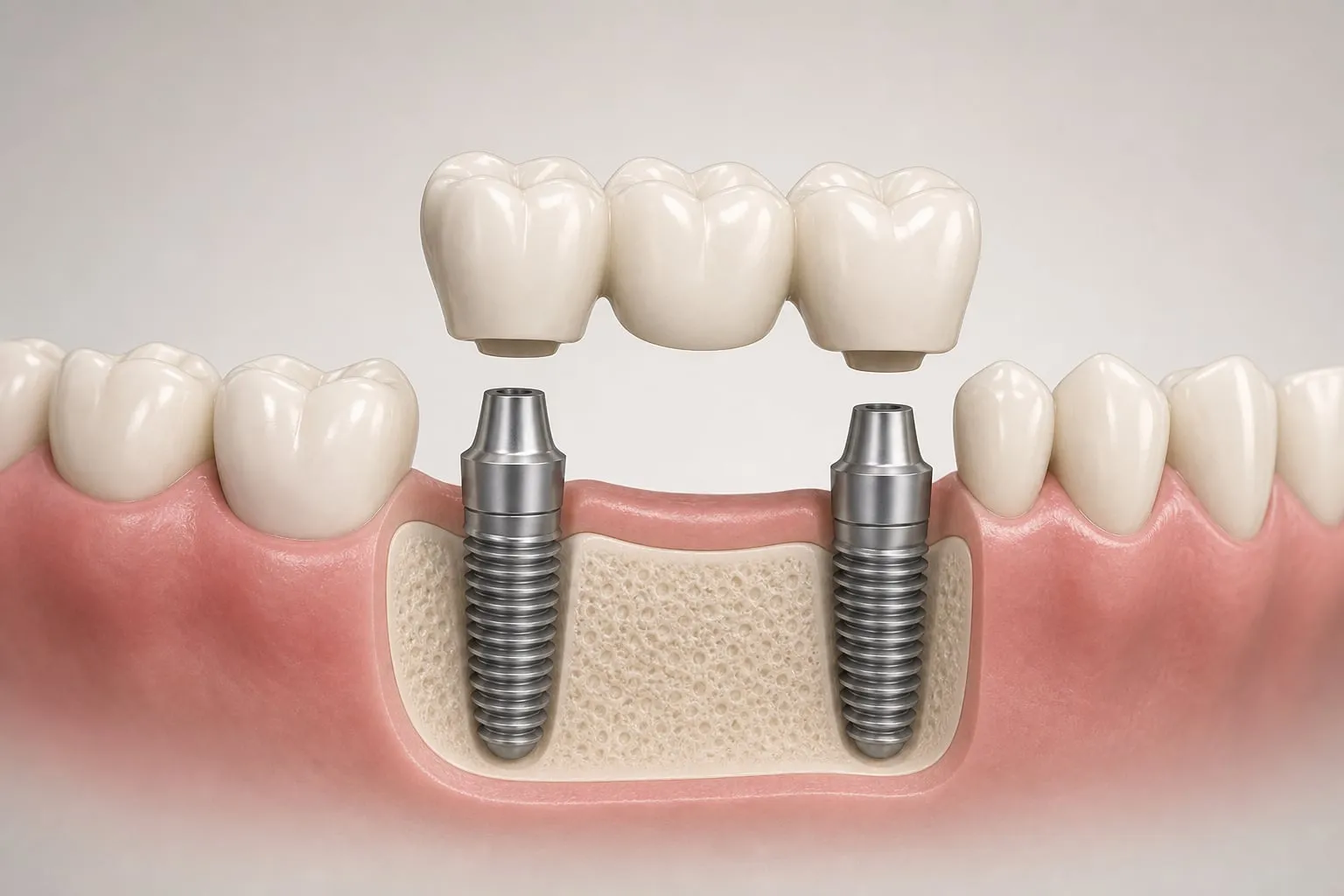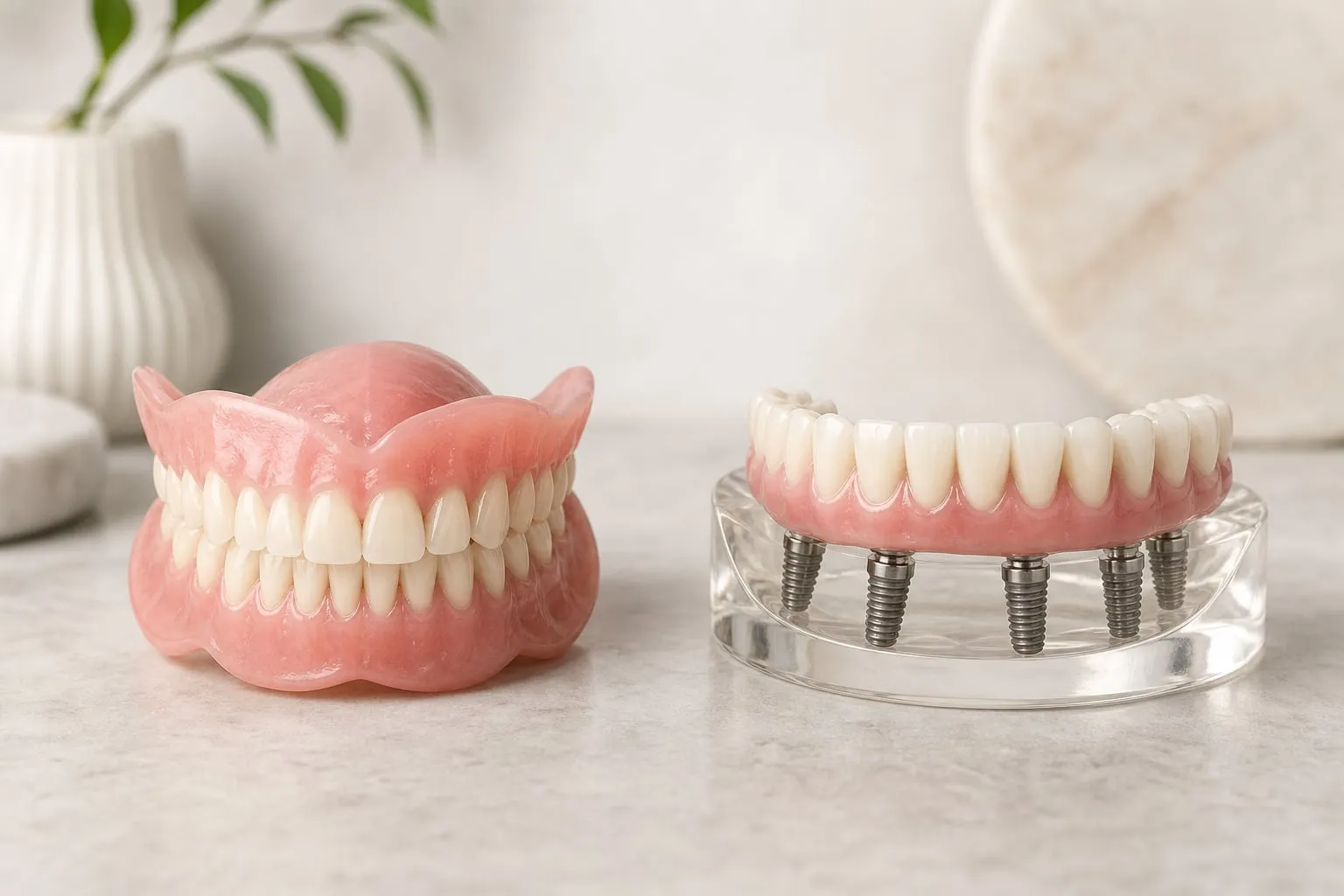

A flipper tooth is a lightweight, removable temporary partial denture: one or more replacement teeth set in a gum-colored acrylic base that rests against the roof of your mouth or along your teeth. It fills a gap while you wait for a longer-term replacement, such as a dental implant, to be ready. It’s designed mainly for appearance and confidence, not for heavy chewing.
Flippers are one of several ways dentists cover a gap while an implant heals. Here’s how they work, how they compare with the alternatives, and what day-to-day life with a temporary is like.
What is a flipper tooth?
A flipper is the simplest form of removable partial denture. It typically has:
- A replacement tooth, or a few, shaded to blend with your own teeth
- An acrylic base, a hard plastic plate that rests against the palate on top or along the inside of the lower teeth
- Sometimes small wire clasps that hook around neighboring teeth for extra grip
It’s made from an impression of your mouth, so it can be prepared ahead of time. The nickname is often said to come from how easily it flips in and out.
A flipper is meant to be temporary. If you’re weighing a removable option for the long term, a sturdier partial denture is a different appliance; our comparison of partial dentures vs. dental implants covers that decision.
Why does an implant need a temporary at all?
Because the final tooth usually can’t go on right away. After an implant is placed, the jawbone gradually grows onto its surface and bonds with it, a process called osseointegration. That typically takes several weeks to a few months, and longer if a bone graft was needed.
During that time, something has to fill the gap, especially for a front tooth. A temporary keeps your smile looking complete, helps with speech, and gives you confidence at work and in public. Our article on front tooth implants explains why visible teeth need particular care during healing.
At our office, the final tooth is attached after the implant has integrated with the bone, not on the day of surgery. What you wear while you heal is planned in advance and discussed with you.
Why shouldn’t a healing implant take chewing pressure?
A newly placed implant is held mostly by the snug fit of the post in the bone. Until the bone has bonded to it, repeated pressure and small movements can disrupt that healing.
That’s why a good temporary is designed to keep force off the implant site. A flipper’s tooth is usually shaped or adjusted so it doesn’t press on the healing gum, and patients are generally asked to chew on the other side. If a temporary starts to rub or press on the area, it should be adjusted rather than tolerated.
What are the pros and cons of a flipper?
Advantages:
- Usually one of the lower-cost temporary options
- Relatively quick to make
- Doesn’t require reshaping neighboring teeth
- Easy to take out for cleaning
- Can be adjusted as the gums heal and change shape
Drawbacks:
- Can feel bulky, especially the palate portion of an upper flipper
- May shift or feel loose when you talk or eat
- Not designed for real chewing
- Acrylic can crack if dropped or bitten on hard
- Can trap food and plaque against the gums and neighboring teeth
- Not intended for long-term wear
What other temporary options do dentists use?
A flipper isn’t the only choice. Depending on the tooth and your bite, dentists may consider:
- A clear retainer-style temporary. A thin, clear plastic tray fits over your teeth with a tooth-colored replacement in the gap. It’s discreet and doesn’t cover the palate, but it covers your biting surfaces, so it’s usually taken out to eat.
- A temporary bridge. Where appropriate, a temporary tooth can be attached to the neighboring teeth. It stays in and feels more like a natural tooth, but it involves those neighbors, which isn’t always desirable when they’re healthy.
- No temporary. For a back tooth that doesn’t show, some people prefer to go without and simply chew on the other side while they heal.
You may also read about temporary teeth attached to implants on the day of surgery, often called immediate loading. That’s a different approach, and not one our office offers.
How do the temporary options compare?
| Flipper | Clear retainer-style | Temporary bridge | |
|---|---|---|---|
| Removable? | Yes | Yes | No, stays in |
| Covers the palate? | Often, on the upper jaw | No | No |
| Eating | Gently, soft foods; sometimes removed | Usually removed to eat | Soft foods; avoid biting hard on it |
| Appearance | Natural-looking tooth; the base may show slightly | Discreet, though teeth can look slightly glossy | Most like a natural tooth |
| Neighboring teeth | Clasps may grip them | Covered but not altered | Used to hold the temporary |
| Cleaning | Remove and brush the appliance | Remove and clean the tray | Clean around it in place |
| Relative cost | Generally lower | Generally lower | Generally higher |
General comparison for education only. Which option suits you depends on your case.
What is it like to live with a temporary tooth?
Most people get used to a temporary fairly quickly. A few practical tips:
- Eating. Choose soft foods, cut them into small pieces, and chew away from the implant site. Avoid hard, sticky, or crunchy foods unless your dentist says otherwise.
- Cleaning. Take a removable temporary out after meals to rinse it, and brush it gently once a day with a soft brush. Avoid hot water, which can warp acrylic, and keep it in its case, out of reach of pets.
- The healing site. Clean the area exactly as instructed, gently, and keep up your normal routine everywhere else.
- Speech. A slight lisp at first is common, especially with a flipper that covers the palate. Reading aloud helps your tongue adapt faster.
- Sleeping. Many dentists recommend taking removable temporaries out at night to let the gums rest. Ask what applies to you.
Contact your dentist if a temporary cracks, causes a sore spot, presses on the implant site, or stops fitting. Our recovery and aftercare guide covers what’s normal during healing.

How is the right temporary chosen?
It depends on which tooth is missing, how visible it is, your bite, whether you grind your teeth, how long healing is expected to take, and your budget. A front tooth may call for a different approach than a molar, and a single gap is different from several.
Good questions to ask before treatment:
- What will I wear while the implant heals?
- Will it press on the implant site?
- Can I eat with it in, or should I take it out?
- What happens if it breaks?
These are part of the planning conversation at your consultation. You can see what that visit involves on our first visit page, and how a single tooth implant is planned from start to finish.
The bottom line
A flipper tooth is a simple, removable stand-in that keeps your smile complete while an implant heals. It isn’t built for chewing, and alternatives such as a clear retainer-style temporary or a temporary bridge may suit some cases better. Whatever you wear, the goal is the same: keep pressure off the healing implant so it can bond with the bone. To talk through the plan for your own tooth, request a free consultation or call (949) 773-4170.
This article is general education, not a diagnosis or a substitute for professional dental advice. Individual results vary, and only a personalized evaluation can determine which treatment may be appropriate for you.