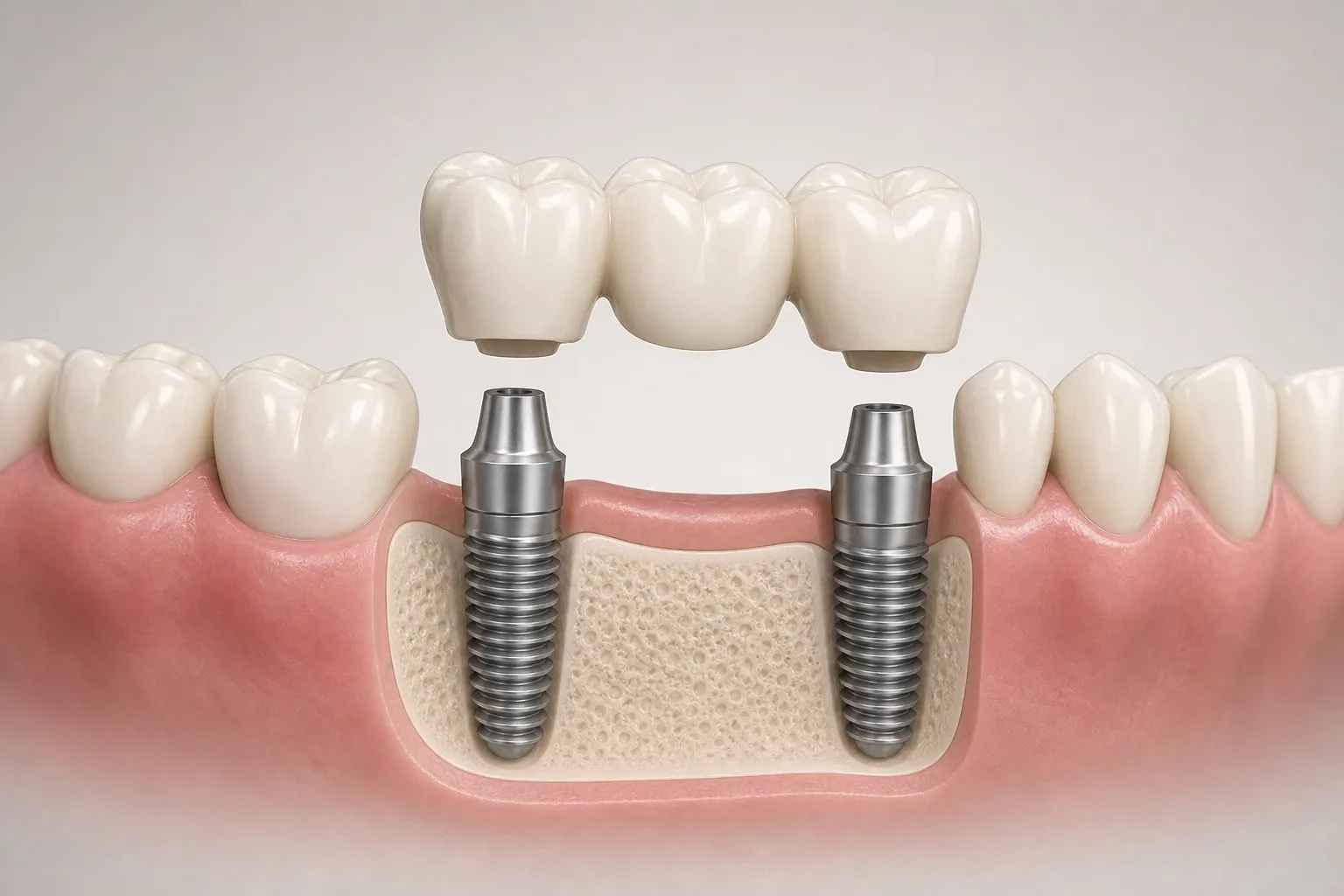

Short answer: implant pricing is more predictable than most people expect — the anxiety usually comes from not being told the number.
Here’s how the money side actually works.
Start with a real, written price
Our single dental implant pricing starts at $1,995, which covers the consultation, the implant surgery, and the crown.
Some patients need preparatory treatment first — an extraction, a bone graft, or a sinus lift. Those are quoted separately and up front, so nothing appears on a bill that you didn’t see coming.
Pricing may vary based on individual needs — contact the office for a personalized estimate.
The most important question to ask any office
“What exactly does that price include?”
This one question explains most of the price variation you’ll see while shopping. A quote might cover:
- the implant post only, or
- the post plus the abutment, or
- the post, abutment, and crown, or
- all of the above plus imaging, extraction, or grafting
Two quotes that look thousands of dollars apart are sometimes describing different scopes of work. Get every quote itemized and you can actually compare them. Our breakdown of what’s included in a $1,995 implant shows what that looks like in practice.
How dental insurance typically applies
Insurance for implants has improved, but it remains genuinely variable. Broadly:
- Some plans contribute toward implants directly
- Some exclude the implant but cover related work such as extractions or the crown
- Many carry an annual maximum that caps what they’ll pay in a calendar year
- Some have waiting periods for major services
Two practical tips: ask about your annual maximum before scheduling, and if treatment spans a year boundary, ask whether sequencing could let you use two years of benefits.
We accept most dental insurance and will help you read your specific plan. See our financing and insurance page for details.
Financing routes patients actually use
Third-party dental financing. The most common route. Monthly payment plans, often with promotional interest-free periods for qualified applicants. Approval and terms are set by the lender, not by us.
HSA and FSA funds. Dental implants are commonly an eligible expense. If you have a balance, this is effectively pre-tax money toward treatment — check your plan documents.
Phasing treatment. For larger cases, treatment can sometimes be sequenced over time so costs land across multiple budget periods. This isn’t right for every case clinically, but it’s worth asking about.
Combining sources. Many patients use insurance for part, HSA for part, and finance the remainder.
Thinking about it as long-term value
Implants usually cost more up front than a bridge or denture. Two things belong on the other side of the ledger:
- Longevity. Implants are designed for the long term — see how long implants last.
- Bone preservation. Implants stimulate the jawbone the way tooth roots do. Dentures don’t, which is why they loosen as the ridge changes shape — see dental implants for denture wearers.
That doesn’t automatically make implants the right choice for everyone. It does mean the up-front number alone isn’t the whole comparison. See missing teeth: your options.
A word on bargain implants
If a price is dramatically below the local range, ask what’s driving it — which components are used, what’s included, who performs the surgery, and what happens if something needs attention later. A low number attached to an unclear scope isn’t a saving.
Let’s talk actual numbers
The clearest path is a consultation with a written plan: your case, your options, your cost. The consultation is free, and there’s no pressure to proceed.
Request your free consultation or call (949) 773-4170.
This article is general education, not financial advice. Insurance coverage, financing approval, and terms depend on your individual plan and lender.