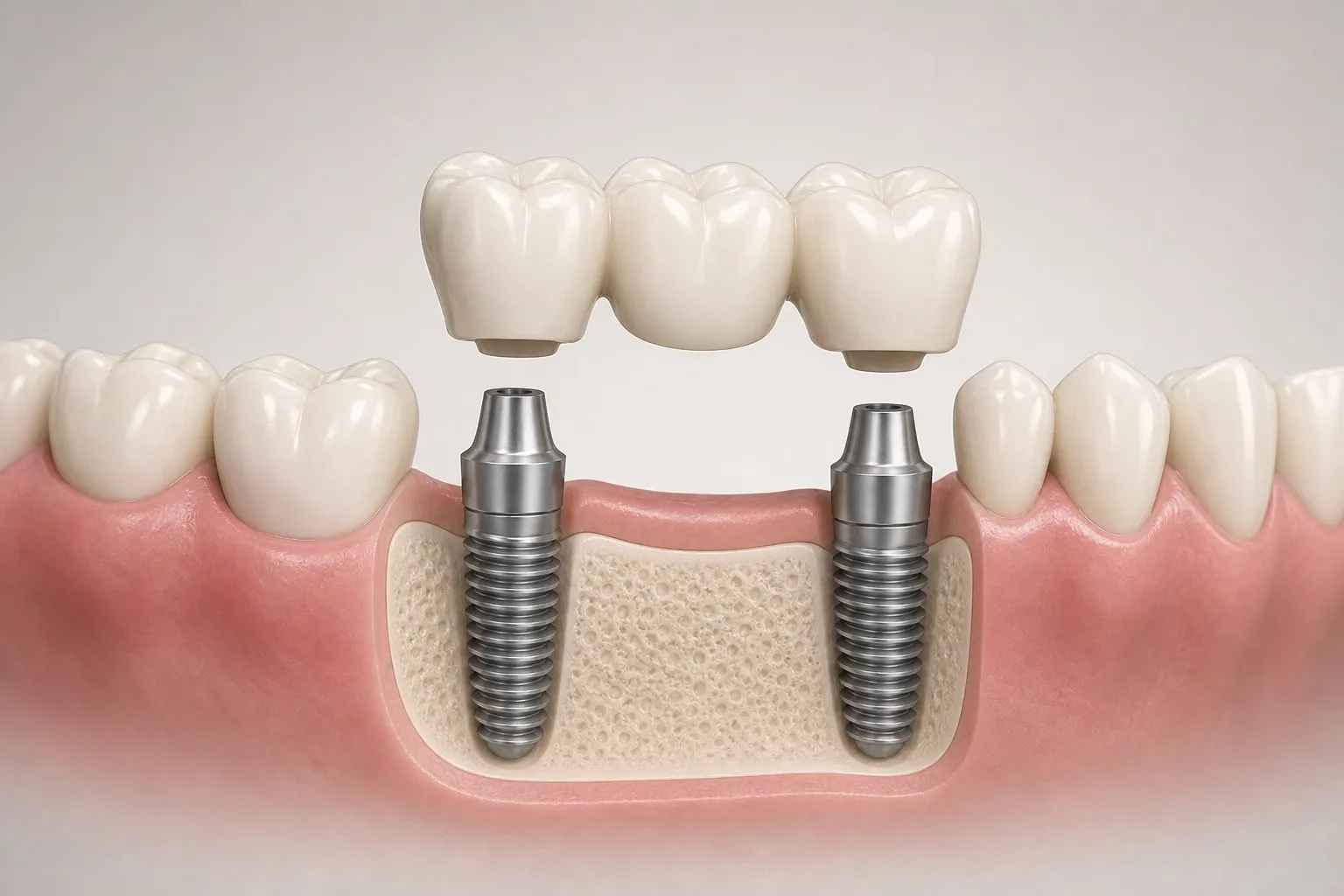

Short answer: the titanium post is built to last decades, and long-term reviews commonly report implant survival above 90% at ten years. The crown on top is a different story — it’s a wear item.
Almost every confusing thing you’ll read about implant lifespan comes from mixing up those two parts. So let’s separate them.
An implant is two things, not one
1. The implant post. A titanium screw placed in your jawbone that fuses with it through a process called osseointegration. Once integrated, it becomes a stable foundation. This is the part designed to last for the long haul.
2. The restoration. The crown, bridge, or full-arch prosthesis on top. It’s exposed to chewing forces, temperature, and wear every single day — like any quality dental restoration, it can chip, wear, or loosen over many years and eventually need replacing.
So when someone says “my implant needed work after twelve years,” they usually mean the crown was replaced. The post underneath was fine.
What the research actually shows
Published long-term studies and systematic reviews consistently report implant survival rates above 90% at the ten-year mark, with many series reporting the mid-90s. Both titanium and zirconia implants report long-term success in a broadly similar range.
Two honest caveats worth knowing:
- “Survival” is not the same as “problem-free.” An implant can survive while still needing maintenance for gum inflammation along the way.
- Averages are not predictions. Your bone quality, health, habits, and hygiene move your individual odds more than any published average does.
We won’t quote a success rate as a promise, because no one can honestly make one.
What actually shortens implant lifespan
Here’s where you have real influence:
Peri-implantitis — the big one. Inflammation and infection of the gum and bone around an implant is the leading cause of late implant failure. It develops quietly, often without pain, which is exactly why it gets missed. It is also largely preventable — see our recovery and aftercare guide.
Smoking. Published research associates smoking with a meaningfully higher failure risk — see smoking and dental implants.
Unmanaged grinding. Clenching and bruxism load the implant and its connections far beyond normal chewing. A nightguard is a small investment that protects a large one.
Skipped maintenance. Professional cleanings catch tissue changes around an implant while they’re still easy to reverse.
Uncontrolled health conditions. Well-managed diabetes is not a barrier; poorly controlled diabetes affects healing and gum health. See dental implants with diabetes.
What helps them last
The routine is refreshingly ordinary:
- Brush twice daily with a soft brush, angling toward the gumline
- Clean between and around implants every day — floss, interdental brushes, or a water flosser
- Keep your professional cleaning schedule
- Wear a nightguard if you grind
- Don’t use your teeth as tools
- Tell us early if anything feels different
That last one matters more than people expect. A crown that has just started to feel slightly loose is a simple fix. Ignored for months, it becomes a bigger one — see failing implants and second opinions.
Comparing the alternatives
Longevity is a real part of the value calculation. Bridges and dentures typically have shorter service lives and, unlike implants, don’t stimulate the jawbone — which is why denture fit changes over time. Our comparisons of implants vs. dentures and single implant vs. bridge lay out the trade-offs.
The bottom line
Implants are among the most durable options in dentistry, and the parts most likely to need attention are the visible ones you can see and we can service. What determines your outcome is mostly daily cleaning, professional maintenance, and addressing habits like grinding and smoking.
Planning for the long term?
We’ll evaluate your bone and gum health and give you an honest picture of what to expect. Request your free consultation or call (949) 773-4170.
This article is general education, not a diagnosis or a guarantee of results. Individual outcomes vary; a personalized evaluation is required to determine what may be right for you.