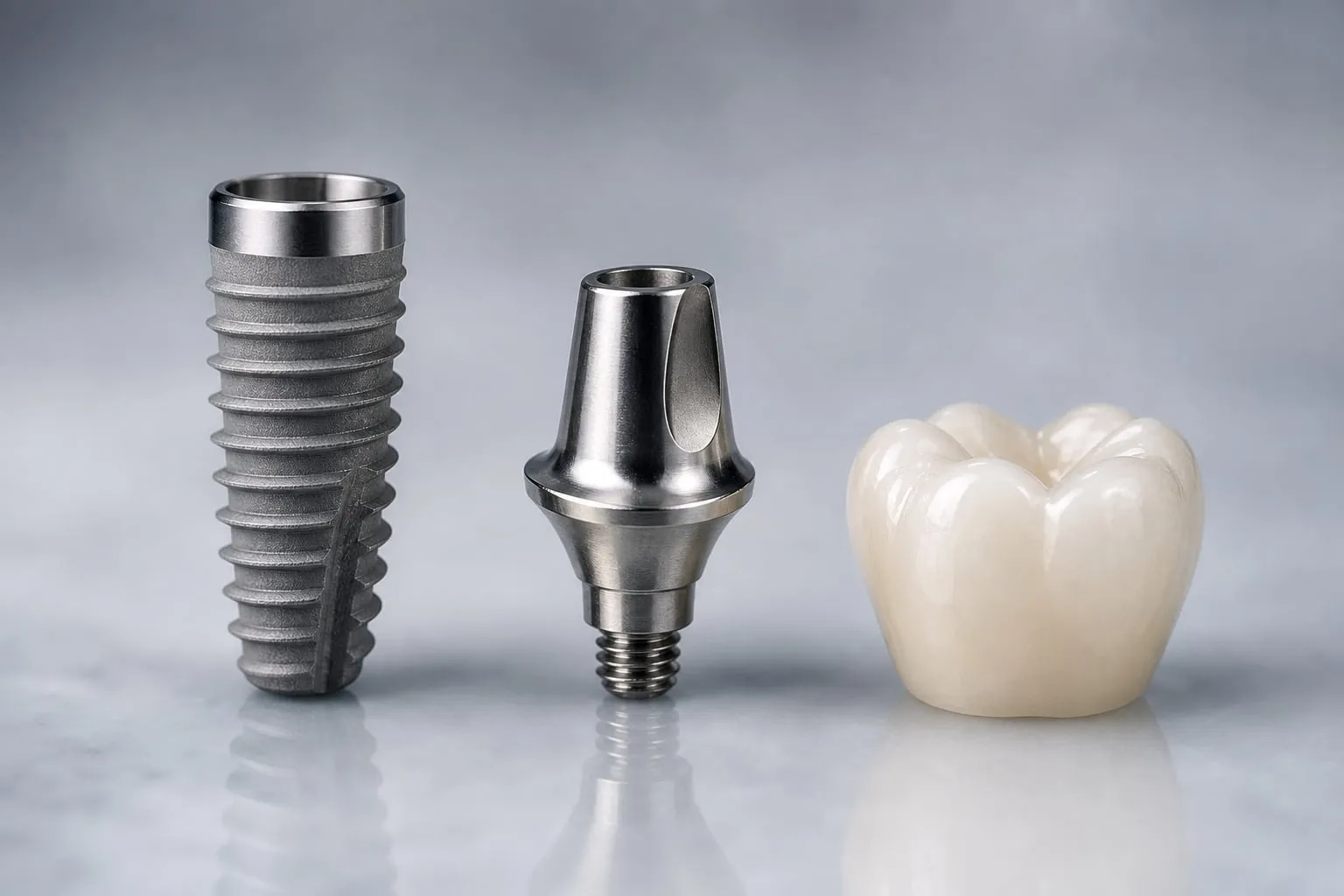
Short answer: titanium has the longest track record and the most flexibility; zirconia is metal-free and tooth-colored. Both report high long-term success — and for most patients, this isn’t the decision that determines their outcome.
Here’s what actually separates them.
Titanium: the established standard
Titanium has been used in implant dentistry for decades and is one of the most studied materials in medicine. It’s what the large long-term datasets are built on.
Strengths:
- The deepest evidence base. Decades of published follow-up, including large multi-year series reporting survival in the mid-90s at ten years.
- Widest component range. More sizes, shapes, and angulations, which matters in constrained or unusual sites.
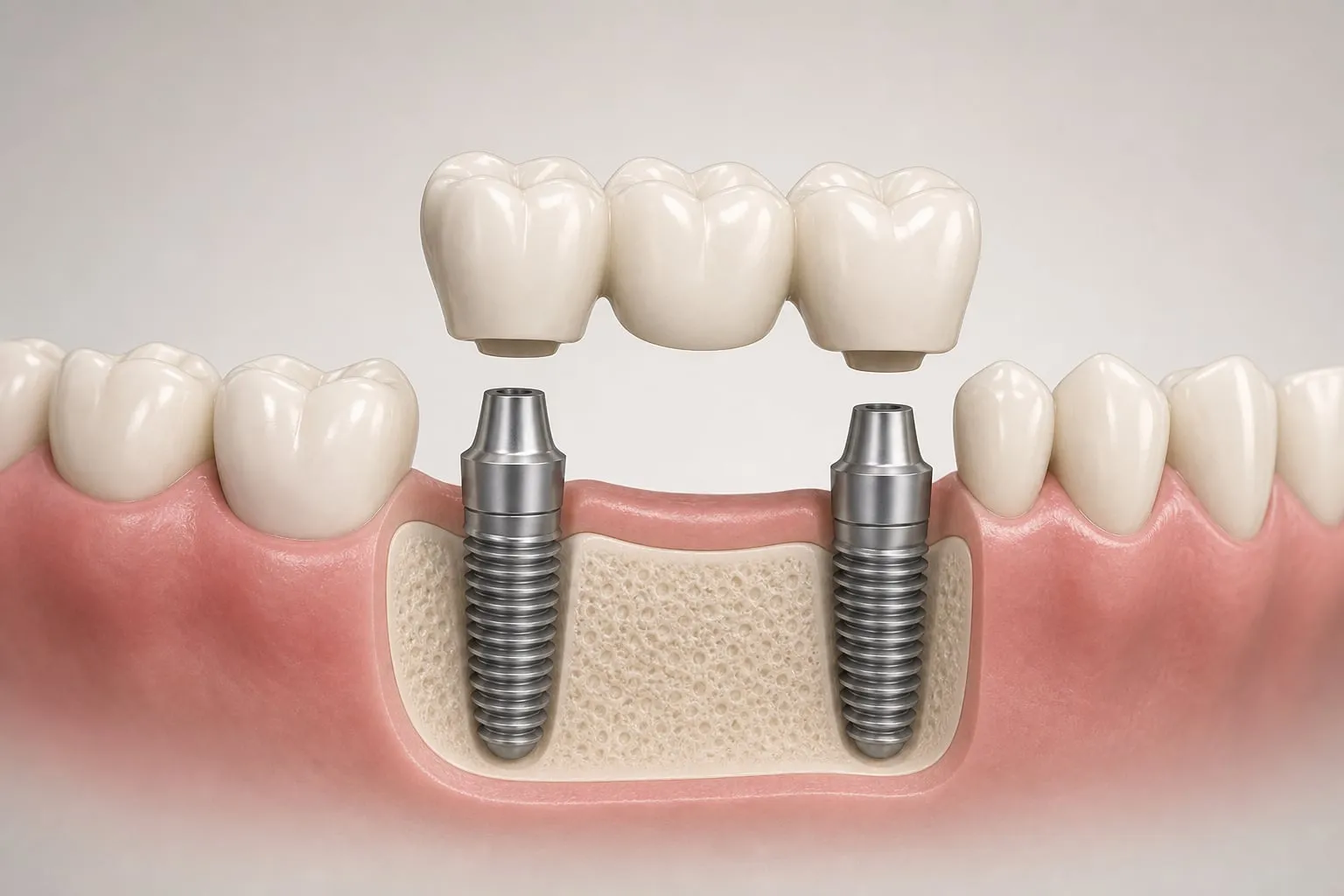
- Two-piece design. The post and abutment are separate, allowing more flexibility in how the restoration is angled and attached.
- Generally lower cost.
Considerations:
- It’s a metal. In patients with very thin gum tissue, a grey shadow can occasionally show through at the gumline — mostly relevant for front teeth.
- Some patients prefer to avoid metal on principle. True titanium allergy is considered rare, but if you have known metal sensitivities, raise it during planning.
Zirconia: the ceramic alternative
Zirconia is a strong, tooth-colored ceramic. It’s newer to implant dentistry than titanium but has been in clinical use for years.
Strengths:
- Metal-free, which some patients specifically want.
- Tooth-colored, so no grey shadow risk through thin gum tissue.
- Smooth surface that some research associates with lower plaque accumulation.
- Often one-piece, meaning no micro-gap between post and abutment.
Considerations:
- Less long-term data — not because results are poor, but because it simply hasn’t been in use as long.
- Fewer components and sizes, which can limit options in difficult sites.
- One-piece design reduces restorative flexibility — the angle is largely determined at placement.
- Generally higher cost.
Side by side
| Titanium | Zirconia | |
|---|---|---|
| Track record | Decades of published data | Shorter, but growing |
| Appearance | Metal; possible grey shadow in thin gums | Tooth-colored |
| Component range | Extensive | More limited |
| Design | Usually two-piece | Often one-piece |
| Cost | Generally lower | Generally higher |
| Reported success | High long-term survival | High, with less long-term data |
What the research says about success rates
Systematic reviews comparing the two report long-term success in a broadly similar range, commonly cited between roughly 92% and 98% depending on the study, the site, and the follow-up period. Titanium’s figures rest on more cases and longer follow-up.
Two honest points about those numbers:
- They’re population averages, not predictions for any individual.
- Material choice is not the main driver of your outcome. Bone quality, gum health, hygiene, smoking, and grinding influence implant longevity far more than titanium versus zirconia does. See how long dental implants last.
When the material choice actually matters
For most posterior implants, it genuinely doesn’t move the needle much. It matters more when:
- The site is highly visible and your gum tissue is thin. Zirconia’s tooth color removes the grey-shadow risk — relevant for front teeth.
- You have documented metal sensitivities or a strong personal preference for metal-free treatment.
- The site is anatomically difficult. Titanium’s broader component range and angulation options can be the deciding practical factor.
- Cost is a binding constraint. Titanium is generally the more economical route.
What we recommend and why
We’ll tell you which material we’d recommend for your specific case and explain the reasoning — the site, your bone, your gum thickness, aesthetic demands, and your preferences all feed into it.
What we won’t do is present one material as universally superior. Anyone who does is describing what they stock, not what the evidence shows.
The bottom line
Titanium is the well-evidenced, flexible, generally more affordable default. Zirconia is a legitimate metal-free option with real advantages in visible sites and for patients who want it. Both are credible; neither is a gimmick.
And the factors that will actually determine how long your implant serves you — cleaning, maintenance, smoking, grinding — sit entirely with what happens after placement.
Questions about which is right for you?
Bring them to a consultation and we’ll walk through the options for your specific case. Request your free consultation or call (949) 773-4170.
This article is general education, not a diagnosis. Individual results vary; a personalized evaluation is required to determine what may be right for you.