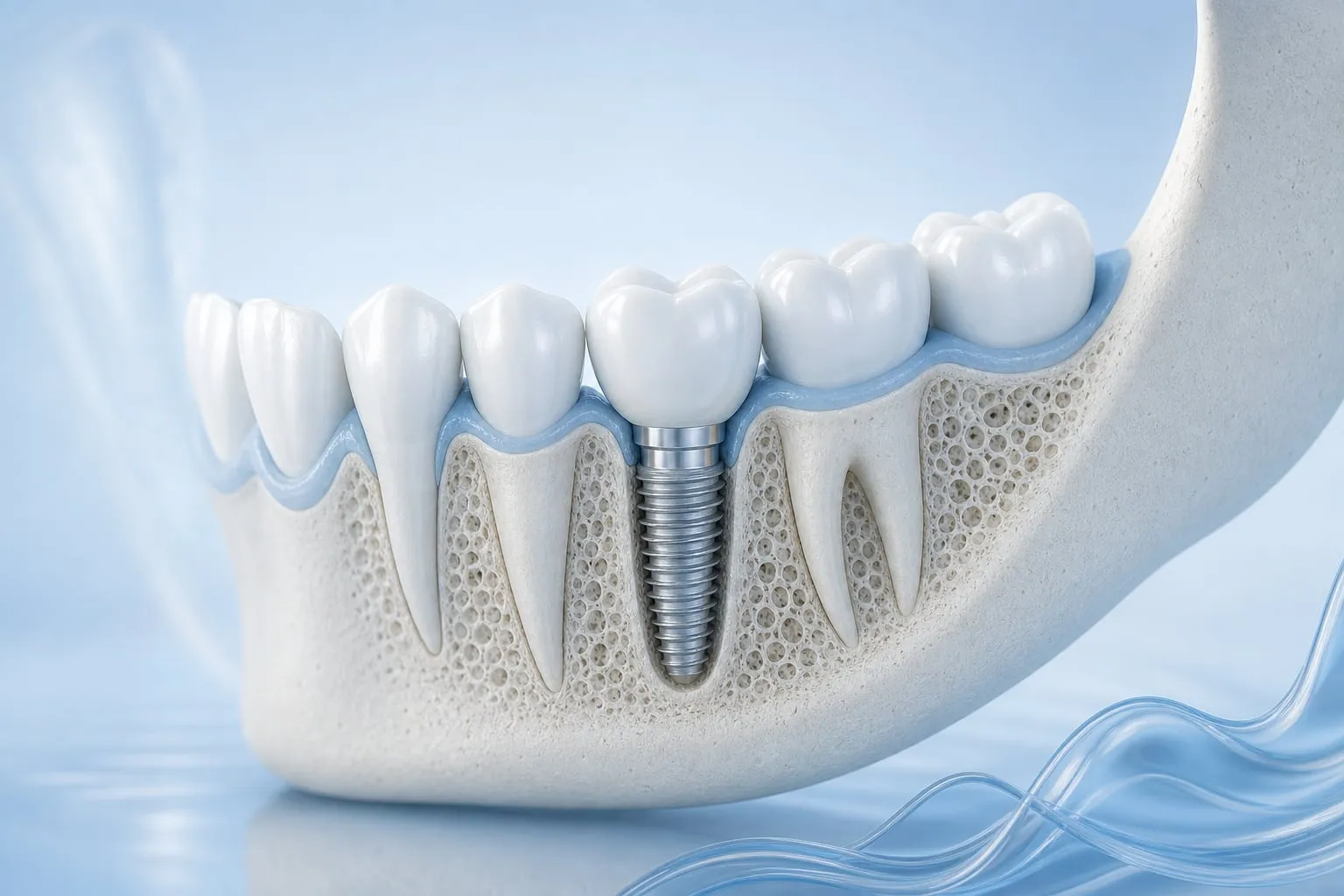
Usually not. A tooth that has been missing for years can often still be replaced with a dental implant, but time changes the site: the jawbone tends to shrink and neighboring teeth can drift. Those changes affect how the implant is planned, and whether a step such as a bone graft comes first, far more often than they rule an implant out.
If you’ve put off replacing a tooth for years, or even decades, you haven’t necessarily missed your window. Here’s what changes over time, how a dentist finds out where you stand, and what the options look like.
What changes when a tooth has been missing for years?
A missing tooth rarely stays a simple gap. Three things tend to happen around it, at a pace that varies a lot from person to person.
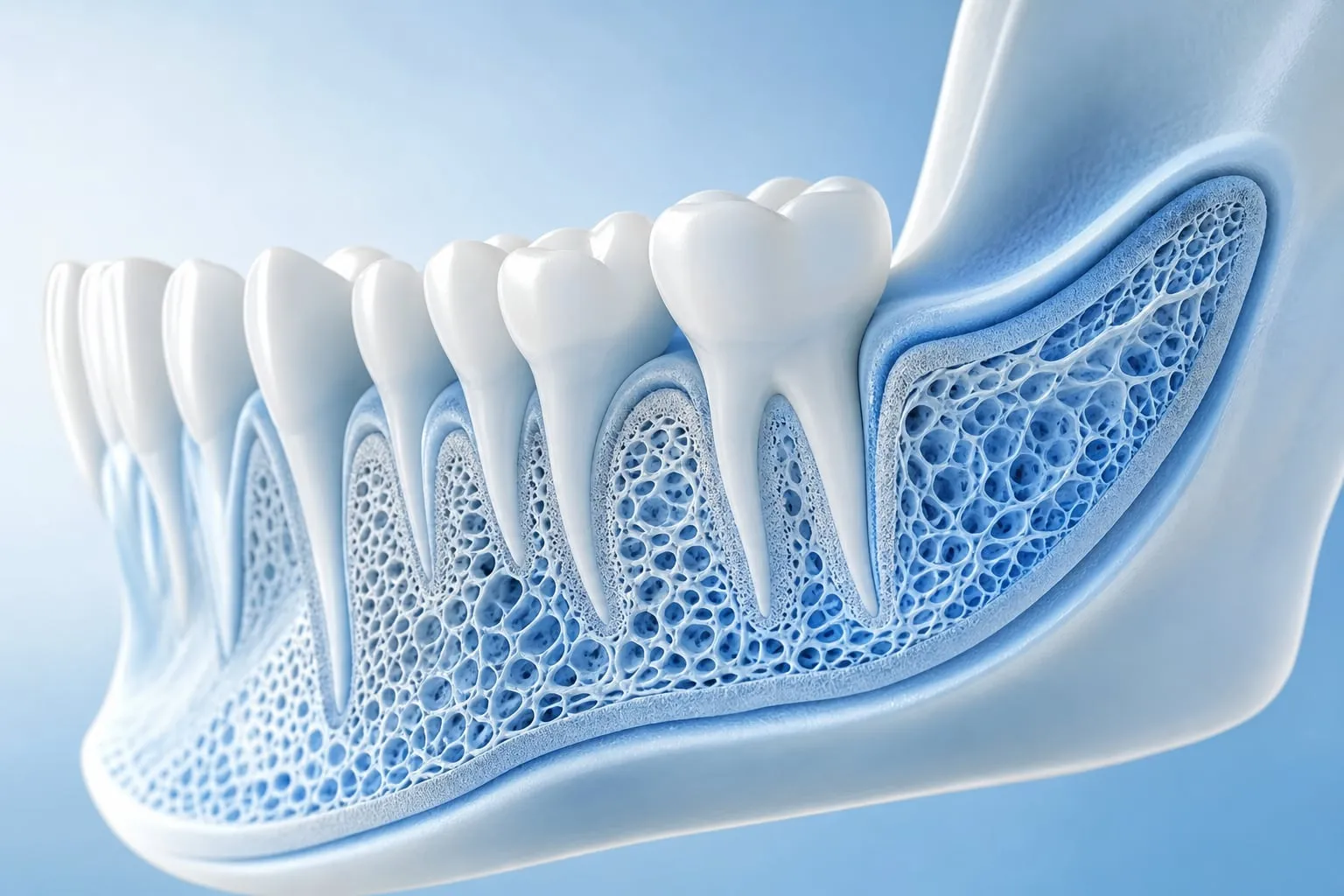
The bone shrinks. Tooth roots stimulate the jawbone when you chew. Without that stimulation, the bone where the root used to be gradually resorbs. Resorption means the body breaks down and reabsorbs bone it no longer needs. The ridge often gets narrower first, then shorter. In the upper back jaw, the sinus above can also expand downward, leaving less bone height beneath it.
Neighboring teeth drift or tip. Teeth are held upright partly by contact with the teeth beside them. Remove one, and the neighbors can lean or slide into the gap, sometimes narrowing it until there’s no longer room for a normal-sized tooth.
The opposing tooth over-erupts. The tooth in the opposite jaw, with nothing to bite against, can slowly grow further out of its socket. Dentists call this over-eruption. It can use up the vertical space a new crown would need.
Our article on what happens if you don’t replace a missing tooth covers these changes in more depth. The key point here: none of them automatically closes the door. They change the plan.
How does a dentist tell if there’s still enough bone?
You can’t judge it in the mirror, and a standard flat X-ray only tells part of the story. It shows roughly how tall the bone is, but not how wide, and width is often what decides whether an implant fits.
That’s why implant planning typically uses a CBCT scan (cone beam computed tomography), a 3D X-ray that captures the jaw as a volume rather than a flat picture. It lets a dentist measure:
- Bone height and width at the exact spot the implant would go
- Bone density, which affects how firmly an implant is held while it heals
- The sinus floor in the upper back jaw
- The nerve canal that runs through the lower jaw
- The roots of neighboring teeth, including any that have tipped toward the gap
We use 3D CBCT imaging to plan implants, and our 3D imaging and implant planning page explains what the scan shows. A plan built on measurements starts from what is actually there, not from what is likely.

What are the options if the bone has thinned?
“Not enough bone” is common in long-standing gaps, and it is often a solvable problem. Depending on what the scan shows, approaches may include:
| What the scan shows | What may help |
|---|---|
| The ridge is too narrow or too short | Bone grafting to rebuild width or height |
| Too little height under the sinus (upper back teeth) | A sinus lift, which raises the sinus membrane and adds bone beneath it |
| Usable bone, but not in the ideal spot | A different implant position, angle, or size planned around the bone you have |
| Many teeth missing in the same arch | A full-arch approach such as All-On-4, which uses angled implants to make use of existing bone |
A bone graft adds bone or bone-substitute material where the jaw is too thin. The body gradually replaces it with its own bone over a healing period. Not everyone with an old gap needs one. Our post on whether you need a bone graft before implants explains how that decision is made, and the bone grafting and sinus lift page covers what the procedures involve.
If you’ve already been told you have bone loss, dental implants with bone loss walks through what that means for candidacy.
Grafting adds time, because the graft usually needs to mature before an implant is placed. It is also quoted separately, so you see it in your written treatment plan before any work begins.
Might I need other treatment first?
Sometimes. A long-standing gap can create issues beyond the bone, and they’re usually addressed before or alongside the implant:
- Space that has closed up. If neighboring teeth have tipped into the gap, there may not be room for a crown that looks and works like a normal tooth. In some cases, orthodontic treatment to reposition those teeth is suggested first; in others, the plan can work around the shift. This varies widely, and your dentist will tell you which applies.
- An over-erupted opposing tooth. That tooth may need to be reshaped or restored so there’s room for the new crown and your bite meets evenly.
- Gum disease. Active gum disease is generally treated and brought under control before implants are placed.
- Other failing teeth nearby. It often makes sense to plan the whole area together rather than one tooth at a time.
None of these is unusual, and none of them means an implant is off the table. They are part of why an exam matters more than the calendar.
Is there ever a point where it really is too late?
The deciding factor is rarely how many years have passed. It’s the combination of bone, gum health, general health, and what you want from treatment.
Some situations do make an implant a harder path. Very limited bone combined with health conditions that affect healing is one example. In cases like that, a bridge or a partial denture may be the more sensible choice, and an honest evaluation should say so.
If you have a medical condition or take medication that affects bone or healing, discuss it with both your dentist and your physician. It rarely ends the conversation, but it does shape the plan.
Why is it still worth asking?
- Bone loss tends to continue. The longer a gap stays empty, the more the site can change. Finding out now keeps more options open.
- The answer may be better than you expect. You may have more bone than you feared, and many people who assumed they’d waited too long still have workable options, sometimes with a graft and sometimes without.
- Finding out costs you nothing. Our consultation is free and comes with no obligation. It includes an exam and imaging, and you leave with a written plan and pricing to consider on your own timeline.
The bottom line
In many cases, it isn’t too late for a dental implant even years after losing a tooth, but a long-empty gap is more likely to need an extra step such as a bone graft, a sinus lift, or attention to shifted teeth. The only way to know is an exam and 3D imaging of the actual site. If you’ve been wondering whether you waited too long, request a free consultation or call (949) 773-4170 to find out where you stand.
This article is general education, not a diagnosis or a substitute for professional dental advice. Discuss your own health history and medications with your dentist and physician. Individual results vary, and only a personalized evaluation can determine whether a dental implant may be an option for you.