
Short answer: gum disease doesn’t disqualify you from implants. Placing implants into active gum disease is what causes problems — so it gets treated first.
This is one of the most common worries we hear, often from people who’ve been told elsewhere that implants aren’t an option for them. Usually that’s not quite what was meant.
Why gum health matters so much for implants
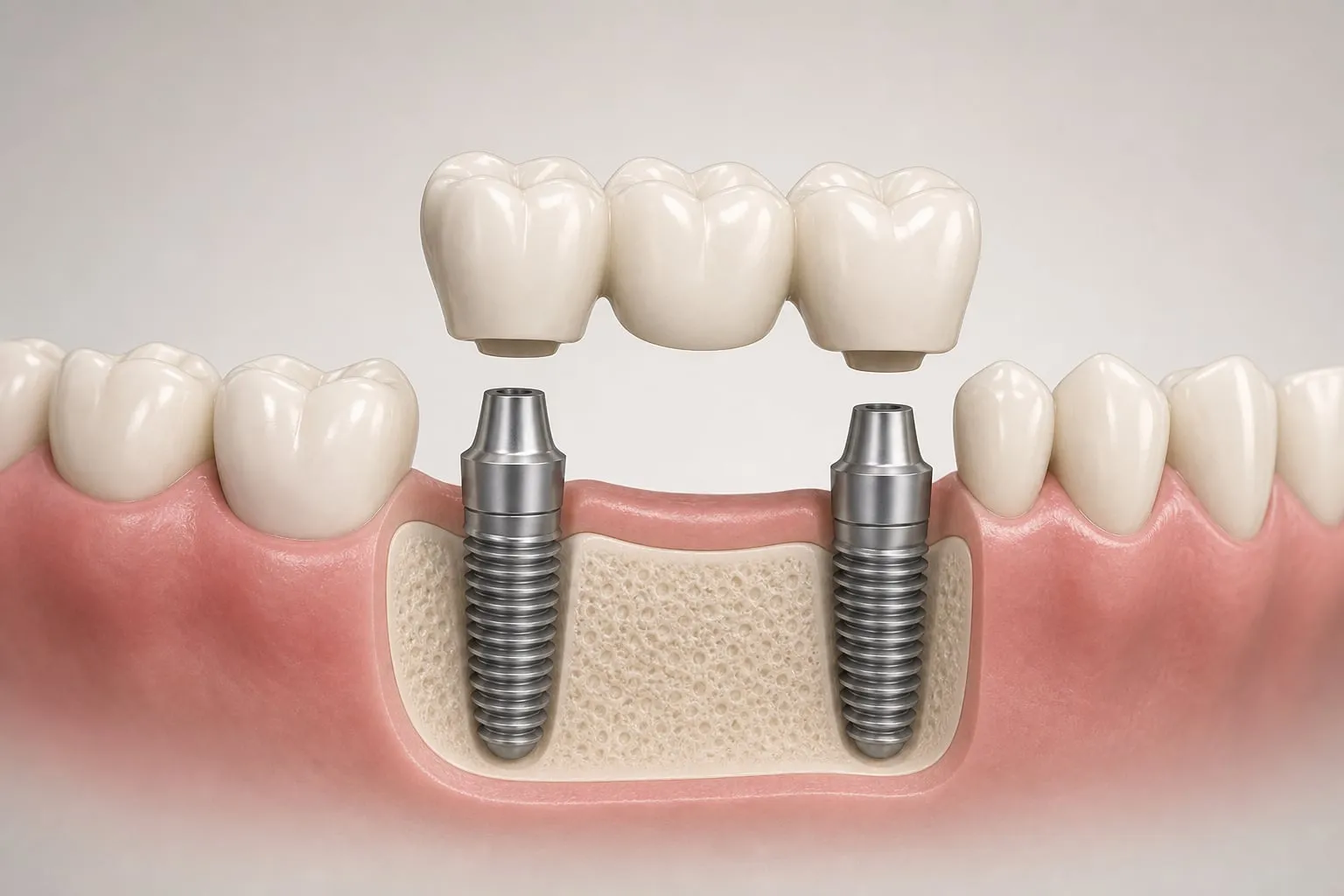
An implant is anchored in bone and surrounded by gum tissue. That tissue is the seal protecting the bone underneath.
Gum disease — periodontitis — is a bacterial inflammatory process that destroys the attachment between teeth and their supporting bone. It’s the leading cause of adult tooth loss, and it’s frequently the reason someone needs an implant in the first place.
Here’s the key point: the same process can affect implants. Around an implant it’s called peri-implantitis, and published research identifies it as the leading cause of late implant failure.
So placing an implant into an environment with active, untreated gum disease means introducing it to the exact bacterial conditions most likely to compromise it.
That’s not a reason to refuse treatment. It’s a reason to sequence it properly.
The usual sequence
1. Assessment. A full periodontal evaluation — pocket depths, bleeding, bone levels on imaging — establishes what you’re actually dealing with.
2. Treatment. Depending on severity, this may involve deep cleaning below the gumline, localized treatment, and in more advanced cases periodontal surgery. Hopeless teeth may be removed at this stage.
3. Re-evaluation. After healing, the tissue is reassessed. Have the pockets reduced? Has bleeding resolved? Is it stable?
4. Planning. Once tissue is stable, implant planning proceeds with imaging to assess remaining bone — gum disease often means bone loss, so grafting is sometimes part of the plan.
5. Placement and maintenance. After placement, the maintenance schedule matters more for you than for the average patient.
Realistically this adds months. It also substantially improves the foundation you’re building on.
”But my teeth are already loose — isn’t it too late?”
Often the opposite. Patients with advanced gum disease and failing teeth are frequently good candidates for implant treatment, because implants don’t depend on the periodontal attachment that gum disease destroys.
For patients losing most of an arch, All-On-4 or full-mouth implants may be appropriate — replacing compromised teeth with a solution anchored directly in bone.
What matters is treating the infection first so the bone you’re anchoring into is healthy.
Your risk profile afterward
Being honest about this: a history of periodontitis is associated in published research with a higher risk of peri-implantitis. It doesn’t mean your implant will fail. It means you’re in a group where maintenance genuinely matters.
Practically:
- More frequent professional maintenance — many patients with periodontal history are seen more often than the standard interval
- Meticulous daily cleaning — see how to clean implant-supported teeth
- Not smoking — it compounds both risks, see smoking and dental implants
- Managing related health conditions such as diabetes
- Reporting changes early — bleeding or tenderness around an implant is worth a call, not a wait
Patients who take maintenance seriously do well. That’s within your control.
Early warning signs around an implant
- Bleeding when brushing near the implant
- Redness, swelling, or tenderness at the gumline
- Gum recession exposing metal
- A bad taste or persistent bad breath
- Any looseness — see why an implant feels loose
Caught early, inflammation around an implant is far more manageable than once bone has been lost.
If you’ve been told implants aren’t possible
It’s worth understanding whether that meant not possible, or not until the gum disease is treated. Those are very different statements, and the second one is far more common.
A second opinion with fresh imaging will tell you which it was — see failing implants and second opinions.
Let’s assess where you stand
We’ll evaluate your gum and bone health and give you a straight answer about what’s realistic and in what order. Request your free consultation or call (949) 773-4170.
This article is general education, not a diagnosis. Individual results vary; a personalized evaluation is required to determine what may be right for you.