
Once it has healed, a dental implant typically feels firm, stable, and much like a natural tooth, and many people stop noticing which tooth it is. During placement the area is numbed, so patients usually feel pressure rather than pain, followed by a few days of soreness. The main difference from a natural tooth is subtle: an implant senses pressure through the bone instead of through a cushioning ligament, so the feedback is a little less finely tuned.
Here’s what to expect at each stage, why an implant feels the way it does, and which sensations are worth a phone call.
What does implant placement feel like?
Before anything begins, the treatment area is fully numbed with local anesthesia, medication that blocks pain signals from that part of your mouth. A topical numbing gel is usually placed first to dull the injection, which for many patients is the most uncomfortable moment of the appointment, and it lasts seconds.
Once you’re numb, what patients consistently describe is pressure and movement, not pain. You may notice vibration and sound, and a sense that something is happening, without it hurting. If you feel anything sharp, say so, and more anesthetic can be given.
Sedation options are available where appropriate for patients who feel anxious. For a fuller account of comfort during and after surgery, read do dental implants hurt?
What does it feel like while the implant heals?
The first few days. As the anesthetic wears off over a few hours, you’ll feel the site. Expect soreness, swelling, and sometimes bruising. These typically peak within the first couple of days and then ease, and most patients manage with the medication and instructions they’re given.
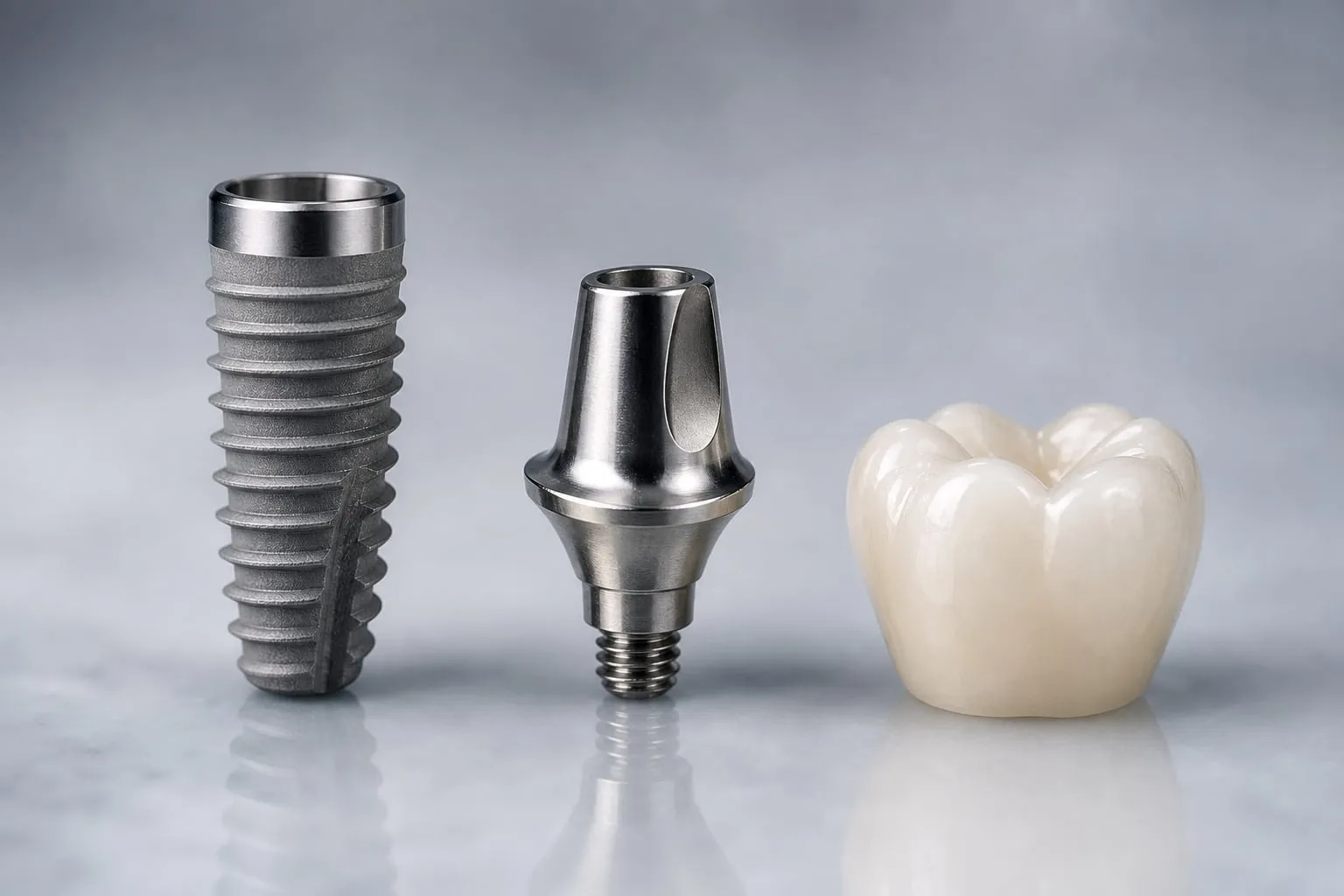
The following weeks. Tenderness fades, and the site becomes something you’re aware of rather than something that hurts. You may feel a small healing cap, a smooth cover that sits on the implant at the gumline, with your tongue. It often feels odd for a few days and then stops registering.
Integration. Over the next several weeks to a few months, bone grows onto and bonds with the implant surface, a process called osseointegration. This typically isn’t something you feel at all. It’s a quiet process. Our recovery and aftercare guide covers this stage in more detail.
How does a finished implant feel when you chew and talk?
Once your final crown is in place, most people describe the implant as solid. It doesn’t flex or slide the way a removable denture can, and you can generally bite and chew normally once your dentist clears you to.
A few things are common early on:
- The crown feels new. Your tongue notices any new shape, and that usually fades within days to weeks.
- Your bite may feel slightly different. If it feels high or uneven, tell your dentist. A small adjustment usually fixes it.
- Speech is rarely affected by a single implant. Larger restorations, such as a full arch, often involve a longer adjustment period for both speech and chewing. See eating and speaking with new implants.

Why does an implant feel different from a natural tooth?
This is the biological part, and it explains almost everything people notice.
A natural tooth doesn’t touch the bone directly. Its root sits in a periodontal ligament, a thin layer of fibers between the root and the bone that works like a shock absorber and a sensor. It’s rich in nerve endings that tell your brain how hard you’re biting and exactly where, and it lets the tooth move very slightly under pressure.
An implant has no periodontal ligament. It bonds directly to the bone. In practice, that means:
- You still feel pressure, transmitted through the bone, the jaw, and the surrounding tissues. Some researchers call this “osseoperception.”
- Fine feedback is reduced. You may not detect a tiny seed or a slightly heavy bite as precisely as you would with a natural tooth.
- You may bite harder at first than you intend, until your brain recalibrates. That awareness generally improves with experience.
- The implant doesn’t give under load the way a natural tooth subtly does.
| Natural tooth | Healed dental implant | |
|---|---|---|
| Held in place by | Periodontal ligament | Direct bond with the bone |
| Pressure sensation | Fine-tuned, through the ligament | Present, through bone and tissue, but less precise |
| Nerve inside | Yes (the pulp) | No |
| Hot and cold sensitivity | Can develop | Not in the implant itself |
| Slight movement when biting | Yes | No |
Do dental implants get sensitive to hot and cold?
Not in the way natural teeth do. Sensitivity in a natural tooth usually comes from the nerve inside it reacting through worn or exposed layers of the tooth. An implant and its crown have no nerve inside them, so they don’t develop that kind of sensitivity.
If you feel sensitivity near an implant, it’s usually coming from somewhere else, such as a neighboring natural tooth, an exposed root, or inflamed gum tissue around the implant. That’s worth having checked rather than ignored.
What’s not normal, and when should I call?
A healed implant should feel comfortable and solid. Contact your dentist promptly if you notice:
- Any looseness or movement of the implant or the crown
- Pain that worsens after the first few days instead of improving, or new pain in a healed implant
- Pain or tenderness when biting on the implant
- Bleeding, swelling, or redness around the implant, or gums pulling back to show metal
- A bad taste or discharge from around the implant
- Numbness or tingling in the lip or chin that hasn’t faded as expected
- A bite that suddenly feels off
Sometimes the cause is simple, such as a loose crown or screw. Sometimes it’s inflammation in the gum and bone around the implant, which is generally easier to manage when caught early. Our page on failing dental implants explains the warning signs and what an evaluation involves.
The bottom line
Placement is numbed, healing involves a few sore days, and a finished implant typically feels solid and natural enough that many people forget which tooth it is. The difference from a natural tooth is real but subtle: pressure comes through the bone rather than a cushioning ligament, and the implant itself doesn’t become temperature-sensitive. Anything that hurts, moves, or bleeds after healing deserves a prompt look, and if you’d like to know what to expect in your own case, request a free consultation or call (949) 773-4170.
This article is general education, not medical advice, and describes typical experiences rather than promising a specific outcome. Individual experiences vary, so discuss your own situation with your dentist.