
Dental implants don’t reshape your face the way cosmetic surgery does. What they can do is help maintain the jawbone they’re placed in, and full-arch implant teeth are designed to give the lips and cheeks the support that missing teeth or a worn-out denture may no longer provide. How much difference that makes varies from person to person.
If you’ve noticed your lips looking thinner or the area around your mouth looking more sunken since losing teeth, you’re not imagining a connection. Here’s what’s going on underneath, what implants can realistically help with, and where their limits are.
Why can missing teeth change how your face looks?
Your teeth and the bone that holds them act as scaffolding behind your lips and cheeks. When that scaffolding shrinks, the soft tissue in front of it has less to rest on.
The shrinking happens through bone resorption: the gradual loss of jawbone volume after teeth are gone. Tooth roots stimulate the surrounding bone every time you chew. Once a root is lost, that stimulation stops, and the bone in that area tends to narrow and flatten over time. Our article on what happens if you don’t replace a missing tooth walks through the process.
One missing back tooth rarely changes how a face looks. When many teeth are missing, especially at the front or across a whole arch, some people notice:
- Lips that look thinner or seem to fold inward
- Deeper lines around the mouth
- Less fullness in the cheeks
- A lower face that looks shorter, with the chin and nose seeming closer together
These changes vary widely. Aging, sun exposure, weight changes, and genetics all shape the face too, so not every change around the mouth comes from the teeth.
Do dentures change your face over time?
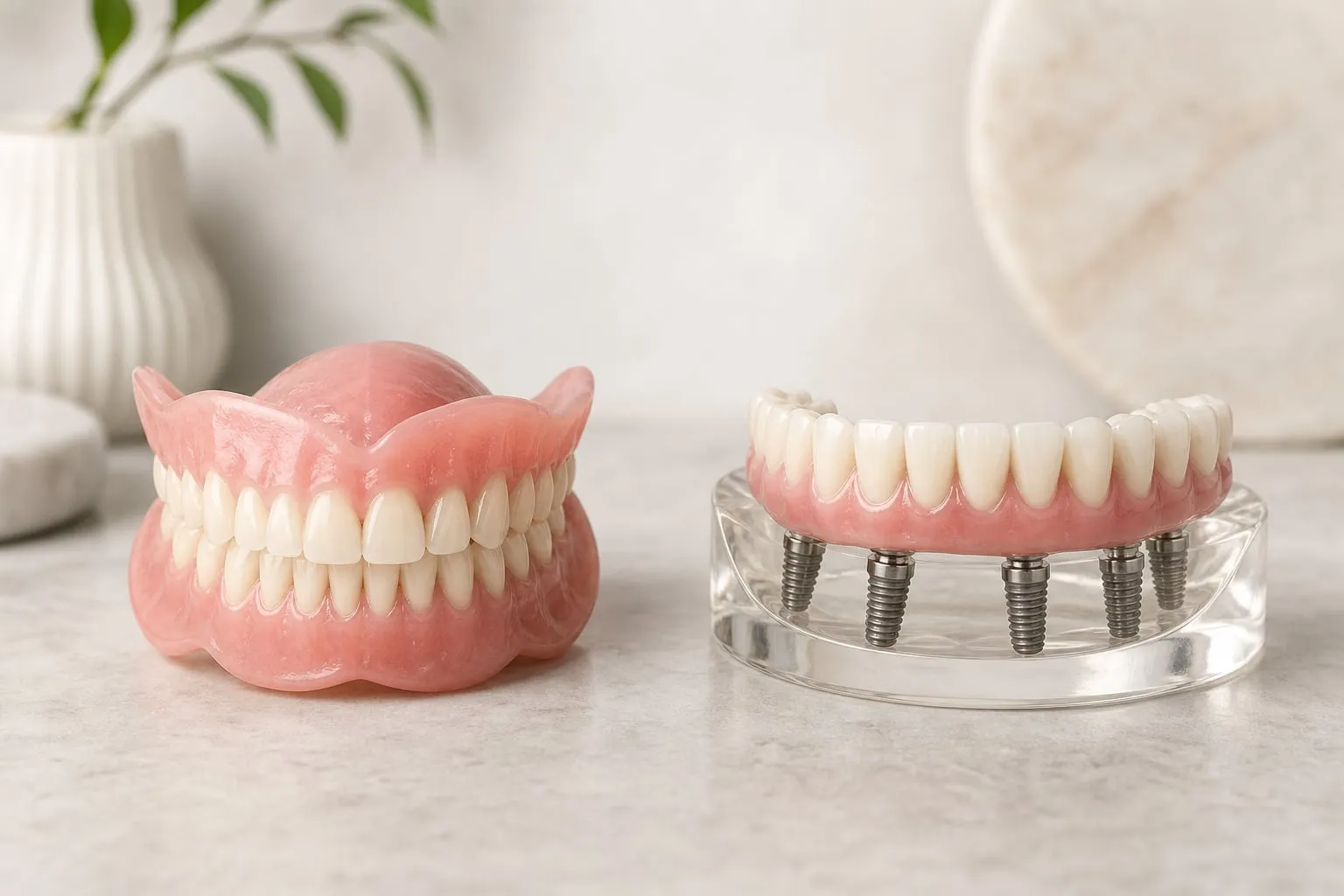
A conventional denture rests on the gums rather than being anchored in the bone, so it doesn’t provide the stimulation a root does. The ridge underneath can keep changing shape, which is why dentures that fit well at first often loosen over the years.
Two things can affect appearance as that happens:
- Lost lip support. As the ridge shrinks, a denture can sit differently against the lips and cheeks.
- Lost bite height. Dentists call the distance between your upper and lower jaws when your teeth meet the vertical dimension. Worn denture teeth or a sinking denture can let the jaws close further than they used to, which some people notice as a collapsed look around the mouth.
If your denture slips, rubs, or needs more adhesive than it used to, our guide on what to do when dentures no longer fit explains the options, from relining to implant-secured teeth.
How can dental implants help support your face?
Implants can help in two separate ways, and it’s worth keeping them apart.
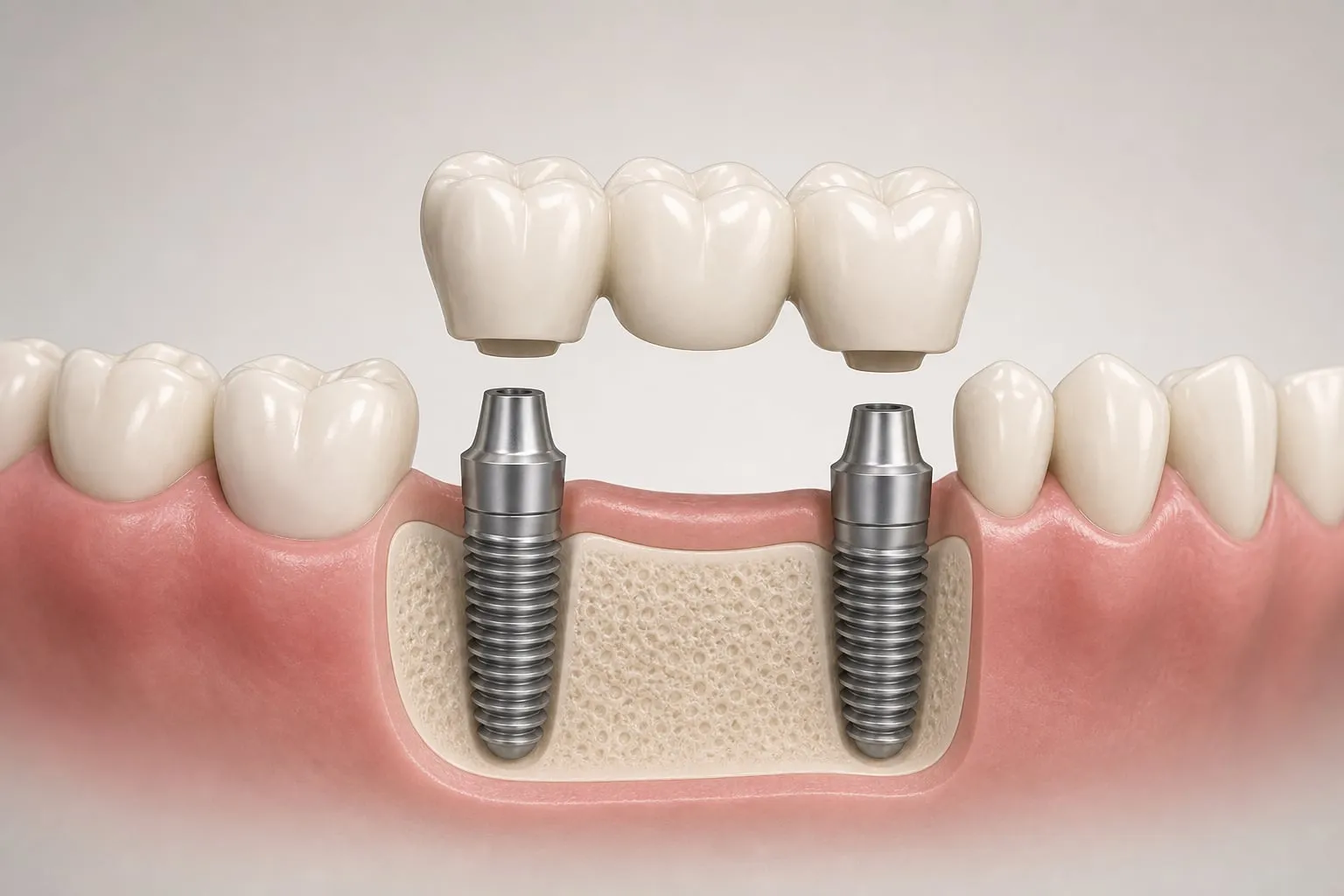
They can help maintain the bone they’re placed in. An implant sits in the jawbone much like a root and passes chewing forces into it. That can help preserve the bone around the implant, which a denture resting on the gums doesn’t do. Bone elsewhere in the jaw, away from the implants, doesn’t get the same benefit.
Full-arch teeth are designed to support the lips. When a whole arch is replaced, the new teeth are planned for position, length, and how far forward they sit, and many designs include a gum-colored section that fills out the area where bone and gum have been lost. Together, these are designed to restore lip support and a comfortable bite height. Our page on full mouth dental implants explains the fixed and removable options.
| No replacement | Conventional denture | Implant-supported teeth | |
|---|---|---|---|
| Stimulates the jawbone | No, not where teeth are missing | No, it rests on the gums | Yes, around each implant |
| Lip and cheek support | Reduced where teeth are missing | Provided by the denture, but can change as the ridge shrinks | Designed into the shape of the teeth and any gum-colored section |
| Over time | Bone at the gap typically resorbs | Fit often loosens and may need relines | Bone around the implants can be maintained with good care and checkups |
Will dental implants make me look younger?
This is where expectations matter most. Implants are not a facelift, and they don’t tighten skin, smooth wrinkles, or reverse the other effects of aging.
What well-planned replacement teeth can do is restore some of the support that missing teeth or a worn denture took away. For some people, that change around the mouth is noticeable. For others, especially those replacing one or a few teeth, the difference is mostly in how they chew and smile rather than how their face looks at rest.
A few honest points:
- Results vary. Bone, gum tissue, lip thickness, and facial structure differ from person to person.
- More isn’t better. Teeth pushed too far forward to fill out the lips can look and feel unnatural. Good planning aims for balance, not maximum fullness.
- Implants don’t regrow lost bone. If bone has already resorbed, a graft may be needed at an implant site, and some changes may not be fully reversible. See dental implants with bone loss.
Our smile gallery shows before-and-after photos of actual patients. Each one shows what was achieved for one person, not a prediction of your result.
What does a dentist look at when planning for facial support?
If the appearance of your mouth and lips is part of why you’re considering implants, say so at the start. A dentist planning replacement teeth will typically consider:
- Bone volume and shape, measured with imaging such as a 3D CBCT scan
- Bite height, and whether it has decreased
- Lip support at rest and when smiling
- How much tooth shows when your lips are relaxed and when you smile
- Your current denture, if you wear one, including what you like and dislike about how it looks
- Your goals, in your own words
From there, the dentist can explain which option may suit you, from a single implant to a full arch, and what kind of change is realistic for your situation.
The bottom line
Implants won’t reshape your face, but they can help maintain the bone they’re placed in, and full-arch implant teeth are designed to support lips and cheeks that missing teeth or a loose denture leave unsupported. How much that changes your appearance depends on your bone, your tissues, and your treatment plan. The way to find out what’s realistic for you is a personal evaluation with imaging. See what happens at your first visit, or request a free consultation and call (949) 773-4170 with any questions.
This article is general education, not a diagnosis or a substitute for professional dental advice. Individual results vary, and only a personalized evaluation can determine what may be appropriate for you.