Short answer: plenty of overseas clinics do genuinely excellent work. The real risks aren’t about skill — they’re structural.
We’re not going to tell you that dental care abroad is dangerous. That would be both unfair and untrue. Many international clinics are modern, well-equipped, and staffed by highly trained clinicians, and the price difference can be substantial enough that dismissing it outright would be disingenuous.
But there are specific things worth thinking through before you book, and they’re mostly not about the quality of the dentistry.
Why the price is lower
Mostly labor costs, overheads, real estate, and regulatory environment. These are real economic differences, not evidence of corner-cutting.
What varies more is what’s included. A quoted price may or may not cover imaging, extractions, grafting, the abutment, the final crown, follow-up visits, or travel between stages. Get it itemized before comparing.
The timeline problem
This is the most substantive concern.
Implants need bone to fuse to them — osseointegration — and that takes months. It cannot be compressed by scheduling.
Clinics advertising a complete implant journey in a single trip are working around that biology somehow: either with immediate loading (appropriate in some cases, not all), or by fitting a final restoration before integration is confirmed, or by expecting you to return for a second trip.
Ask directly: how many trips, how far apart, and what happens between them. If the answer is one trip for a full-arch case, ask specifically how integration is confirmed before the final prosthesis goes on.
We don’t offer same-day teeth ourselves for exactly this reason — see how long All-On-4 healing takes.
Follow-up is the practical issue
Implant treatment isn’t a single event. It involves healing checks, adjustments, and long-term maintenance.
Once you’re home, your treating clinician is thousands of miles away. If a crown loosens, the bite needs adjusting, or you develop peri-implantitis — the leading cause of late implant failure — you need local care.
That’s usually arrangeable, but it means paying locally for work related to treatment you already paid for abroad, which changes the total.
The component question
This one is underappreciated and genuinely important.
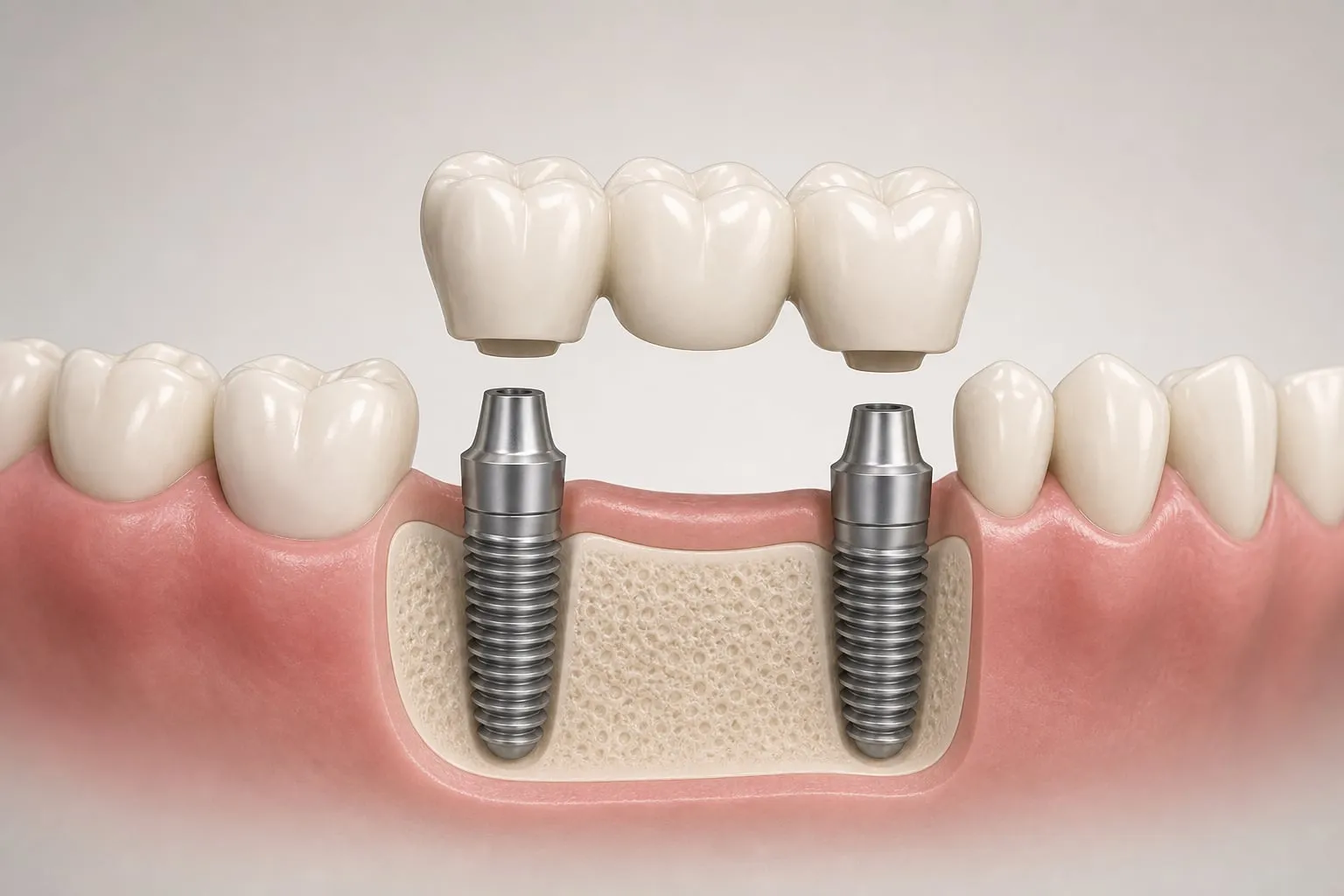
Implants aren’t universal. Each system has its own abutments, screws, and connections. If you need servicing years later, your local dentist needs matching components.
If the system used isn’t widely distributed in the US, sourcing parts can be difficult — occasionally to the point where a restoration is impractical to service and has to be redone.
Before treatment, ask for:
- The exact implant system and model, in writing
- Documentation of what was placed and where
- Copies of your imaging
- Whether the system is distributed in the US
Any reputable clinic will provide this without hesitation. Reluctance is informative.
Other practical considerations
Flying after oral surgery. Ask about recommended waiting times before flying, particularly for procedures involving the sinus.
Recourse. Consumer protection and malpractice frameworks differ by country, and cross-border claims are difficult in practice.
Complications away from home. If something needs attention while you’re still traveling, you’re managing it in an unfamiliar healthcare system.
Total cost. Flights, accommodation, time off work, and possible return trips all belong in the comparison — as does any local follow-up you end up paying for.
Questions to ask an overseas clinic
- Exactly what is included in the quoted price?
- What implant system do you use, and is it distributed in the US?
- How many trips, and how far apart?
- How is bone integration confirmed before the final restoration?
- Will I receive full records and imaging?
- What is your policy if a complication occurs after I return home?
- Who performs the surgery, and what is their training?
These are the same questions worth asking any implant provider.
Making the comparison fairly
If cost is what’s driving you to look abroad — and for many people it genuinely is — it’s worth getting a local written quote first, so you’re comparing real numbers rather than a headline figure against an assumption.
It’s also worth asking about financing, HSA/FSA funds, and phased treatment locally. Sometimes the gap is smaller than expected once travel and follow-up are counted.
Our own pricing starts at $1,995 for a single implant including consultation, surgery, and crown. Pricing may vary based on individual needs — contact the office for a personalized estimate.
If you’ve already had treatment abroad
Bring your records and imaging and we’ll evaluate what you have. Sometimes everything is fine and you just need local maintenance. Sometimes there’s an issue worth addressing. Either way you’ll get a straight assessment — see failing implants and second opinions.
Want a local number to compare against?
Get a written plan and cost with no obligation, and take it wherever you like. Request your free consultation or call (949) 773-4170.
This article is general education, not a diagnosis or a recommendation for or against treatment in any particular country. Individual results vary; a personalized evaluation is required to determine what may be right for you.