
If you’re planning to whiten your teeth, it’s commonly done before your implant crown’s shade is chosen. Crowns made from ceramic or zirconia don’t change color with whitening, so a crown matched to your current shade will stay that shade even if the teeth around it get lighter. Many dentists also prefer to let whitened teeth settle before matching the crown, so ask yours how they handle the timing.
Here’s why the order matters, what happens if you whiten later, and how to keep everything looking consistent.
Why don’t implant crowns whiten?
Whitening products work on natural teeth. Their active ingredient, usually a form of peroxide, moves into the enamel and the layer beneath it, called dentin, and breaks down the compounds that cause stains.
Implant crowns are different. They’re commonly made from zirconia, glass-ceramics, or porcelain, and they get their color when the crown is made. Whitening gel doesn’t change that color, so the crown stays the shade it was made in. The same is generally true of veneers, crowns on natural teeth, and tooth-colored fillings or bonding.
In other words, whitening changes your natural teeth and nothing else. Our guide to implant crown materials explains how those materials differ.
When is an implant crown’s shade chosen?
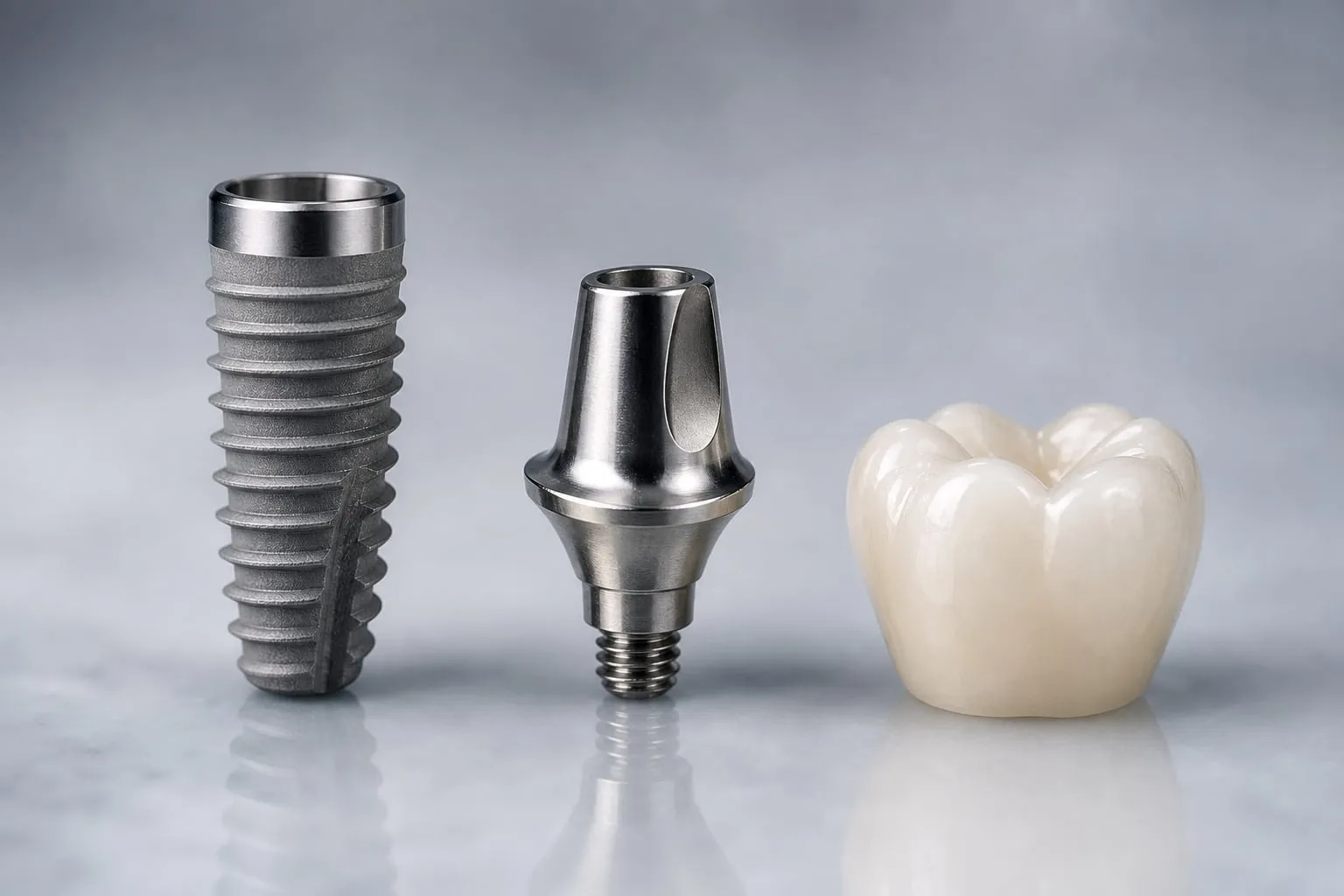
Later than many people expect. An implant tooth is built in stages, and the crown comes last. First the implant is placed and the bone bonds to it, which typically takes several weeks to a few months. Then the abutment (the connector that rises through the gum) and the crown are made. Our article on the parts of a dental implant shows how they fit together.
Shade matching, choosing a crown color that blends with your surrounding teeth, usually happens at that final stage. It typically involves comparing your teeth against a shade guide, often in natural light, and sending photos and notes to the lab.
That timing can work in your favor. The healing months give you room to decide about whitening, and to ask your dentist whether and when to do it, before the crown’s color is locked in.
What’s a typical order of steps?
If you’d like whiter teeth and an implant crown, a common sequence looks like this. Your dentist will adjust it to your situation.
- Mention it early. Bring up whitening at your consultation or during planning, so it’s part of the plan rather than an afterthought.
- Check that whitening suits you. It isn’t right for everyone. Decay, gum problems, exposed roots, or sensitive teeth may need attention first, and some stains respond poorly to whitening.
- Ask about timing around the surgical site. Whitening gel can irritate gum tissue. Your dentist may want the implant site healed before trays or gel are used near it.
- Whiten to the shade you want.
- Let the shade settle. Teeth can look a little lighter right after whitening than they will a while later. Many dentists prefer to match the crown once the color has stabilized. Ask how long yours recommends waiting.
- Match the crown to your new shade.
What if you whiten after the crown is made?
Then your natural teeth may get lighter while the crown stays the same. On a back tooth, a small difference may hardly show. On a front tooth, it can be obvious. Our article on front tooth implants explains why matching a single front crown is so demanding.
If your crown is already in place, options to discuss with your dentist include:
- Whitening conservatively, so your natural teeth stay close to the crown’s shade
- Replacing the crown to match. Because an implant tooth is built from separate parts, the crown can usually be replaced without disturbing a healthy implant. It’s an added cost, so weigh it before you start whitening.
- Skipping whitening, if your current match already looks natural to you
The key is to ask before you whiten, not after.
How do natural teeth and restorations compare?
| Natural teeth | Implant crown (ceramic or zirconia) | Veneers, other crowns, bonding | |
|---|---|---|---|
| Lightens with whitening? | Yes, to varying degrees | No | Generally no |
| Can darken over time? | Yes, with age and with coffee, tea, wine, or tobacco | Generally holds its color; surface stain can build up and is usually polished off at cleanings | Varies by material; bonding may stain more readily than ceramic |
| Keeping it bright | Daily brushing, cleanings, and touch-ups if your dentist advises | Daily cleaning around the implant and routine professional cleanings | Daily brushing and cleanings; ask before using whitening products |
General comparison for education only. Materials and products vary, and your dentist can advise on your own teeth and restorations.
What if you have crowns or veneers on other teeth?
Whitening affects them the same way: it doesn’t. If you already have crowns, veneers, or bonding on teeth near the implant, whitening your natural teeth could leave several restorations darker than their neighbors, not just the implant crown.
In that case, it helps to plan the whole smile together. Useful questions include:
- Should the implant crown match my natural teeth, my existing restorations, or a new shade?
- Would whitening mean replacing older restorations to match, and is that worth it to me?
- What result is realistic for my teeth?
How do you care for whitened teeth and an implant crown?
- Brush twice a day and clean between your teeth daily, paying attention to where the implant crown meets the gum.
- Use a non-abrasive toothpaste. Some whitening toothpastes are abrasive and can scratch restorations. Ask your hygienist which to use.
- Keep routine cleanings and checkups. Professional cleanings remove surface stain from both teeth and crowns.
- Rinse with water after coffee, tea, or red wine to help your natural teeth keep matching the crown.
- Check before touch-ups. Natural teeth can gradually darken again over time, so occasional touch-ups may help keep them near the crown’s shade. Ask your dentist first so you don’t overshoot it.
Talking it through at your consultation
At our office, a single implant is completed with a custom crown that is shade-matched once the implant has integrated with the bone. If whitening is on your mind, mention it at your consultation so the timing can be discussed as part of your plan. On our team, Dr. Khashayar Etemadi lists cosmetic dentistry among his areas of practice. You can read more about how a single tooth implant is planned from start to finish.
The bottom line
Implant crowns don’t change color with whitening, so if you want whiter teeth, it’s commonly done before your crown’s shade is chosen, often with time allowed for the new shade to settle. Whitening after the crown is made can leave a mismatch, especially at the front of the mouth. Existing crowns, veneers, and bonding won’t whiten either, so plan the whole smile together with your dentist. To talk through your implant and how it will fit your smile, request a free consultation or call (949) 773-4170.
This article is general education, not a diagnosis or a substitute for professional dental advice. Individual results vary, and only a personalized evaluation can determine what treatment may be appropriate for you.