
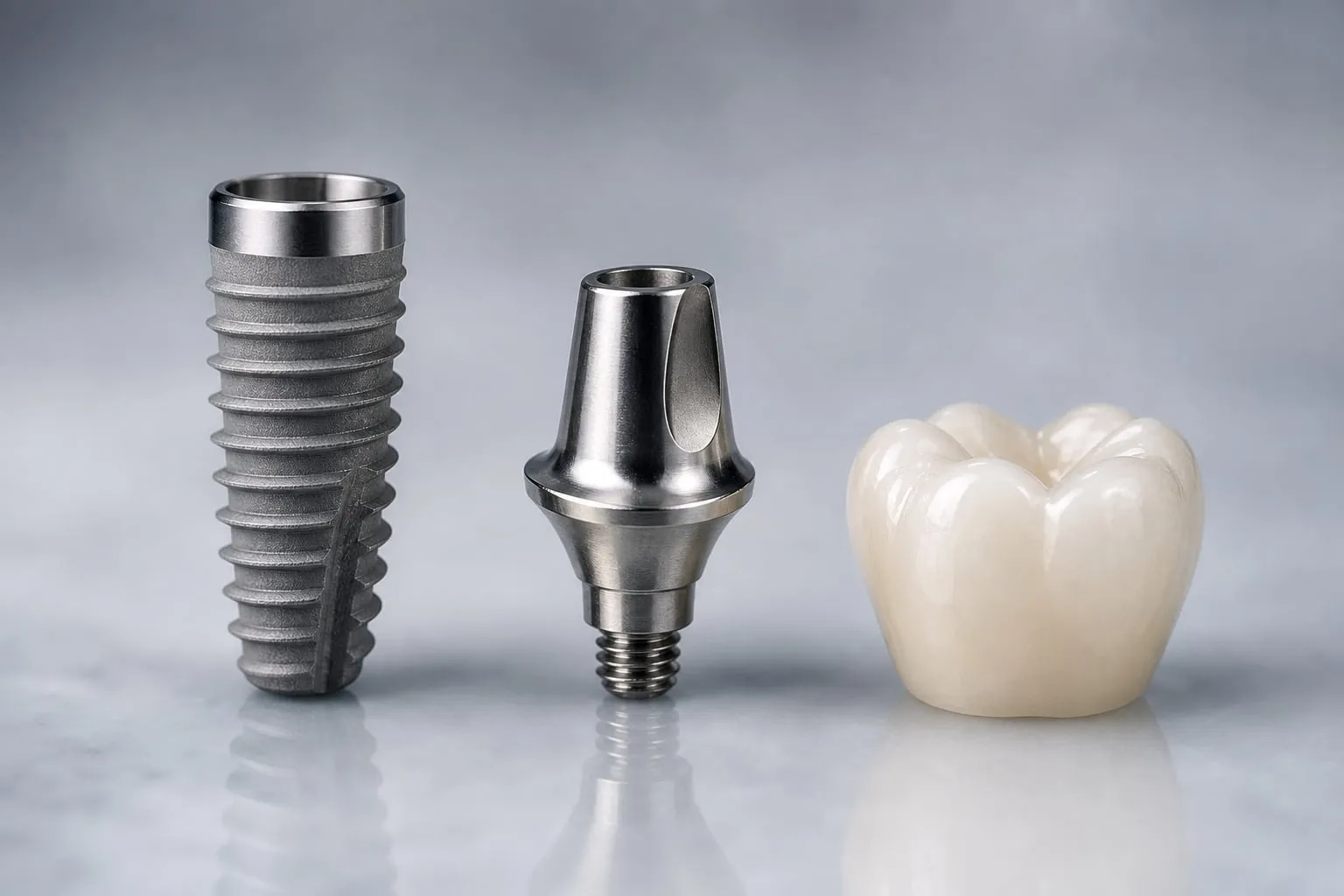
A dental implant tooth has three main parts: the implant, a small post in the jawbone that acts as the root; the abutment, a connector that rises through the gum; and the crown, the visible tooth on top. While the gum heals, a temporary healing cap often sits on the implant to shape the tissue. Each part does a different job, and each goes in at a different stage of treatment.
Knowing which part is which makes treatment much easier to follow. It also explains why an implant tooth can often be repaired one piece at a time. Here’s a plain-English tour.
What are the parts of a dental implant?
From the bone up, an implant tooth is built like this:
- The implant: the post anchored in the jawbone
- The healing cap: a temporary cap used while the gum heals
- The abutment: the connector between the implant and the tooth
- The crown: the tooth you see and chew with
A small screw usually holds the abutment, and sometimes the crown, to the implant, so you may also hear a dentist mention the “abutment screw.”
| Part | What it is | When it’s placed |
|---|---|---|
| Implant | A threaded post, usually titanium, that acts as the tooth root | At the surgical placement appointment |
| Healing cap | A smooth, temporary cap that shapes the gum | At placement, or at a short follow-up visit, depending on the approach |
| Abutment | A connector that links the implant to the crown | After the implant has bonded with the bone |
| Crown | The custom, tooth-shaped top | Last, once it has been made from an impression of your mouth |
The exact sequence varies by case, and your dentist will explain the plan for yours.
What does the implant itself do?
The implant does the job of a tooth root. It’s a small, threaded post placed into the jawbone. Over a healing period, living bone grows onto its surface and bonds with it, a process called osseointegration. That bond is what lets the implant withstand everyday chewing.
Most implants are made of titanium, which has a long track record and which bone readily bonds to. Ceramic zirconia implants are an alternative some patients prefer; our article on titanium vs. zirconia dental implants compares the two.
Implants come in different lengths and widths. The size and position are chosen from 3D imaging of your jaw, so the implant sits where the bone can support it and where the final tooth needs to be.
What is a healing cap, and why is it used?
A healing cap, also called a healing abutment, is a small, smooth, temporary cap screwed onto the implant. It sits through the gum while you heal.
It has two jobs. It keeps the gum from closing over the top of the implant, and it encourages the gum to heal in a shape that leaves room for the abutment and crown. Once the implant is ready, it’s simply unscrewed and removed.
In some cases, the implant is instead covered by the gum while it heals and uncovered later in a short step, at which point a healing cap goes on. Either way, the healing cap isn’t a tooth. What you wear to fill the gap during healing is a separate question, planned ahead of time.
What does the abutment do?
The abutment is the connector. It fastens into the top of the implant, rises through the gum, and gives the crown something secure to attach to.
Abutments are commonly made of titanium or zirconia. Some are prefabricated; others are custom-shaped so the crown emerges from the gum at a natural angle and contour. Custom abutments are often favored where appearance matters most, such as front teeth.
The crown can attach to the abutment in two main ways. It can be cemented on, much like a crown on a natural tooth, or held with a screw so a dentist can remove it later. In some designs, the abutment and crown are made as a single piece that screws directly into the implant.
What is the crown, and how is it made?
The crown is the part everyone sees. It’s custom-made to match the shape, size, and shade of your neighboring teeth and to fit your bite.
To make it, your dentist takes an impression of the implant site, either with a putty-like material or with a digital scan. A dental lab uses that record to make the crown, which is then fitted and adjusted until your bite feels right.
Crowns are made from several materials, including zirconia, glass-ceramics, and porcelain fused to metal. Each balances strength and appearance differently, as our guide to implant crown materials explains.
In what order do the parts go in?
The parts arrive in stages, and most of the calendar time is healing rather than appointments:
- Planning. An exam and 3D imaging show your bone and where the implant should go.
- Placement. The implant is placed under local anesthesia, with sedation options where appropriate. A healing cap or cover goes on top.
- Healing. The implant bonds with the bone, typically over several weeks to a few months, and longer if grafting was needed.
- Abutment and impression. Once the implant has integrated, the abutment is attached and an impression or scan is taken.
- Crown. The finished crown is attached and the bite is checked.
At our office, the final tooth is attached after the implant has integrated with the bone, not on the day of surgery. For a stage-by-stage walkthrough, see what to expect during the dental implant process.
How are the parts different for bridges and full-arch teeth?
The same building blocks scale up.
- An implant-supported bridge uses two or more implants to hold a row of connected teeth. Each implant typically has its own abutment, and the teeth in between, called pontics, sit on the gum with no implant beneath them.
- A full-arch restoration, such as All-On-4, replaces a whole upper or lower arch on a small number of implants. The back implants are often tilted, so angled connectors are typically used to line everything up. The replacement teeth are made as one piece, usually with a gum-colored base, and secured to the implants so that only a dentist can remove them.
- An implant-supported overdenture is removable. It snaps onto attachments on the implants, or onto a bar connecting them, and the wearer takes it out to clean.
In every case, the principle is the same: implants in the bone, connectors through the gum, and teeth on top.
Which parts can be repaired or replaced on their own?
This is one of the practical advantages of a multi-part design. Because the pieces are separate, a problem with one doesn’t automatically mean replacing everything.
- The crown can wear or chip over the years and can usually be replaced without touching the implant. A screw-retained crown is easier to remove and replace.
- The abutment screw can occasionally loosen. A crown that wiggles is often a loose screw rather than a failing implant, and the screw can usually be tightened or replaced.
- The abutment can be replaced if it’s damaged or if a new crown design calls for it.
- A full-arch prosthesis can be removed by a dentist for cleaning, repair, or adjustment.
- The implant is the part that matters most. If it loses its bone support, often because of inflammation around it, that needs prompt evaluation. In some cases the implant can be removed and the site treated so a replacement can be considered later.
If anything feels loose, sore, or different, contact your dentist rather than waiting to see.
The bottom line
A dental implant tooth is a set of parts: the implant acts as the root, the abutment connects it through the gum, and the crown is the tooth you see, with a healing cap shaping the gum in between. They go in at different stages, which is why treatment unfolds over months rather than in a single visit. That modular design also means individual parts can often be repaired or replaced without starting over. To see how the parts would come together for your own tooth, request a free consultation or call (949) 773-4170.
This article is general education, not a diagnosis or a substitute for professional dental advice. Individual results vary, and only a personalized evaluation can determine which treatment may be appropriate for you.