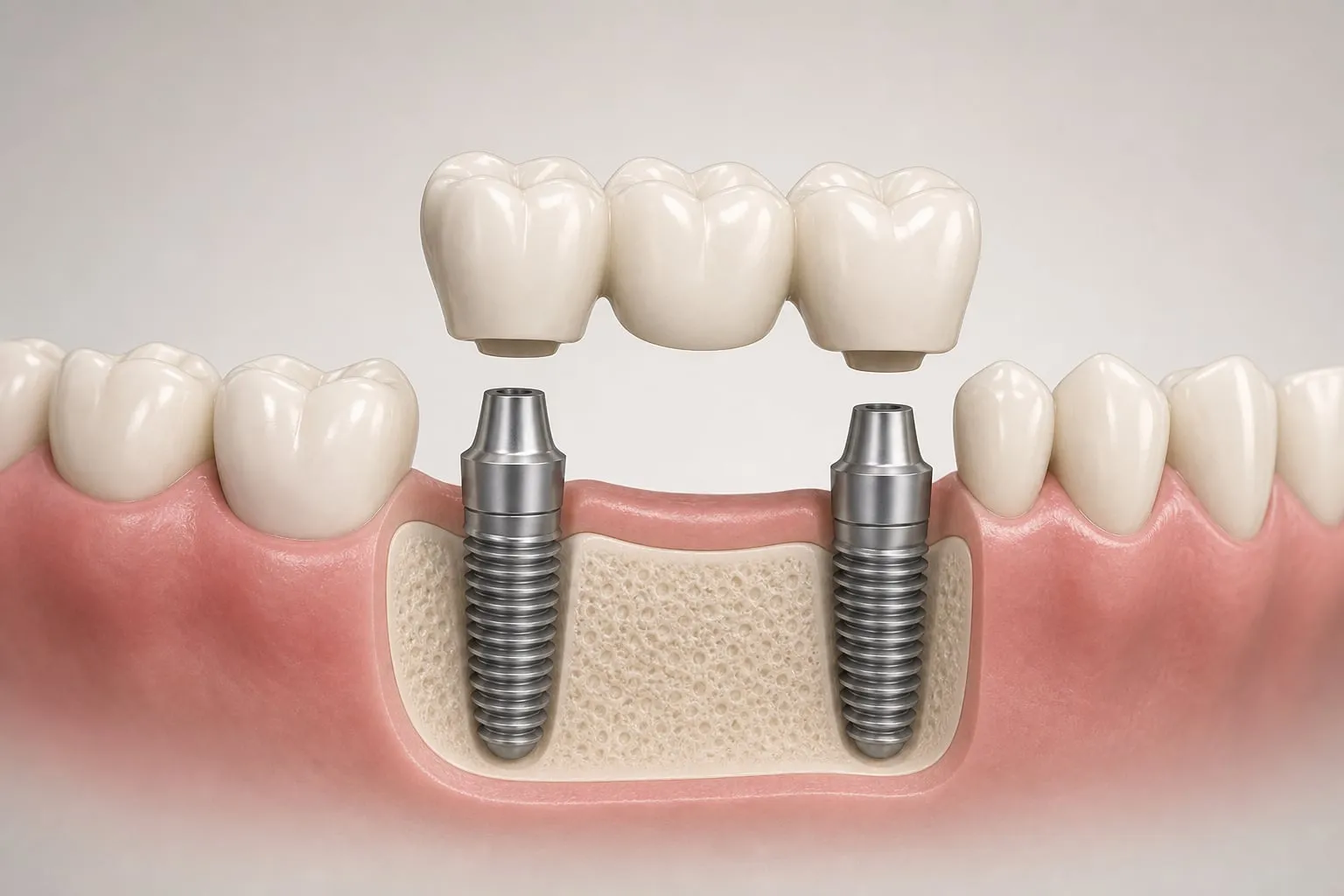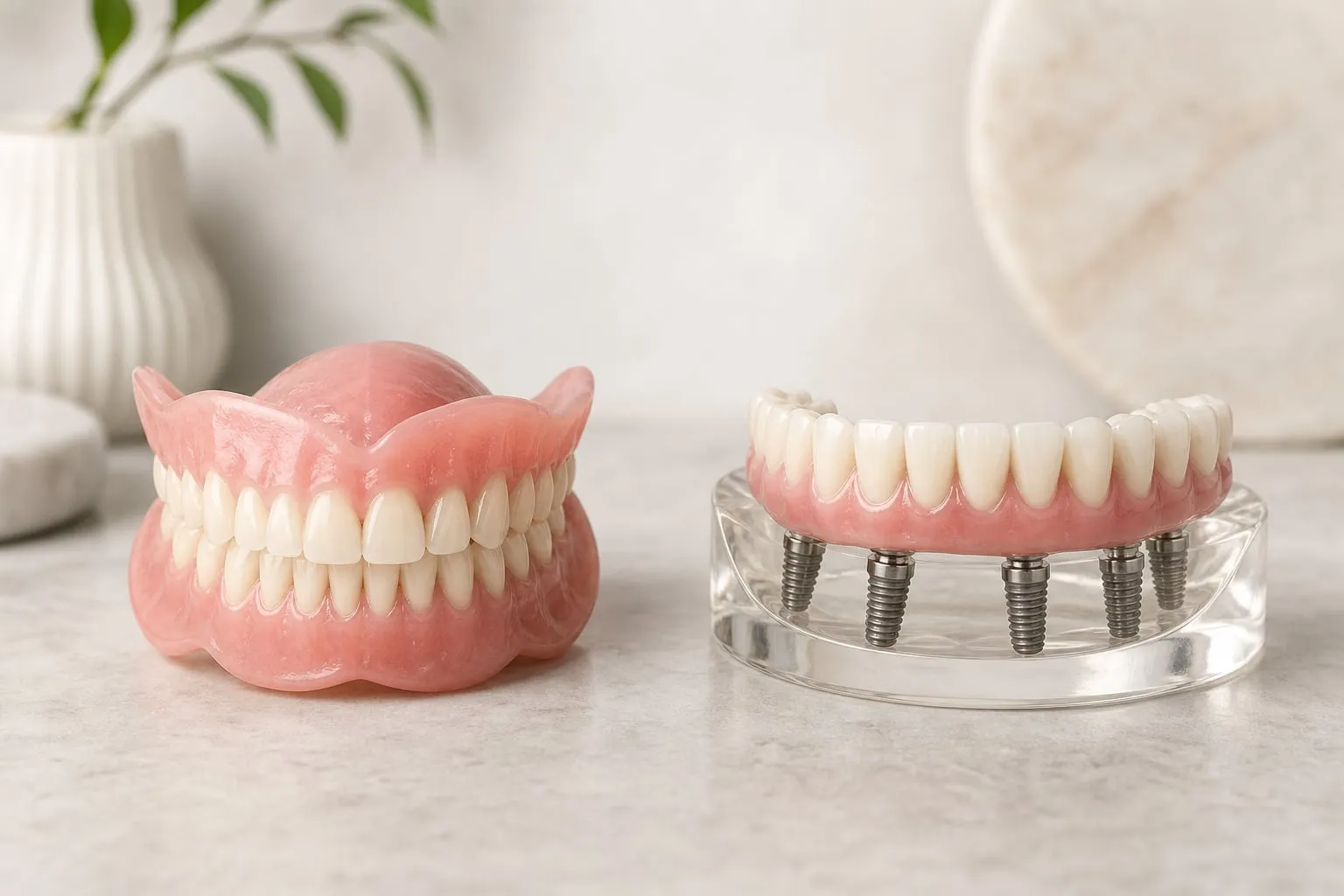

Usually the orthodontic treatment comes first. A dental implant is fused to the jawbone and can’t be moved by braces or aligners, so when teeth need to be straightened or a gap needs to be opened or narrowed, that movement is generally finished before the implant is placed. The implant then goes into a space that’s already the right size, with the bite already where it should be.
That’s the general rule. The details depend on why you need each treatment, how far your teeth have shifted, and, for younger patients, whether the jaw has finished growing. Here’s how the two fit together.
Why can’t braces or aligners move a dental implant?
A natural tooth isn’t fused to the bone. It sits in its socket held by the periodontal ligament, a thin layer of fibers between the root and the jawbone. When braces or clear aligners put steady, gentle pressure on a tooth, that ligament allows the bone to break down slightly on one side and rebuild on the other. Over months, the tooth moves.
An implant has no ligament. Through osseointegration, the bone bonds directly to the implant surface, which is exactly what makes it strong enough to chew on. It also means orthodontic pressure won’t budge it.
So an implant placed before orthodontic treatment becomes a fixed point that every other tooth has to be planned around. If the surrounding teeth are moved afterward, the implant crown can end up out of line with them, too close to a neighbor, too high or low for the new bite, or with a gum line that no longer matches. Correcting that might mean a new crown or, in some cases, a much bigger fix.
When might orthodontics be needed before an implant?
Not everyone with a missing tooth needs orthodontic treatment first. Many gaps are fine as they are, and some plans can work around minor shifts. But orthodontics is often suggested first when:
- Neighboring teeth have drifted into the gap. After a tooth is lost, the teeth beside it can tip or slide into the space, sometimes narrowing it until there’s no longer room for a normal-sized tooth. Our article on what happens if you don’t replace a missing tooth explains why.
- Roots are tipped toward the gap. Even when the crowns leave enough room, tilted roots can block the path where an implant would need to go. An implant needs space between the roots, not just between the visible teeth.
- Spacing is uneven. Several small gaps may need to be gathered into one space of the right width, so the replacement tooth looks like it belongs. This matters most at the front of the mouth; see what makes a front tooth implant different.
- The bite leaves too little room. If the tooth opposite the gap has over-erupted, meaning it has grown further out of its socket with nothing to bite against, there may not be enough vertical space for a crown. Sometimes orthodontics helps; sometimes reshaping that tooth is enough.
If your tooth has been missing for a long time, is it too late for a dental implant? covers how shifted teeth and bone changes affect the plan.
What’s the usual order in different situations?
| Situation | Usual order | Why |
|---|---|---|
| Teeth have drifted into the gap | Orthodontics first, then the implant | Reopens the space to a natural tooth width |
| Roots are tipped toward the gap | Orthodontics first, then the implant | Clears a path for the implant between the roots |
| Gap is the right size and the bite is stable | Implant without orthodontics | Nothing needs to move |
| You already have an implant and want straighter teeth | Orthodontics planned around the implant | The implant stays fixed while other teeth move |
| A young patient whose jaw is still growing | Space usually held until growth is assessed | An implant doesn’t move with the surrounding teeth as the jaw develops |
These are general patterns, not rules. Your dentist and orthodontic provider decide the order for your mouth after examining it.
How is a space kept open for a future implant?
Teeth tend to drift back toward where they started once orthodontic treatment ends. So when braces or aligners have created the right space for an implant, that space needs to be held until the implant goes in.
That’s usually done with a retainer, sometimes with a replacement tooth attached so the gap isn’t visible in the meantime. With clear aligners, a tooth-colored filler can sometimes be added to the aligner over the gap during treatment.
Before the implant is placed, imaging is used to confirm two things: that the neighboring roots are positioned to leave a clear path, and that there’s enough bone in the space. If the bone has thinned, a graft may be recommended first.
For children, teenagers, and young adults who are missing a tooth, implant timing also depends on whether jaw growth is complete, because an implant doesn’t move as the jaw and surrounding teeth continue to develop. That decision is made individually by the dentist and orthodontic provider, together with the patient’s physician when health or growth questions come up, rather than by age alone. Our guide to dental implants for teens and young adults covers that timing question in more depth.
Can implants ever help with orthodontic treatment?
Orthodontic providers sometimes use temporary anchorage devices, which are very small screws placed in the bone for a limited time to give braces a fixed point to push or pull against. They’re removed when they’re no longer needed, and they’re different from a dental implant that replaces a tooth.
Whether anything like that is part of your treatment is up to your orthodontic provider. For most people weighing an implant and orthodontics, the practical point is simpler: plan both together before either one starts.
How do the dentist and orthodontic provider coordinate?
A coordinated plan usually follows a sequence like this:
- Exam and imaging. A full exam and 3D CBCT imaging show the bone, the roots, and how much space exists.
- Agreeing on the end point. The final tooth width, position, bite, and gum line are set before anything moves.
- Orthodontic treatment. Braces or aligners move the natural teeth into position.
- Holding the space. A retainer keeps the result stable.
- Implant placement and healing. The implant integrates with the bone over several weeks to a few months. We don’t offer same-day teeth, so the final crown is made after integration is confirmed.
- The final crown. It’s shaped and shade-matched to fit the space and bite that orthodontics created.
At our practice, Dr. Khashayar Etemadi’s listed areas of focus include Invisalign, a brand of clear aligners, along with dental implants and cosmetic dentistry. You can read more on his profile. If you’re considering both treatments, raise it at your consultation so the plan accounts for both from the beginning. For a broader view of tooth replacement choices, see missing teeth: your options.
The bottom line
Teeth can be moved; implants can’t. When alignment, spacing, or the bite needs correcting, orthodontic treatment usually comes first, the space is held, and the implant is placed into a gap that’s already the right size. The exact sequence depends on your teeth, roots, bone, and, for younger patients, growth, and it’s decided by your dental team after an exam. To talk through the order for your situation, see what happens at your first visit or call (949) 773-4170.
This article is general education, not a diagnosis or a substitute for professional dental advice. Treatment order and timing are individual, and only a personalized evaluation can determine what may be right for you.