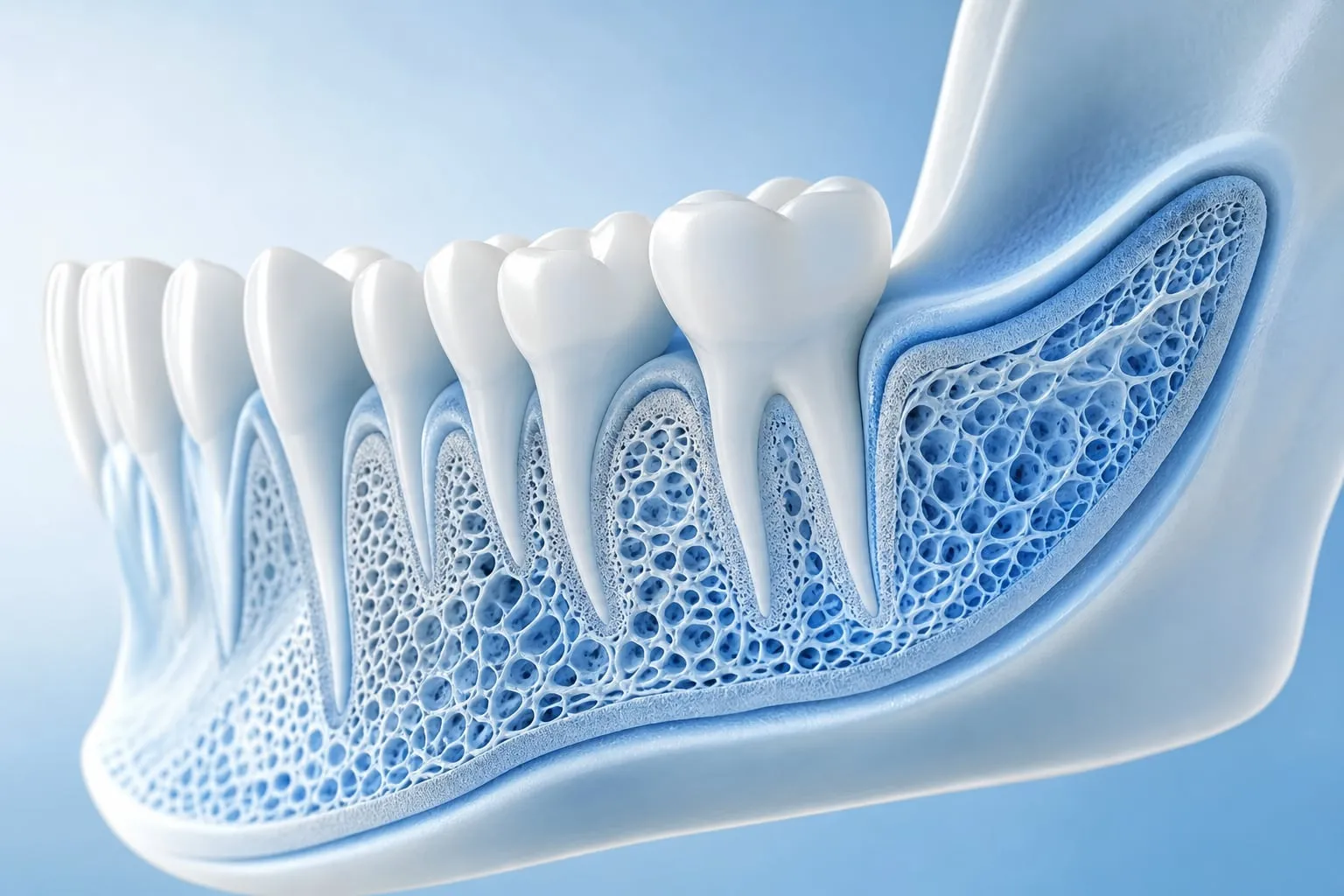

Dental implants are usually placed only after jaw growth is complete, because an implant fuses to the bone and doesn’t move with a growing jaw the way natural teeth do. When growth finishes varies from person to person, so there’s no single “right age”; readiness is assessed individually, often together with an orthodontist. Until then, the goal is to keep the space and the bone ready with a temporary solution.
Most people picture implant patients as older adults, but plenty of teens and young adults need a tooth replaced too. For them, when matters as much as whether.
Why do implants wait until jaw growth is complete?
A natural tooth is held in its socket by a thin cushion of fibers called the periodontal ligament. That attachment lets teeth keep shifting and slowly erupting as the jaws grow and the face matures.
An implant works differently. It bonds directly to the bone, a process called osseointegration, and that’s what makes it so stable. It also means an implant stays exactly where it was placed. It doesn’t erupt or drift.
If an implant goes in while the jaw is still growing, the teeth around it can keep moving while the implant stays put. Over time, it can end up:
- Sitting higher or shorter than its neighbors, so the crown looks out of line
- With a gum line that no longer matches, which is especially visible on a front tooth
- Out of step with the bite as the jaws continue to develop
Those problems are difficult to correct afterward, and waiting avoids them. For front teeth in particular, where small differences show, our article on front tooth dental implants explains what makes the result look natural.
How does a dentist assess readiness?
There’s no birthday that flips a switch. Growth timing varies widely between individuals, so dentists generally look at several things together:
- Whether growth has leveled off, such as height no longer changing
- Records compared over time, such as photos, models, or images taken some time apart, to see whether anything is still shifting
- The orthodontist’s assessment, if one is involved
- The bone at the site, measured with 3D imaging as treatment gets closer
- Gum health and home care, since an implant needs consistent cleaning
- Readiness to follow aftercare, which matters at any age
The decision is individual. Two people of the same age can be at very different points, and the dentist should explain what they’re seeing and why.
Why do young people need dental implants?
The most common reasons include:
- Congenitally missing teeth. Some adult teeth simply never form, a condition called hypodontia. The upper lateral incisors, the narrower teeth beside the two front teeth, are among those most often affected, along with some premolars.
- A baby tooth with no adult tooth behind it. Sometimes the baby tooth is kept for as long as it stays healthy, which can help preserve the space and the bone. Our guide to adult baby teeth and missing permanent teeth covers the options.
- Sports injuries and accidents. A tooth that’s knocked out or broken beyond repair is a common reason, especially at the front. If you play contact sports, a mouthguard is worth discussing; see dental implants and an active lifestyle.
- Teeth that can’t be saved because of a fracture, deep decay, or a failed root canal.
How do you keep the space and bone ready in the meantime?
Waiting doesn’t mean doing nothing. Two things need protecting: the space, so there’s room for a crown later, and the bone, so there’s something for the implant to anchor in.
Keeping the space. When a tooth is missing, neighboring teeth tend to drift into the gap. An orthodontist can use braces or aligners to hold or open the space to the right width, and to position the neighboring roots so there’s room for an implant between them. A retainer then helps keep everything in place until treatment.
Keeping the bone. Bone tends to shrink where a tooth is missing. A healthy baby tooth left in place can help, and if an adult tooth is lost to an injury, ask whether anything can be done to protect the site for the future.
Filling the gap. Temporary options a dentist may discuss include:
| Option | What it is | Things to know |
|---|---|---|
| Retainer with a tooth | A clear or wire retainer with a replacement tooth attached | Often used during or after orthodontic treatment; removable |
| Removable partial | A small plate carrying one or more replacement teeth, sometimes called a “flipper” | Simple and adjustable; taken out for cleaning |
| Bonded bridge | A replacement tooth attached to the backs of the neighboring teeth | Fixed in place, often with little or no reshaping; not suitable for every bite |
Which is appropriate depends on the site, the bite, and where orthodontic treatment stands. For more on these stopgaps, see what a flipper tooth is and the alternatives, and for how aligners or braces fit around an implant, see which comes first: braces, Invisalign or implants.
In some cases, an orthodontist may suggest closing the space instead of saving it for an implant, for example by moving neighboring teeth into the gap left by a missing lateral incisor. Whether that works depends on the bite and the face, so it’s worth asking about both paths.
How do the orthodontist and implant dentist work together?
When a young person is missing a tooth, the plan often runs in roughly this order:
- Diagnosis and a long-term plan, including whether to open or close the space
- Orthodontic treatment to position the teeth and roots
- A retainer and temporary tooth to hold the result
- Monitoring until growth appears to be complete
- Imaging and an implant evaluation to confirm the bone and space are ready
- Implant placement, followed by healing and integration
- The final crown, once the implant has integrated with the bone
Sharing records between offices, and actually wearing the retainer, makes the later steps simpler.
What about young adults?
For many young adults, growth has already finished, but not for everyone, which is why the assessment stays individual. Beyond growth, young adults are evaluated the same way as anyone else: bone, gum health, general health, and habits such as smoking or vaping. Our page on implant candidacy covers those factors, and the single tooth implant page explains how one tooth is replaced from root to crown.
At our office, single implants start at $1,995, covering consultation, implant surgery, and crown. Pricing may vary based on individual needs, and extractions or bone grafting are quoted separately.
At the other end of life, there’s no upper age limit at all; see am I too old for dental implants?
The bottom line
For teens and young adults, the right time for an implant is usually after jaw growth is complete, and that point is judged individually rather than by age. Until then, an orthodontist can hold the space and a temporary tooth can fill the gap. Parents with questions about timing can start with their child’s dentist and orthodontist. If you’re a young adult considering an implant, request a free consultation or call (949) 773-4170.
This article is general education, not a diagnosis or a substitute for professional dental advice. Growth and development vary from person to person, and only a personalized evaluation, together with input from an orthodontist or physician where appropriate, can determine when treatment may be right.