Dental implants take months because your jawbone has to grow onto and bond with the implant before it can safely carry a tooth. That process, called osseointegration, commonly takes several weeks to a few months, and it can’t be hurried. If a tooth has to come out or bone has to be rebuilt first, those steps add healing time of their own.
The appointments themselves are fairly quick. Most of the calendar time is healing at home. Here’s what’s going on during those months, and what you can do to keep things on track.
What is osseointegration?
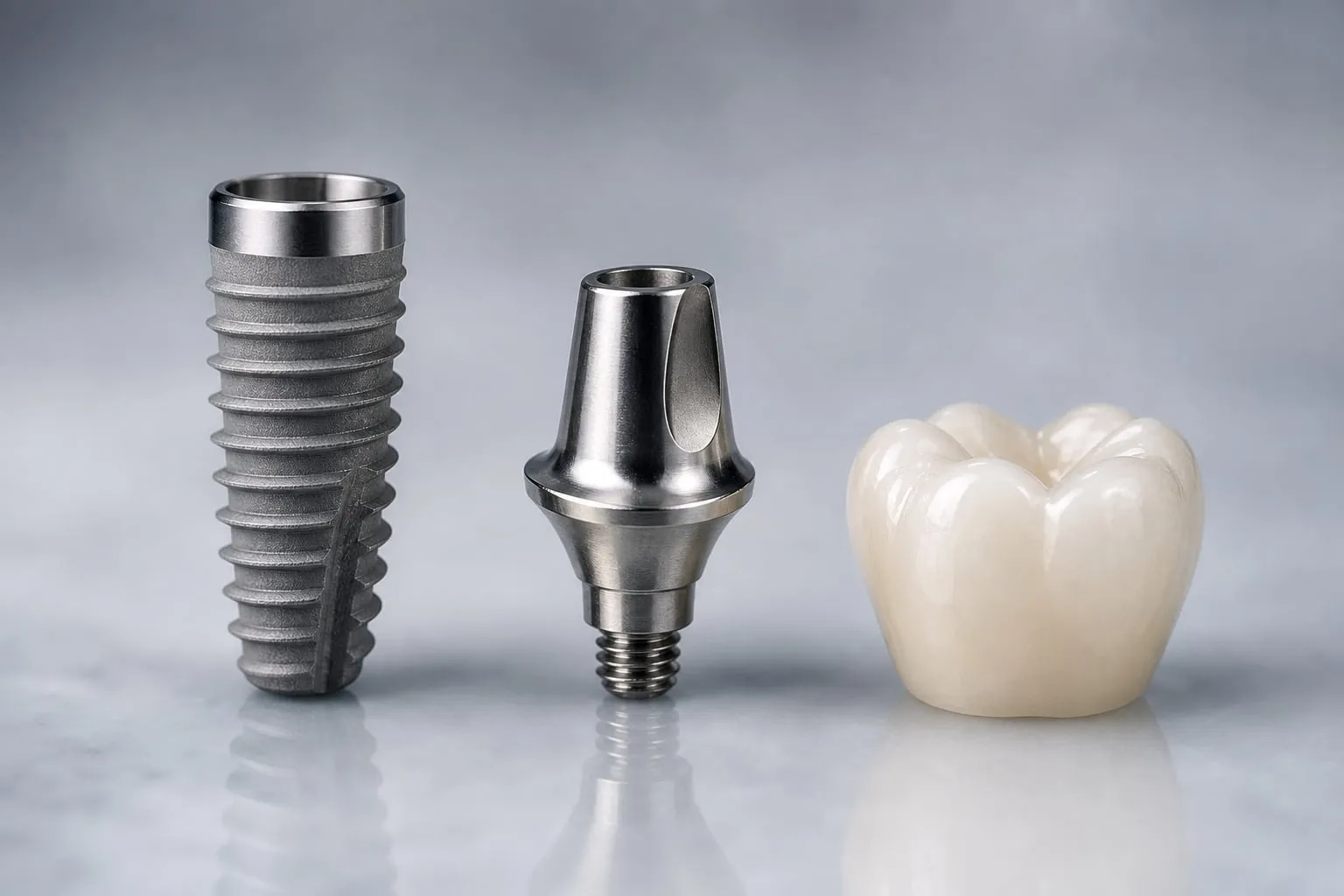
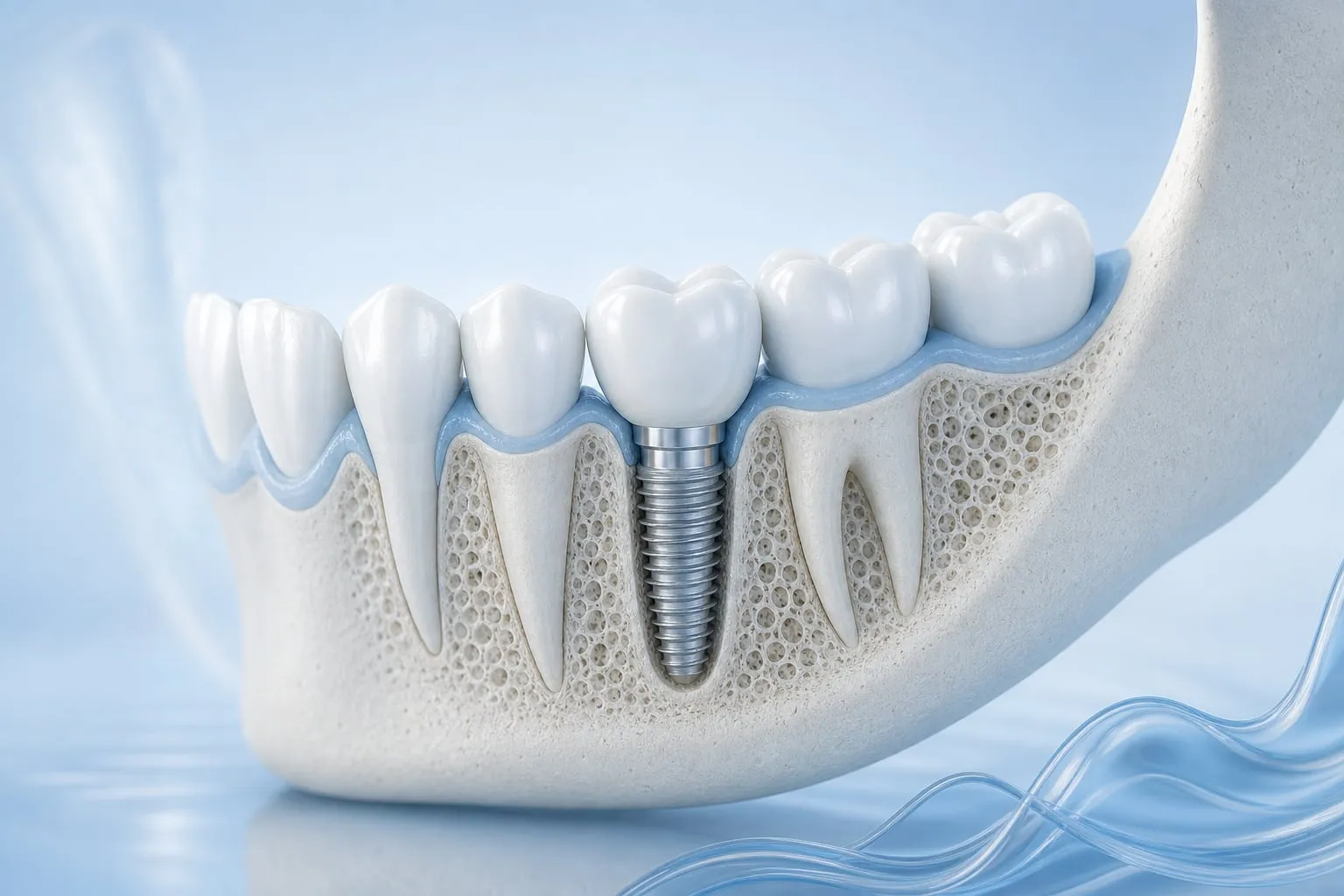
Osseointegration is the bone bonding to the implant. After the implant is placed, living bone gradually grows onto its surface and anchors it firmly in the jaw. Once that has happened, the implant can handle everyday chewing forces much like a natural tooth root.
That bond is the whole point of an implant. A post that is simply wedged into bone is not the same as one the bone has grown onto.
Why can’t the bone heal any faster?
Bone is living tissue, and it renews itself constantly. Some cells remove small amounts of old bone while others lay down new bone in its place. This ongoing cycle is called bone remodeling, and it’s how your skeleton repairs itself after any injury, including surgery.
Here’s roughly what happens around a new implant:
- At first, the implant is held by its fit. The threads grip the bone snugly, which gives the implant its initial stability.
- The bone next to it remodels. Bone right against the implant is gradually replaced by new bone that grows onto the implant’s surface.
- The new bone takes over. Over time, that biological bond replaces the purely mechanical grip.
During this changeover, a healing implant is protected from heavy chewing forces. Repeated pressure and small movements while new bone is forming can disrupt healing. That’s the core reason the final tooth waits.
How long it takes varies from person to person. Bone density plays a part: the upper jaw tends to be softer than the lower jaw, for example. General health, habits, and the size of the treatment area matter too.
What happens to the gums while the bone heals?
The gum heals at the same time. Often a healing cap, a small temporary cap on top of the implant, keeps the gum from closing over it and helps shape the tissue so the crown can fit later. A well-healed collar of gum around the implant helps frame the final tooth, which matters most at the front of the mouth.
Which steps add time, and which are quick?
Not everyone needs every step below. A single implant in healthy bone, where the tooth is already gone, skips the three “if needed” rows. Adding an extraction, a graft, or a sinus lift can extend the timeline by months.
| Stage | What happens | Why it takes the time it does |
|---|---|---|
| Consultation and 3D imaging | Exam, scan, and a written plan | Quick: the 3D scan itself usually takes well under a minute |
| Extraction (if needed) | The damaged tooth is removed, sometimes with graft material placed in the socket | The gum typically closes within a couple of weeks; the bone underneath takes longer, and timing varies by site |
| Bone graft (if needed) | Bone is rebuilt where volume has been lost | The graft has to mature into solid bone, often several months |
| Sinus lift (if needed) | Room is made for an implant in the upper back jaw | Areas near the sinus commonly need longer to heal |
| Implant placement | The post is placed in the jawbone | One appointment; most people feel noticeably better within a few days |
| Integration | Bone grows onto and bonds with the implant | Several weeks to a few months |
| Final crown | A scan or impression, then fitting and adjusting the crown | Brief appointments compared with the healing stages |
General overview for education only. Your own timeline is mapped out after your exam and imaging, and it varies by individual.
If a graft or sinus lift is part of your plan, our page on bone grafting and sinus lifts explains what those procedures involve. For a stage-by-stage walkthrough of the whole journey, see what to expect during the dental implant process.
Why don’t we offer same-day implant teeth?
You may have seen ads for “teeth in a day.” That approach, called immediate loading, attaches a tooth or set of teeth to implants shortly after they’re placed. Practices differ in whether they use it.
We don’t offer same-day teeth or immediate loading. Our planning is built around confirmed integration: we place the implant, let the bone bond to it, confirm that healing, and then fit your final restoration. Detailed planning and 3D imaging tell us where an implant should go, but they don’t shorten biology.
That means more than one visit. Each step, though, rests on healing that has actually been verified rather than assumed.
What will you wear while the implant heals?
Usually you won’t be left with a visible gap. What you wear while you heal is planned in advance and discussed with you, and the right choice depends on which tooth is being replaced and how visible it is.
Common options include a flipper (a lightweight, removable temporary tooth on an acrylic base), a clear retainer-style temporary, or, for a back tooth that doesn’t show, sometimes nothing at all. Our article on the flipper tooth and other temporaries compares them. Whatever the temporary, its job is to keep pressure off the healing implant.
For full-arch treatment, the integration period generally takes several months. See how long All-On-4 healing takes for that timeline.
How can you keep your timeline on track?
You can’t make bone grow faster, but you can avoid slowing it down:
- Follow your aftercare instructions closely, including exactly how to clean the area.
- Keep the site clean. Plaque around a healing implant can inflame the gum.
- Go easy on the area. Stick to softer foods as directed and chew on the other side.
- Avoid smoking. Smoking can interfere with healing. If you smoke, raise it with your dentist and physician before treatment. Our article on smoking and dental implants explains why.
- Keep your follow-up visits. These checks are how your dentist confirms healing before the next step.
- Mention health changes. If a health condition changes or you’re prescribed something new, tell your dentist. Never stop or change a medication on your own; your physician and dentist decide that together.
- Call rather than wait if pain worsens after several days, swelling increases, or a temporary feels loose.
Our recovery and aftercare guide covers what’s normal during healing and what isn’t.
The bottom line
Dental implants take months because bone needs time to grow onto the implant, and extractions, grafts, or sinus lifts add healing time of their own. The appointments are comparatively quick; the waiting is biology doing its work. Good aftercare, follow-up visits, and avoiding smoking help keep your timeline on track. To see what your own timeline might look like, request a free consultation or call (949) 773-4170.
This article is general education, not a diagnosis or a substitute for professional dental or medical advice. Timelines vary by individual, and only a personalized evaluation can determine what may be appropriate for you. Discuss your health and medications with your dentist and physician.