
Yes, a well-planned dental implant usually looks natural. The crown on top is custom-made to match the shape, shade, and translucency of your own teeth, and when the implant is well positioned and supported by healthy bone and gum, the new tooth appears to rise out of the gum the way a natural tooth does. Front teeth are the most demanding, and your gum tissue and bone set real limits, so results vary from person to person.
Here’s what goes into a natural-looking result, what can work against it, and what to ask before your crown is made.
What part of a dental implant can people see?
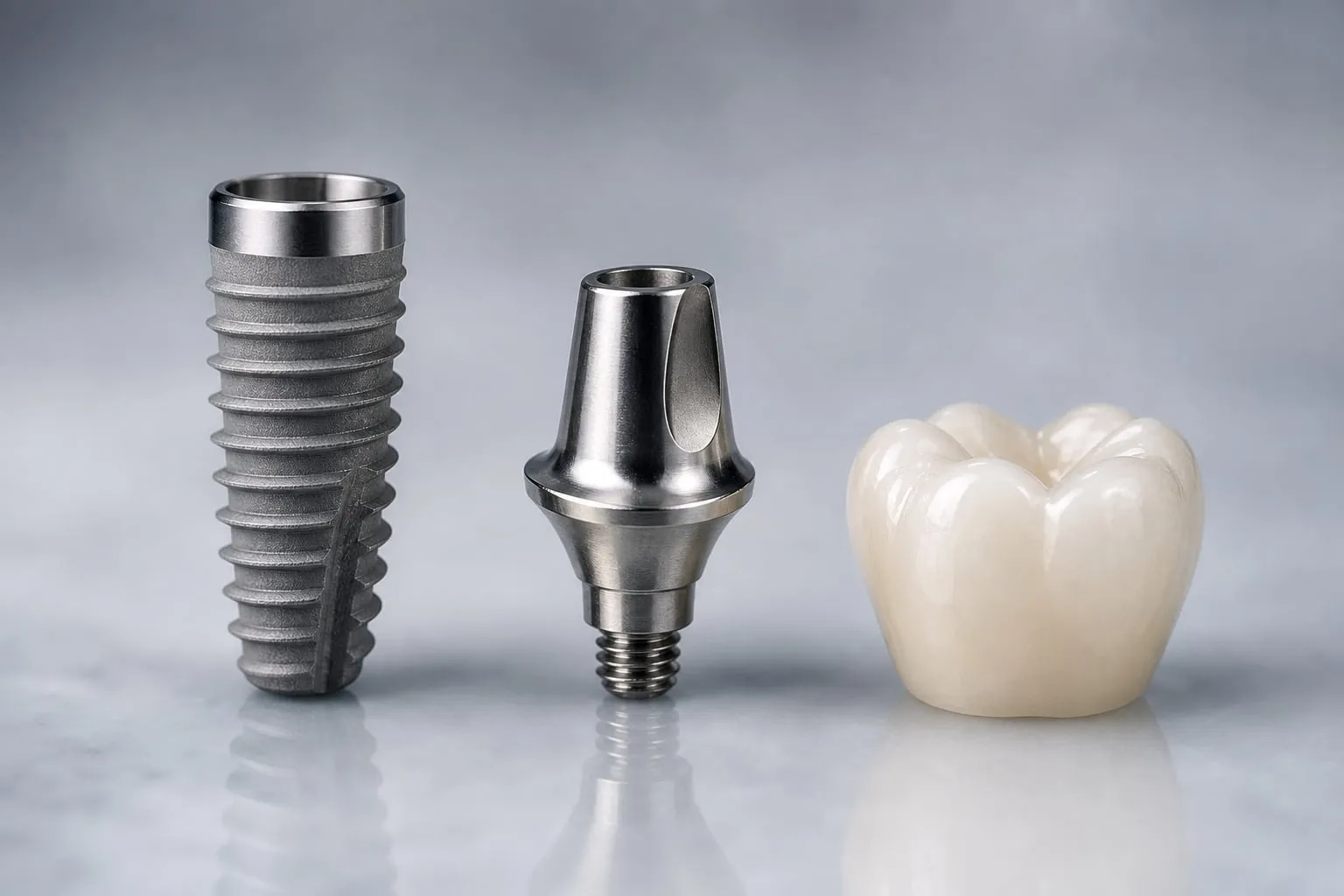
Only the top. The implant itself is a small post that sits in the jawbone, completely out of sight. The abutment, the connector between the implant and the crown, usually sits at or just under the gumline. What people see when you smile is the crown and the gum around it.
So “does it look natural?” really means two things: does the crown blend in with your other teeth, and does the gum frame it the way it frames its neighbors?
What makes a dental implant look natural?
Several things have to come together. Here are the main ones.
- The crown material. Implant crowns are commonly made of zirconia, glass-ceramics such as lithium disilicate, or porcelain layered over a stronger core. Glass-ceramics and layered porcelain can closely mimic the slight see-through quality of natural enamel, while solid zirconia leans toward strength. Our guide to implant crown materials compares the options.
- Shade and translucency matching. Natural teeth aren’t one flat color. They’re usually a little darker near the gum, lighter toward the middle, and slightly translucent at the biting edge. Shade matching compares your teeth against a shade guide, often in natural light, and photos and notes go to the lab so the crown can copy those details, along with surface texture.
- The shape of the gum around the crown. Dentists call this the emergence profile: the way the crown rises out of the gum, from the gumline up to its widest point. A natural tooth’s root flares gradually into the crown. An implant is round and often narrower, so the abutment and crown have to be shaped to recreate that gradual rise. In some cases a custom abutment, or a temporary crown worn for a while first, helps guide the gum into a natural contour.
- Implant position. The implant needs to sit at the right depth, angle, and spacing for the crown to come out of the gum where a tooth naturally would. That’s planned before surgery from 3D imaging, which shows the bone in three dimensions.
- Enough bone and gum support. Bone holds up the gum, and the gum frames the tooth. After a tooth is lost, the bone underneath gradually shrinks, and the gum can follow. Where there isn’t enough, bone grafting, and sometimes gum grafting, may be recommended to rebuild the contour before or alongside the implant.
One small detail matters a lot: the papilla, the little point of gum that fills the space between two teeth. When it’s full, the gumline looks continuous. When it’s missing, a small dark triangle can show between the implant crown and its neighbor.
Do front teeth and back teeth look natural in the same way?
The goal is the same, but the priorities differ.
| Front teeth | Back teeth | |
|---|---|---|
| How visible | On display whenever you smile or talk | Usually seen only up close |
| Main priority | Appearance, then strength | Strength, then appearance |
| Common crown choices | Glass-ceramics or layered porcelain, for translucency | Zirconia, for strength under chewing forces |
| The gumline | Visible, and needs to mirror the tooth on the other side | Rarely seen |
| Hardest part | Matching one crown to its natural neighbor | Handling heavy bite forces |
General patterns only. Your dentist will recommend materials based on your own bite, space, and gum tissue.
A single front tooth is often considered one of the most demanding implant cases, because the crown has to match your teeth, not just look like a tooth. Our article on front tooth dental implants covers why.
Do full-arch implant teeth look natural?
They can, but they work a little differently. When most or all of the teeth in a jaw have been lost, some bone and gum have usually been lost too. Full-arch implant teeth often include a gum-colored section, made of pink acrylic or shaded ceramic, that replaces that missing volume and supports the lips and cheeks.
Two things help full-arch teeth look natural:
- Where the pink section meets your own gum. Planning typically aims to keep that transition line hidden behind your upper lip when you smile.
- The teeth themselves. Their size, shape, and shade are chosen to suit your face. A little natural variation often looks more lifelike than a row of identical, very bright teeth.
The material matters here too; see zirconia vs. acrylic full-arch teeth.
What can make an implant look less natural?
Some of the common reasons an implant stands out:
- Gum recession. If the gum pulls back, the crown can look longer than its neighbors, or a gray edge of metal can show. Recession can also be a sign of inflammation, so it’s worth having checked; see gum recession around a dental implant.
- Thin gums letting a gray tint show. With thin gum tissue, a titanium abutment or implant can sometimes cast a grayish shadow through the gum. A tooth-colored abutment, such as zirconia, can help in visible areas, and in some cases a zirconia implant is considered.
- A missing papilla, leaving a dark triangle between teeth.
- A shade mismatch, which can appear later if you whiten your natural teeth, or as natural teeth slowly darken with age, coffee, or tea.
- Crown shape. A crown that’s too bulky or too flat at the gumline can look and feel different from its neighbors.
- Implant position. An implant set too shallow or angled too far toward the lip can make a natural gumline harder to achieve.
Some of these can be improved later, for example by replacing the crown or abutment, since the parts are separate. Lost gum and bone are harder to restore, which is why planning before the implant goes in matters so much.
Should you whiten your teeth before the crown is matched?
If you want whiter teeth, it’s commonly done first. Implant crowns don’t change color with whitening, so a crown matched to your current shade will stay that shade even if the teeth around it get lighter. Many dentists also prefer to let whitened teeth settle before matching the crown. Our article on whitening before a dental implant crown explains the timing.
What should you ask before your crown is made?
- Which crown material do you recommend for this tooth, and why?
- How will the shade be matched, and can I see the crown before it’s final?
- Is my gum tissue thin, and would a tooth-colored abutment help?
- Do I have enough bone and gum to support a natural gumline, or will grafting be needed?
- What can be adjusted if something doesn’t look right?
At our Mission Viejo office, implant plans are built from 3D CBCT imaging, and a single tooth implant is completed with a custom crown that is shade-matched once the implant has integrated with the bone. You can see before-and-after photos of actual patients in our smile gallery. Individual results vary.
The bottom line
A well-planned dental implant usually looks natural, because the crown is custom-made to match your teeth and the gum frames it like a natural tooth. The result depends on the crown material, shade matching, the emergence profile, the implant’s position, and healthy bone and gum, with front teeth the most demanding. Whitening first, if you want it, and an honest assessment of your gum and bone before treatment both help. To find out what’s realistic for your smile, request a free consultation or call (949) 773-4170.
This article is general education, not a diagnosis or a substitute for professional dental advice. Individual results vary, and only a personalized evaluation can determine what may be achievable for you.